
Letters to the editor, Aug. 4: ‘I see Mark Carney following in the steps of Brian Mulroney’
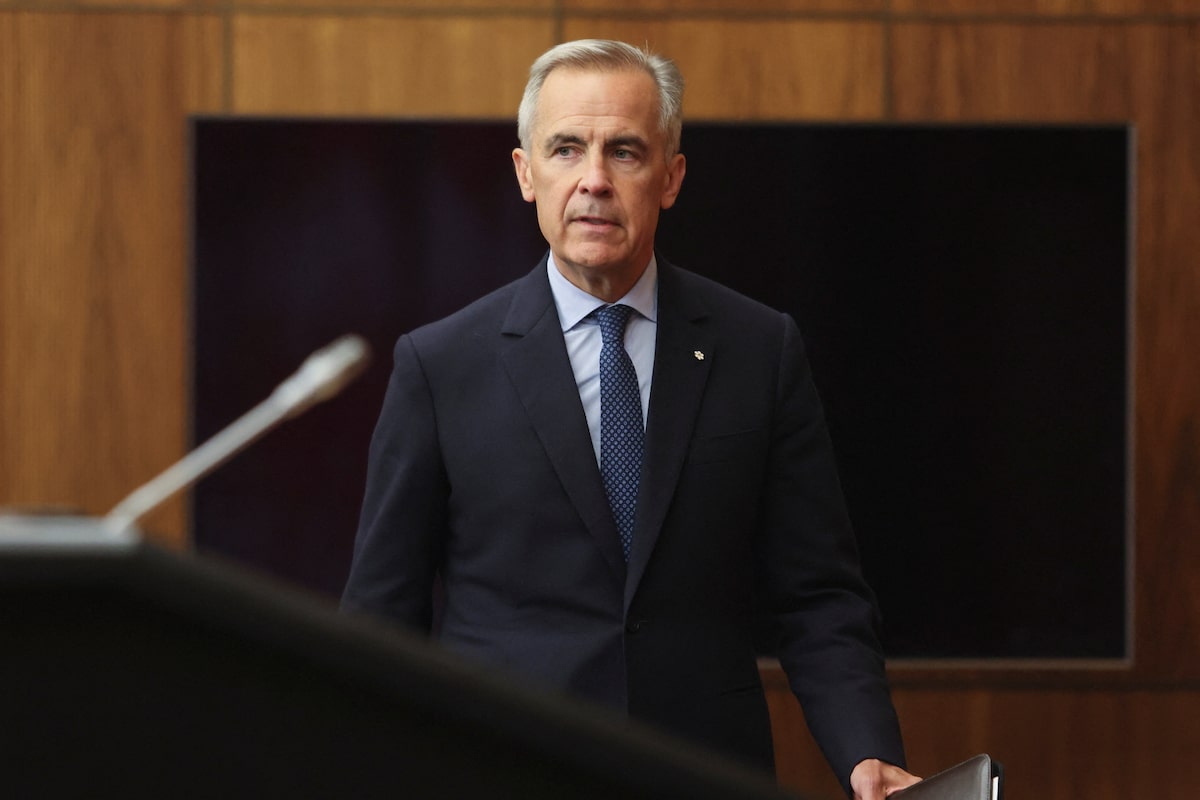
Prime Minister Mark Carney at an Ottawa press conference in July, 2025.Patrick Doyle/Reuters
Past precedent
Re “Carney, the foreign-policy risk-taker” (Aug. 1): I see Mark Carney following in the steps of Brian Mulroney, who sanctioned South Africa to help end apartheid. We know that it helped then, and I believe Mr. Carney’s decision will help Palestinians today.
I have worked in the Palestinian territories assisting in their past elections. I got to know the area and the people.
For the past 20 years, I have been hoping and praying that democratic countries in the Western world would give support to people who have been terribly abused for much too long, by too many powerful nations.
Time for justice to prevail.
G.A. Teske Strathcona County, Alta.
Friends and enemies
Re “Is China a better trading partner than Trump’s America?” (July 31): China has taken the lead globally in electric vehicles, even recently figuring out how to recharge them in about five minutes. Yet Chinese EVs are called “state-subsidized, inexpensive spy machines on wheels.”
Really? Compared to the monopoly Canada has allowed the United States on everything web-related, from Google to Facebook to computers to smartphones, all of which makes a fortune out of mining our personal data?
We already have spy machines in every Canadian pocket, going everywhere we go, but they’re not Chinese, they’re not cheap and they sure don’t help reduce the impact of climate change.
Marsha Copp Toronto
Referencing China and the Tiananmen Square massacre to discourage trade with the Middle Kingdom ignores the behaviour of the United States in my lifetime: Vietnam, Afghanistan, Iraq and other disastrous imperialist adventures resulting in millions of lives lost – and now they threaten us.
As for China’s “spy machines on wheels,” Canadians using U.S. software might wonder how, when they mention a word like “hat” in an e-mail, ads for hats can appear on screen minutes later.
Open thine eyes: Our neighbour has been spying on us for years.
Don McLellan Vancouver
Clean it up
Re “The International Court of Justice’s statement on fossil fuels puts Carney in a tough spot” (July 28): This makes it sound like the International Court of Justice decision is the worst thing that could happen to Mark Carney and his nation-building agenda. I think this decision just helped him shorten the list of projects that meet criteria.
There are lots of projects that can be great for Canada, such as electric interties between provinces and wind and solar power projects. These projects would not only be nation-building, they would also supply the clean energy we need for a more livable world. And now that clean energy is cheaper than fossil fuels, we would also save money. A win on many levels.
Let’s move forward in a direction that aligns with international law, supports climate action and saves money.
Cathy Page Calgary
Re “Hard place” (Letters, July 30): A letter-writer argues that the Canadian public needs to be better educated on the role of oil in our economy. Getting off it quickly would certainly have significant economic costs, but the overall cost to the economy can be a good deal less than losses to the industry itself.
For example, oil resources such as capital and labour would move to other industries and be productive there. Even getting off oil rapidly would not “rip our economy to shreds.” More likely it would have a negative impact of 1 to 2 per cent of GDP in the short run, and less in the longer run. (In 2022, oil and gas accounted for 3.2 per cent of Canada’s GDP).
I also see no reason to get off oil rapidly. Economists who bear the environmental implications in mind generally propose a gradual shrinkage.
Albert Berry Toronto
Do the math
Re “How Norway cracked the electric-vehicle code” (Aug. 1): I calculate that electric vehicles are already more economical than others in Canada.
Even though an EV’s purchase price may be higher than an equivalent fossil fuel vehicle, for most drivers that difference may be reduced to zero in a few years. An EV’s fuel and maintenance costs are a small fraction of those of other cars.
While EV owners are erasing the initial cost difference, they’re also driving a non-polluting car with the time-saving convenience of charging at home.
Paul Rapoport Member, Electric Vehicle Society; Hamilton
100
Re “For some of Canada’s most prestigious university programs, mid-90s grades are not enough” (July 30): Absent a standardized test to measure academic merit, such as the U.S. SATs, there is no means by which to effectively compare the marks of students at one high school with those of another, let alone one teacher with another at the same school.
The practice of grading on a bell curve – caving to the pressure of individual parents, the pleas of students and the inherent discretion of teachers – further makes the comparison of marks a mug’s game. Meanwhile, standardized tests are used for many postgraduate programs (LSATs, MCATs) to level the playing field, in recognition of the inability to compare undergraduate marks in different areas from different universities.
Standardized testing should be a requirement if Ontario is to use Bill 33 to determine merit.
Richard Austin Toronto
I graduated in 1969 from Jarvis Collegiate in Toronto, considered then to be one of the city’s top schools.
My graduating class of 120-plus students had only 10 Ontario scholars – a student with a graduating average of 80 (yes, 80) or more – and only one averaged over 90. The financial reward for Ontario Scholars was terminated years later, after grade inflation rendered the distinction meaningless.
Most students have a shock when they first encounter university grading, where a mark of 70 is average, 90 is a real distinction, rarely given, and students can actually fail – many of them, in fact.
At the University of Ottawa, the highest possible grade is 10, or an A+ covering the 90-to-100 range. In my 42-year career, I only once saw a student graduate with a 10 average in my department. In other words, all others, including many really outstanding ones, had averages below 90.
William Hallett Emeritus professor, department of mechanical engineering, University of Ottawa
Recently, the Toronto District School Board touted its several graduates with 100 averages. How do you get 100 on, say, a course in English literature?
I venture to say William Shakespeare and W. B. Yeats would expect to fall short of that, and be appalled some teacher saw fit to award a perfect score to a teenage student.
Perhaps the spirits of James Joyce, William S. Burroughs and Henry Miller can be summoned to inject some awareness of the impossibility of perfection.
Barry Stagg Toronto
Letters to the Editor should be exclusive to The Globe and Mail. Include your name, address and daytime phone number. Keep letters to 150 words or fewer. Letters may be edited for length and clarity. To submit a letter by e-mail, click here: [email protected]

