
Hong Kong fire: How bamboo scaffolding fuelled the deadly high
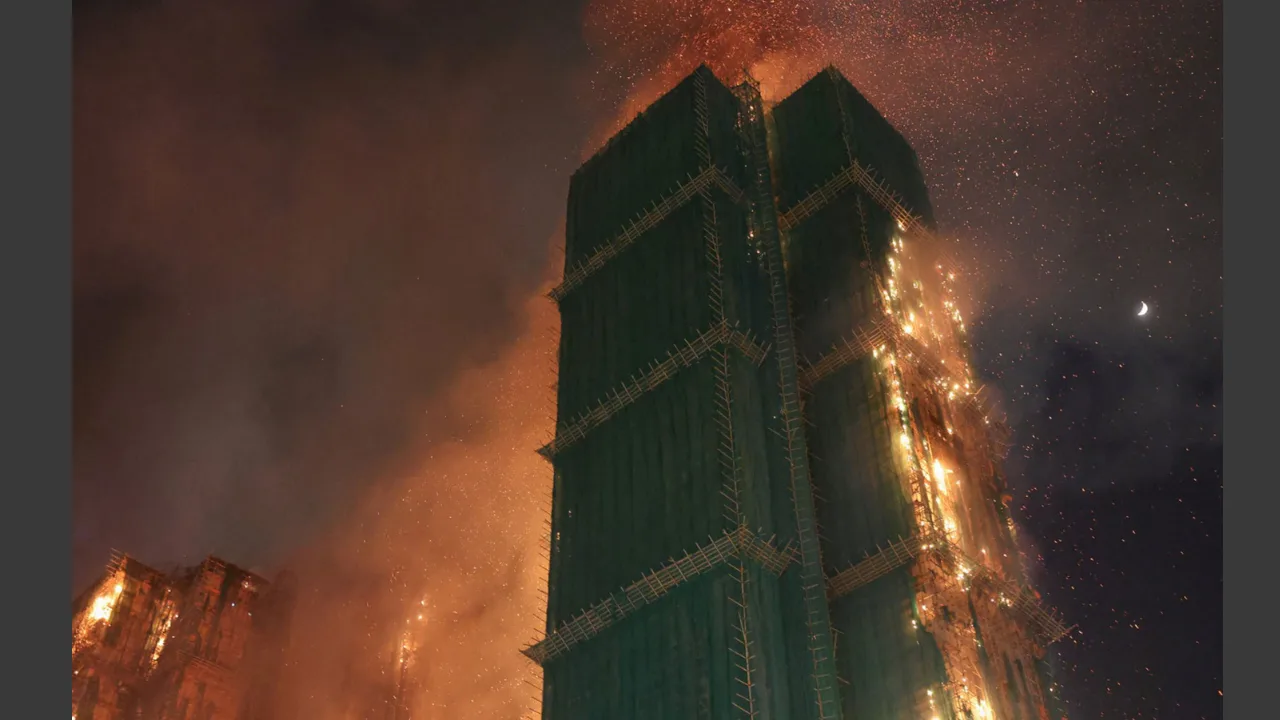
Bamboo scaffolding, a millennia-old tradition used in the construction work of buildings in Hong Kong, is now under scrutiny following a massive fire that led to the deaths of 55 people, left several injured, and saw over 250 people reported missing amid deadly fires across seven high-rise buildings.
Advertisement
The fire, which ignited on Wednesday afternoon, spread rapidly across seven buildings. By midnight (IST), the blaze had been doused in three buildings, and as of Thursday morning, flames in four other buildings have also been brought “under control,” though not fully extinguished. It took 16 hours for firefighters and authorities to contain the deadly, massive fire.
Advertisement
<!– –>
The mega fire required the deployment of more than 800 firefighters and paramedics, with 140 fire engines deployed to deal with the blaze. Three people have been arrested on charges of manslaughter.
As per media reports, officials also suspect that other construction materials at the site, such as protective nets, canvas sheets, and plastic coverings, did not meet required safety standards.
However, several media platforms cited the use of bamboo scaffolding as the main reason for the inferno. So, let us take a closer look at the role of the centuries-old tradition of wrapping Hong Kong buildings in bamboo scaffolding during construction or repair work, and how it may have contributed to the rapid spread of the fire. Hong Kong’s leader, John Lee, briefed the press on Wednesday night, stating that a task force had been set up to probe the exact cause of the blaze.
Bamboo scaffolding: A long-standing tradition
Not just a construction technique in Hong Kong, the centuries-old tradition of using bamboo in building construction is rooted in mainland China. It continues to prevail in Hong Kong today. It is still used in the construction of high-rise buildings. According to long-held beliefs in China and Hong Kong, bamboo symbolises grace, resilience, and moral fortitude. It has long been central to architecture and is even known to have been used as scaffolding and tools during the construction of the Great Wall.
In Hong Kong, construction remains deeply intertwined with ritual and belief. Apprentice scaffolders observe feng shui practices, avoid words believed to carry bad omens, worship deities, wear protective talismans, and perform the “bai san” ceremony to seek good fortune before erecting scaffolding at new sites, as reported by the South China Morning Post.
Bamboo is much lighter compared to steel. It is six times faster to erect and 12 times faster to dismantle. Being a fraction of the cost of metal, bamboo scaffolding does not require complicated machinery or complex tools to put up, just skilled workers using nylon ties. When properly erected, bamboo scaffolding can be sturdier than steel and far more flexible, and its structure is easy to modify if necessary.
Bamboo scaffolding can be used for entire structures or parts of them. In Hong Kong, it is common to see “bamboo balconies” sticking out from the sides of buildings where renovations are underway on individual units. Bamboo poles can also be cut to fit unusual spaces, making them ideal for Hong Kong, where construction spaces can be tight amid the densely packed maze of buildings, as per the South China Morning Post.
How bamboo scaffolding fuelled the fire
The complex was wrapped in bamboo scaffolding, a traditional but highly flammable construction method widely used across Hong Kong.
Deputy Director of the Hong Kong Fire Department, Chan Derek Armstrong, stated that the fire was reported at 2:51 pm (local time), and by the time firefighters arrived, the bamboo scaffolding surrounding the complex was already engulfed, prompting a blaze inside the building and outward to adjacent towers, as reported by CNN.
Why this tradition is now under scrutiny
Amid rising cases of fire, bamboo scaffolding is being cornered in favour of metal alternatives under new government guidelines due to safety concerns, CNN reported. However, the Hong Kong Labour Department recorded 24 deaths linked to bamboo scaffolding between 2018 and August 2025. The Wednesday blaze is feared to be Hong Kong’s deadliest fire in nearly 30 years, according to CNN. There were 22 deaths involving bamboo scaffolders between 2019 and 2024, according to official figures, as per media reports.
What is Hong Kong doing to stop the use of bamboo in construction work?
Though the use of bamboo is not banned in Hong Kong, recent legislation is marking a shift from bamboo scaffolding to more metal scaffolding in public works contracts. After the massive fire and 44 deaths, Lee assured that the government will take special action against ongoing projects, inspecting whether scaffolding mesh materials meet fire-retardant standards and other safety requirements.
As per media reports, in March, the government said 50 per cent of new public works contracts would be required to use metal scaffolding going forward.
Protective nets, screens, tarpaulin, or plastic sheeting installed on the face of scaffolding “should have appropriate fire-retardant properties in compliance with a recognised standard,” says the Hong Kong Labour Department’s Code of Practice for Bamboo Scaffolding Safety.
Jason Poon, a whistle-blower known for exposing substandard construction practices in Hong Kong, said in a Facebook post on Wednesday that fire hazards linked to scaffolding were prevalent across many housing complexes.
Advertisement
