
PBBM Bucana Bridge Visit Was Inspection, Not Political
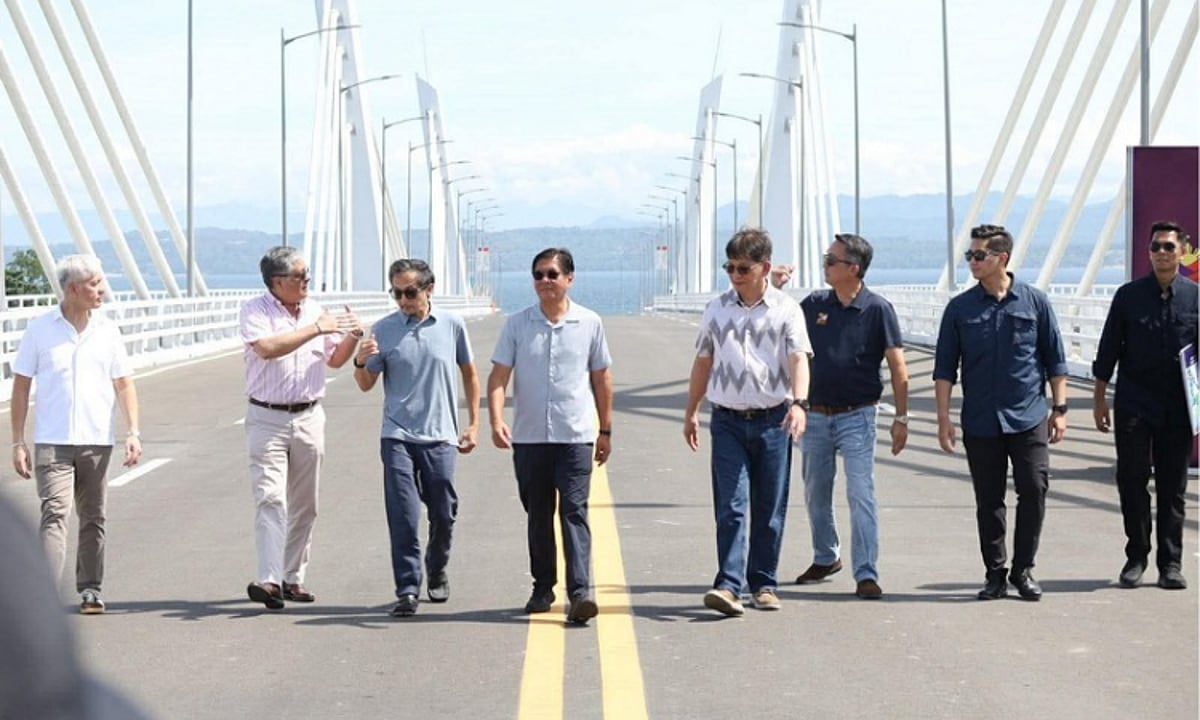
MINDANAO Development Authority (MinDA) Secretary Leo Tereso Magno clarified on Thursday, December 5, 2025, that President Ferdinand Marcos Jr.’s visit here in Davao City on December 4, 2025, was part of his official duties in overseeing national infrastructure projects, such as the P3.126-billion China-grant Bucana Bridge, and it should not be interpreted as a political activity.
Speaking at the year-end Business Forum organized by NCCC Victoria Plaza at Probinsya Restaurant in Bajada, Davao City on December 5, Magno emphasized that the President’s remarks during the site inspection focused on acknowledging Chinese contractors and highlighting the engineering achievements of the project, an infrastructure expected to stimulate economic development not only in the city but across Mindanao.
“The event yesterday was never a political event, which should not be addressed as something political, and that is my official stand on that matter,” Magno told Davao media.
He stressed that site inspections are routine presidential duties, noting that the December 4 activity was purely an inspection, countering circulating reports and social media interpretations suggesting that President Marcos claimed the project as part of his “legacy,” which triggered reactions from netizens and some Dabawenyos.
“And if you listen to what the President said, he praised those responsible for the project. He praised the Chinese contractors, the technology that was used. It was never political. It was an inspection — a job that the President does,” Magno added, noting that Marcos highlighted the state-of-the-art technology China brought in, which can further spur growth in Mindanao.
Bucana Bridge: A milestone in Davao infrastructure
The 480-meter Bucana Bridge is expected to accommodate around 35,000 vehicles daily, significantly easing chronic traffic congestion in downtown Davao City. The bridge is scheduled to open to motorists on December 15, according to President Marcos’ announcement.
The bridge forms a vital component of the Davao City Coastal Bypass Road Project (DCCBRP), a multi-phase infrastructure initiative designed to improve mobility, reduce travel time, and enhance economic activity by linking eastern and western parts of Davao City.
Marcos stated during the site inspection that the project is part of his administration’s Build Better More (BBM) program, the successor to the Build, Build, Build (BBB) program launched during former President Rodrigo Roa Duterte’s tenure.
“This is one of the four major projects — our legacy projects — that we will be finishing in Davao and its environs. Marami na tayong nabuksan na section dito. And this will be now another major part of this bypass road,” Marcos said, praising the Department of Public Works and Highways (DPWH) and contractor China Road and Bridge Corporation for the timely completion of the bridge.
From planning to implementation: Bridging two administrations
The Bucana Bridge, often referred to as the China Aid Localized Project for the Davao River Bridge, traces its origins to the BBB program, conceptualized during the Duterte administration. Although construction is being implemented under Marcos’ BBM program, official records confirm the bridge was part of long-term flagship infrastructure plans initiated under BBB.
The bridge is part of the ₱3.126 billion infrastructure grant by China, which was agreed upon by both countries, following a state visit of former President Rodrigo Duterte to China in 2017.
The commitment was formalized through an Exchange of Letters between the Governments of the Philippines and China, dated November 20, 2018. The document can still be viewed on the government’s website. This document officially confirmed China’s intent to help the Philippines implement the Davao River Bridge Project (Bucana). The project is funded as a Grant under the Agreement on Economic and Technical Cooperation between the two governments.
An agreement signed on December 9, 2020, between the Chinese Embassy and the DPWH formalized a grant of approximately $60 million USD (equivalent to RMB 434.91 million). The total contract cost for the civil works is around ₱3.126 billion, funded by the China Aid Grant and complemented by Philippine funding.
However, the construction was not materialized sooner as the country faced the onslaught of the pandemic.
This makes it an example of continuity in national infrastructure priorities across administrations.
The 1,340-meter bridge, spanning the Davao River, is being executed by the DPWH Unified Project Management Office – Bridges Management Cluster (UPMO-BMC). It connects Barangays 76-A Bucana and Matina Aplaya, linking the eastern and western coastal zones of Davao City, which are currently separated by the river.
Construction began in November 2023 and has since progressed steadily toward its scheduled December 2025 opening.
Engineering excellence and regional impact
The bridge features a four-lane, six-span extradosed structure measuring 480 meters, complemented by 860 meters of approach roads. Designed to meet international standards, it will reduce travel time between the city’s eastern and western coastal barangays from about 1.5 hours to just 20–25 minutes.
The bridge is projected to serve over 14,000 vehicles daily, with expectations to further increase traffic efficiency as more sections of the Coastal Bypass Road are completed.
Economically, the Bucana Bridge is expected to boost trade and mobility in Davao City and surrounding provinces by facilitating faster transport of goods and commuters.
In addition to easing traffic, the bridge is expected to generate employment opportunities during construction and promote urban expansion along the Davao City Coastal Road network. Its strategic location along the Davao River makes it not only a traffic solution but also a potential tourism and commercial catalyst for the region.
Looking ahead
While the Bucana Bridge nears completion, the project highlights the importance of long-term planning, international collaboration, and continuity of national infrastructure programs. Magno said that the bridge symbolizes a significant milestone in Davao City’s urban development and in Mindanao’s broader economic growth strategy. DEF
