
Thailand launches airstrikes along Cambodia border in latest Donald Trump humiliation
Thailand has launched airstrikes along its disputed border with Cambodia as both sides accused each other of violating a ceasefire signed in October, negotiated by US President Donald Trump
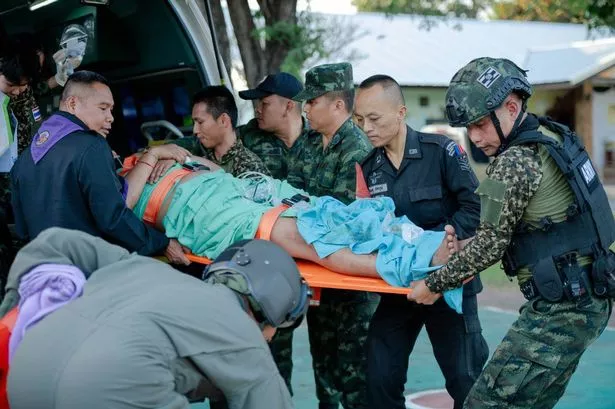
Thailand unleashed air strikes along the contentious border with Cambodia on Monday, all but ripping up US President Donald Trump’s peace deal signed just weeks ago.
Both nations blamed each other for violating a ceasefire that had stopped hostilities earlier this year, after a long-running territorial row flared into five days of warfare in July, claiming the lives of dozens of troops and civilians. US President Donald Trump urged the Southeast Asian neighbours to ink a peace deal in October, but friction remained high.
Thailand’s defence ministry reported that over 35,000 people evacuated border areas for emergency shelters, with more thought to have sought refuge with family members elsewhere, whilst Cambodia’s Information Minister Neth Pheaktra confirmed that inhabitants of multiple border villages have been moved to safety.
READ MORE: ‘Unpredictable’ Donald Trump could walk away from Ukraine peace deal, warns sonREAD MORE: Ukraine must not be left ‘toothless’ by peace deal, minister warns, ahead of crunch talks
Thai Prime Minister Anutin Charnvirakul declared in a broadcast address that armed action would be taken when needed to safeguard the nation and ensure public security.
“Thailand has never wished for violence. I’d like to reiterate that Thailand has never initiated a fight or an invasion, but will never tolerate a violation of its sovereignty,” he said.
The truce came under strain in early November following injuries to Thai soldiers from landmines, prompting Thailand to declare it would halt implementation of the pact indefinitely. Both nations persist in pointing fingers over who’s to blame, despite supposedly working together to clear the explosive devices.
Trump claimed in mid-November that he had stepped in to maintain the ceasefire as tensions bubbled between the two nations.
However, another short burst of combat erupted along the frontier on Sunday, with both sides blaming each other for opening fire first. Thai military officials reported that Cambodian gunfire wounded two Thai soldiers, prompting Thai forces to respond with retaliatory fire in a clash lasting approximately 20 minutes.
Cambodia maintained that Thai forces initiated the hostilities and insisted its own troops held back from responding.
On Monday, Thai army spokesman Maj. Gen. Winthai Suvaree claimed Cambodian forces launched attacks first across multiple border zones. He confirmed one Thai soldier had been killed with four others wounded, whilst civilians were being moved from the danger zones.
Thailand deployed aircraft “to strike military targets in several areas to suppress Cambodian supporting fire attacks,” he stated.
Cambodian Defence Ministry spokesman Maly Socheata countered that Thai military forces launched the initial assault on Cambodian troops on Monday, asserting that Cambodia refrained from hitting back during the early strikes.
“Cambodia urges that Thailand immediately stop all hostile activities that threaten peace and stability in the region,” she declared.
Malaysia’s Prime Minister Anwar Ibrahim appealed for calm in a social media statement, confirming his nation stands ready to back efforts preventing further conflict. “Our region cannot afford to see long-standing disputes slip into cycles of confrontation,” he wrote.
Thailand and Cambodia share a bitter history stretching back centuries, when they existed as rival empires locked in warfare.
Their contemporary territorial disagreements largely trace back to a 1907 map created during Cambodia’s period under French colonial control, which Thailand maintains is flawed.
In 1962, the International Court of Justice granted Cambodia sovereignty over territory encompassing the ancient Preah Vihear temple, dating back 1,000 years – a ruling that continues to irritate many Thais.
The ceasefire fails to outline a route towards settling the fundamental source of the conflict: the enduring disagreements over the precise location of the border.
