
The bloody rise of the Buddhist ‘war monks’
“Nirvana can wait,” declared Galagoda Aththe Gnanasara, a Sri Lankan Buddhist monk whose spiritual journey has been repeatedly waylaid by his penchant for luxury cars, as well as drunk driving and the odd hit-and-run. His words fit a cosy western caricature of Buddhists as an easygoing, happy-clappy, morally flexible people. But the Indian journalist Sonia Faleiro argues in her brisk and furious book that Gnanasara and the like are not pious eccentrics but political operators who orchestrate religious conflict.
Gnanasara, that petrolhead and populist, abandoned life as a forest monk to co-found, in 2012, the Bodu Bala Sena, the Army of Buddhist Power. Over the past decade he has cultivated a cosier-than-comfortable relationship with Sri Lanka’s first family, the Rajapaksas, the country’s on-off autocratic and kleptocratic rulers. This patronage he turned to good account, becoming a kind of ecclesiastical shock jock, railing against halal labels and cattle slaughter by Muslims for religious reasons.
Gnanasara gained greater notoriety in 2014 when a minor scuffle broke out between a monk and some Muslim youths in the coastal town of Aluthgama. The boys had already been forced by the police to kneel before the offended monk who then slapped and humiliated them. But after a harangue by Gnanasara in support of the monk, Buddhist mobs surged through the town, swinging swords and chucking Molotov cocktails, screaming, “Kill the Muslims!” Three died and dozens of houses were reduced to cinders. The police treated the whole thing as a spectator sport.
This was not an aberration but the latest episode in a long history of Buddhist paranoia about uppity minorities. In 1948, as the British briskly folded their tents, a rumour slithered across the island: the Tamil Hindus, accounting for an eighth of the population, were plotting a takeover. It was nonsense, yet perfect fodder for Solomon West Ridgeway Dias Bandaranaike, the Oxford-polished opportunist who won office in 1956 vowing to make Sinhala — the language of the Buddhist majority — the sole official language.
He signed the act on the Buddha’s 2,500th nirvana anniversary — a neat trick, sanctifying discrimination with a commemorative glow. Tamils who failed to learn Sinhala were shown the door. The resulting resentment sparked riots in 1956, 1958, 1977 and 1981 and the inferno of Black July in 1983, when pogroms launched a civil war that devoured up to 100,000 lives and lasted a quarter of a century.
One might have expected monks to serve as brakes on Sinhalese nationalism. Many, instead, became accelerants, enlisting as “war monks” in the Jathika Hela Urumaya, a party that sent nine of its members to parliament in 2004, the first time that monks sat as lawmakers. When the Tamil Tigers were crushed five years later, Buddhists found themselves enemy-less, a condition they regard as unnatural. They soon hit upon fresh quarry: the island’s Muslims.
• In Sri Lanka fearless reporters risk death to tell the truth
By 2018 the stage was set for Act II. When a Sinhalese lorry driver died after a brawl with Muslim men in Digana, in the Central Province, the monks were quick in whipping up righteous fury. “The sword at home is no longer for cutting jackfruit,” one declared. Within hours shops and mosques were flattened. Worshippers fled into snake-ridden jungle and one man lay dead. The monks walked away untouched. These days, as if rotating enemies for variety’s sake, the Buddhists have turned on Christians — 43 attacks in a year, and counting.
The next pen portrait in Faleiro’s gallery of rogues in robes is the pint-sized, smooth-skulled Burmese monk Ashin Wirathu. “We would like to be like the English Defence League,” he told this paper in 2016, earning himself such nicknames as the “Buddhist Bin Laden” and “bald neo-Nazi” from the foreign press.
Buoyed by the military’s indulgence and Facebook’s algorithms, Wirathu rose from Mandalay preacher to national scourge, hawking lurid tales of a Muslim “sex strategy” to seduce, convert and ultimately outbreed Buddhists. His fellow monks obligingly cast Muslims as “guests” who have overstayed their welcome, although it was rather a while ago, in the 15th century, that they arrived in Myanmar.
• Read more book reviews and interviews — and see what’s top of the Sunday Times Bestsellers List
Thanks to the paramilitary 969 Movement he founded in 2012, Wirathu could summon a mob with no more than the flick of a finger on his smartphone. And when a UN official dared to criticise the Islamophobic laws he was urging the Thein Sein government to adopt — curbs on interfaith marriage and conversion — he sneeringly shot back: “Just because you hold a position at the United Nations doesn’t make you an honourable woman. In our country, you are just a whore. If you are so willing, you should offer your arse to the kalar [a racist slur against Muslims].”
For all of Wirathu’s rabble-rousing and hell-raising, Faleiro makes plain that it is not the monks who run Myanmar but the military. She paints the country as a bleak landscape of submission, give or take the odd dissident monk; today, Myanmar is a far cry from the Saffron Revolution of 2007, when monks marched against the junta.
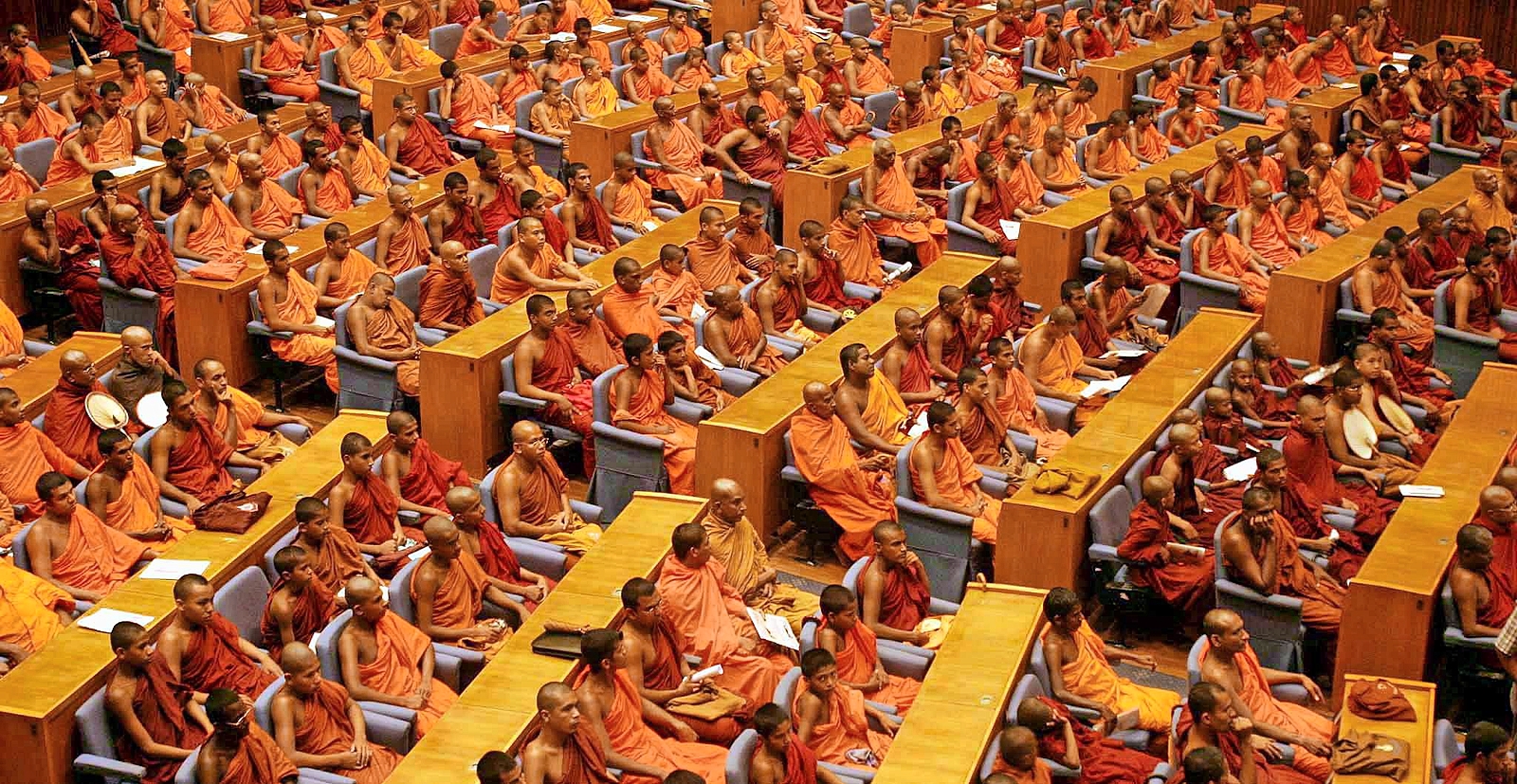
Sri Lankan Buddhist monks at a conference in Colombo, 2005
M A PUSHPA KUMARA/EPA/SHUTTERSTOCK
Floating above this wreckage for a while was the lotus-pure Nobel peace prizewinner in the junta’s dungeon, Aung San Suu Kyi. But then, when power beckoned, she tossed off the halo. Hauled before the Hague, she waved away the massacre of 43,000 Rohingya as “misleading” fake news, chalking up the 1.5 million-strong exodus in Rakhine to a mere lapse in “the rule of law”.
Thailand receives less attention in Faleiro’s pages, and it is easy to see why. The bad behaviour of monks here is of a much lesser order. Among them are cocaine addicts and temple-hopping playboys, occasionally found in monastery beds abusing novices. Yet it is their dangerous liaison with the monarchy that has done the real damage to the reputation of the Sangha Supreme Council, the governing body of Thai Buddhism.
Lèse-majesté laws ensure that anyone with the temerity to mock His Majesty King Maha Vajiralongkorn Bodindradebayavarangkun, who favours crop tops and once made his pet poodle Fufu an air chief marshal, can be locked up for years. Thailand’s democracy has been punctured by 18 coups since 1932, and for all the trappings of democratic life, the military-royalist establishment remains in command.
• Bespectacled, skinny doctor is the biggest fear of Myanmar’s junta
The monarchy’s reach extends deep into the clergy. In 2018 Vajiralongkorn quietly took control of the Sangha Council, giving himself the power to appoint or dismiss senior monks and, by extension, influence more than 41,000 temples and 200,000 monks. The latter maintain the polite fiction that they never touch money, although recent scandals suggest otherwise: this is a clergy where one temple illegally bred tigers for profit — stashing 40 dead cubs in a freezer to avoid detection — and another’s abbot lost $15 million on online gambling.
The Robe and the Sword is an uncomfortable book, and that is its virtue. Faleiro brings moral clarity to terrain that is usually tiptoed around. Reporting on three stiflingly male religious milieux must have been a challenge, although Faleiro is too modest to acknowledge it. Her prose is admirably unshowy, if a touch studenty; Buddhists stand accused of “recasting Muslims as the ultimate ‘other’.”
There are, inevitably, the obligatory swipes at colonialism, as though crimes committed by later generations required British inspiration, but these are fleeting and do little to blunt the force of her reporting. Faleiro delivers a bracing wake-up call, exposing the West’s kitschification of Asian faiths and the East’s enthralment to charismatic, ultraviolent clerics.
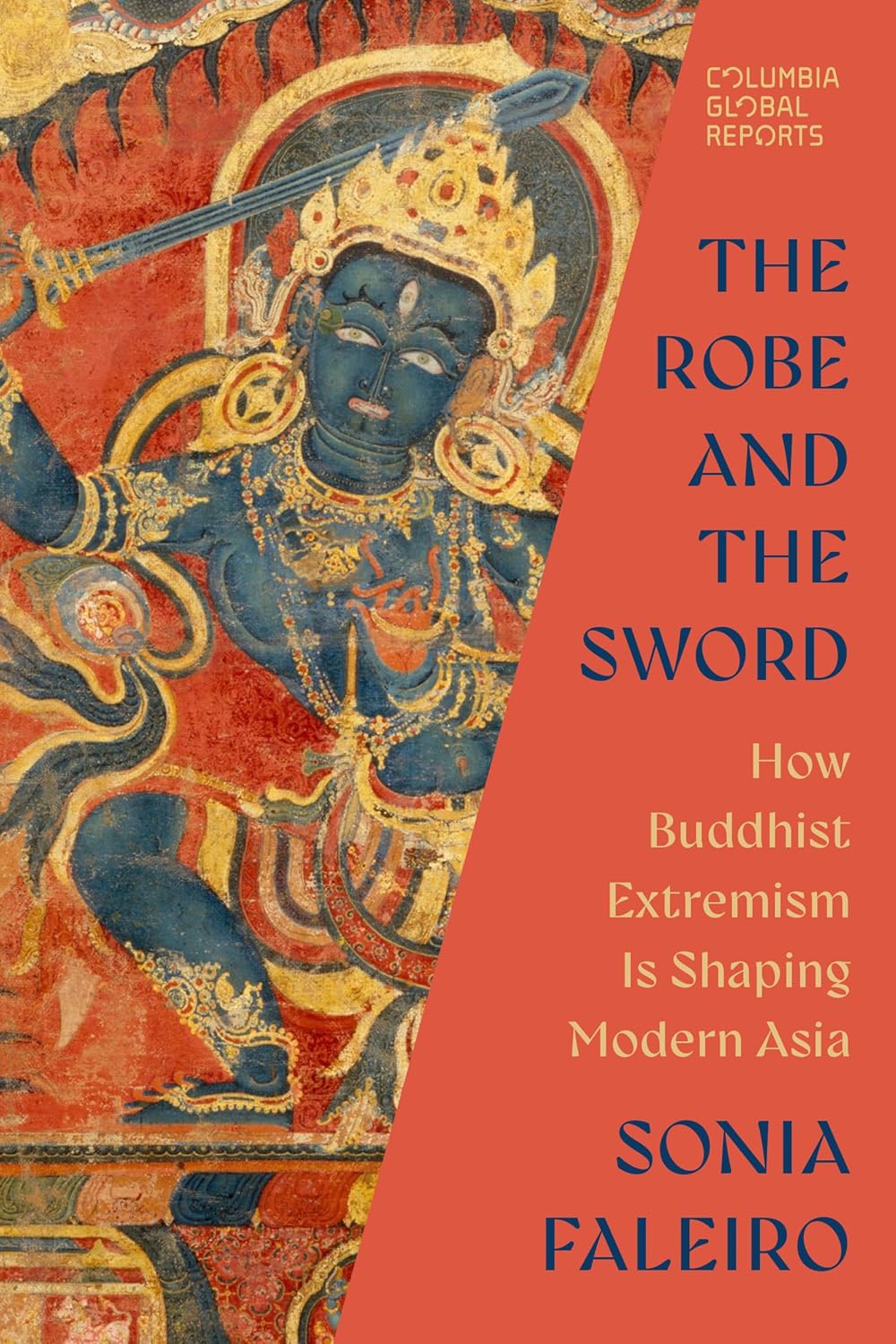
The Robe and the Sword: How Buddhist Extremism Is Shaping Modern Asia by Sonia Faleiro (Columbia Global Reports £12.99 pp160). To order a copy go to timesbookshop.co.uk. Free UK standard P&P on orders over £25. Special discount available for Times+ members
