
Explosions over Caracas as US launch attacks
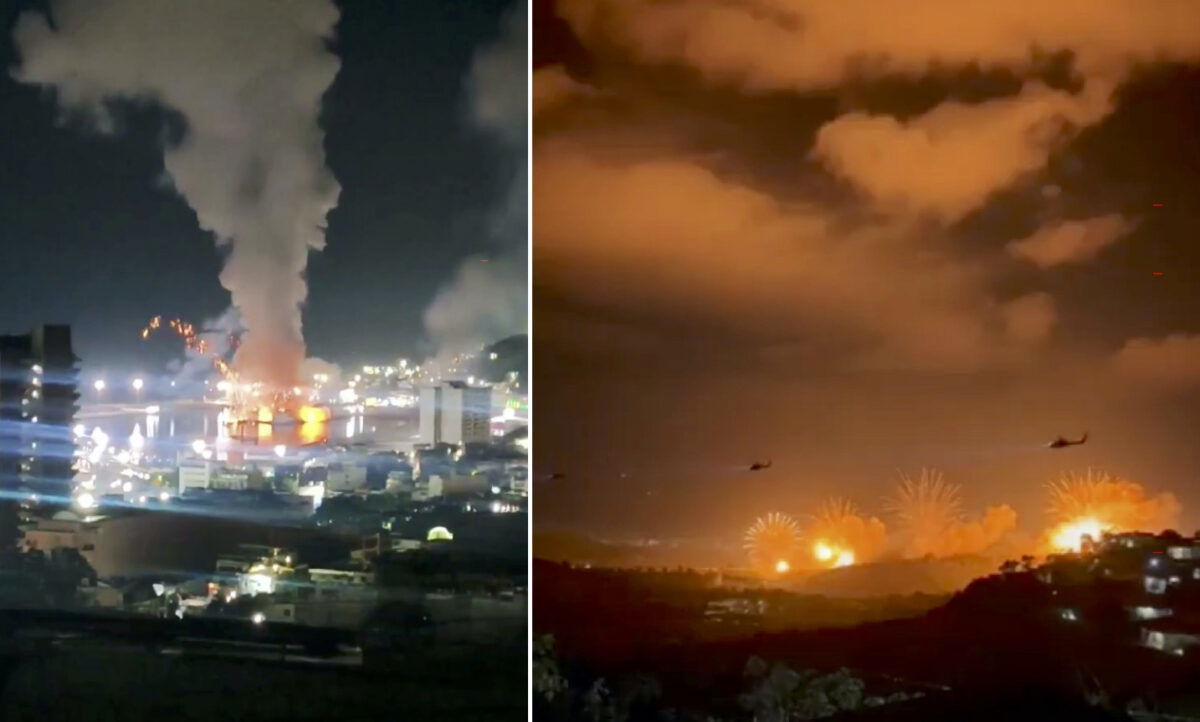
A series of powerful explosions shook Venezuela’s capital in the early hours of Saturday, January 3, as key military sites were targeted by US military missiles. Residents reported at least seven loud detonations around 2am local time, accompanied by the roar of low-flying aircraft and plumes of smoke rising over the city.
Eyewitnesses and social media videos captured blasts near La Carlota airbase, the Venezuelan Air Force’s primary facility, and Fuerte Tiuna, a sprawling complex housing the Ministry of Defence headquarters and high-ranking military commands. Power outages struck southern Caracas near Fuerte Tiuna, plunging neighbourhoods into darkness as panic spread.
Emergency meetings called as US bombs sound in southern Caracas
Colombian President Gustavo Petro quickly sounded the alarm on X, declaring, “Right now they are bombing Caracas. Alert to the whole world—they have attacked Venezuela. They are bombing with missiles.” Petro urgently called for emergency meetings of the Organisation of American States (OAS) and the United Nations to address what he described as an aggression.
Maduro accused of narco terrorism
No official confirmation has come from the US government or the Pentagon, which declined to comment on the incidents. However, the explosions occur during escalating US pressure on President Nicolás Maduro’s administration. Washington has accused Maduro of leading a “narco-terrorist” regime tied to drug trafficking, imposing severe sanctions, blockading oil exports, and conducting dozens of strikes on suspected drug-smuggling vessels in the Caribbean since September 2025.
In recent weeks, the US escalated further with a confirmed CIA drone strike on a Venezuelan coastal dock facility allegedly used for drug loading – just before Christmas – and seizures of oil tankers. Trump has repeatedly threatened land-based operations, shifting from maritime interdictions to direct actions on Venezuelan soil.
Maduro, in a New Year’s interview aired days earlier, expressed openness to “serious talks” with the US on drug cooperation and oil investments while denouncing American “warmongering”. Venezuela recently released additional political prisoners, seen by some as a conciliatory gesture amid the mounting campaign.
Venezuelan election widely viewed as fraudulent
The crisis traces back to the disputed 2024 presidential election, widely viewed internationally as fraudulent, with Maduro claiming victory. Backed by Russia and China, Maduro has accused the US of coveting Venezuela’s vast oil reserves – the world’s largest, although of low-grade crude, expensive to convert into petroleum.
As the night drew longer, unverified videos circulated showing smoke and fires at military sites, with residents describing “Fuerte Tiuna exploding” from their windows. International outlets, including The New York Times, Al Jazeera, and AP, reported low-flying aircraft and ongoing blasts, marking a potential sharp escalation if US involvement is confirmed.
The situation remains fluid, with fears of broader conflict rippling across Latin America. World leaders monitor closely as calls grow for de-escalation and diplomatic intervention.
Currently, the Spanish government’s Instituto Nacional de Estadística (INE) and related ministries indicate that approximately 136,000 Spanish citizens are registered as residents in Venezuela (data as of January 1, 2023). As of January 2026, the most recent official data from Spain’s Instituto Nacional de Estadística (INE) indicate that approximately 377,000 to 400,000 Venezuelan nationals reside exiled in Spain.
