
China’s Navy Advances Through Pacific Island Chain
China continues to expand its military presence across the Pacific, deploying four naval vessels that advanced through the First Island Chain, a north-to-south defensive line conceived under a United States strategy aimed at containing the East Asian power.
Japan‘s Defense Ministry reported that a four-ship Chinese flotilla was tracked sailing through the Miyako Strait—a key waterway in the country’s southwestern waters—as it reached the Philippine Sea from the East China Sea between Tuesday and Wednesday.
The Chinese Foreign Ministry did not immediately respond to a request for comment.
Why It Matters
The First Island Chain stretches from the Japanese archipelago to the Malay Peninsula through Taiwan and the Philippines, separating the East China Sea and the South China Sea from the broader Pacific Ocean. This U.S. maritime strategy is designed to project force by leveraging U.S.-friendly territories to deter and defend against potential aggression.
Operating the world’s largest navy by hull count, China has repeatedly “breached” the First Island Chain by sending warships—including aircraft carriers—to waters east of it. This helps the Chinese military develop the capability to counter U.S. military intervention, which is expected to include naval deployments, in the event of a regional conflict.
What To Know
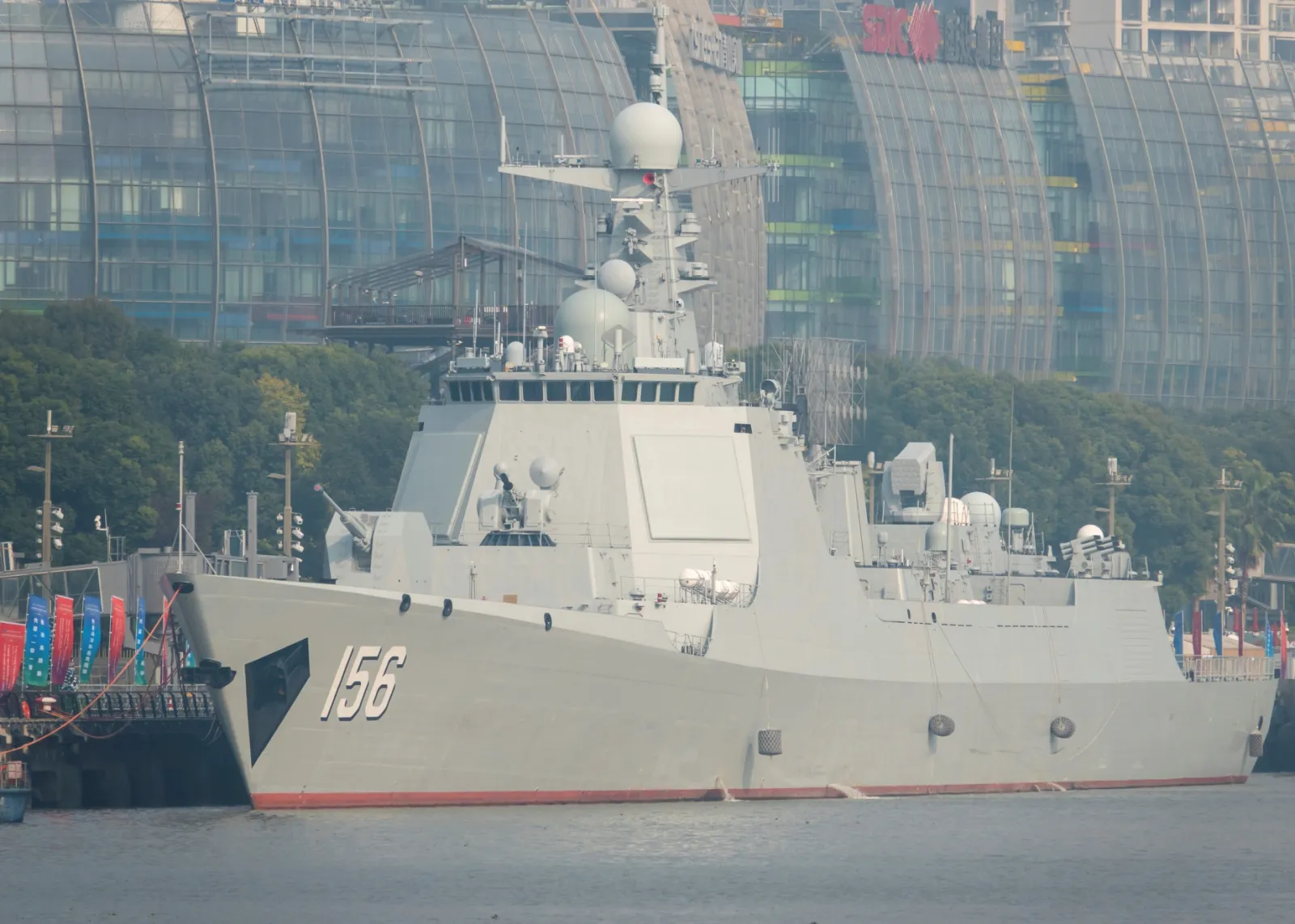
According to Japan’s Defense Ministry, the Chinese naval vessels were identified by their hull numbers as the Type 052C destroyer CNS Xi’an, the Type 052D destroyer CNS Zibo, the Type 054A frigate CNS Binzhou and the Type 903A replenishment ship CNS Chaohu, all of which were monitored by the Japan Maritime Self-Defense Force.
Both the Type 052D destroyers and the Type 054A frigates are major components of China’s surface fleet, with each class having about 40 vessels in service. The destroyers are equipped with up to 64 missiles, while the smaller frigates carry up to 40.
This marked the second time in a week that the Chinese navy has transited the Miyako Strait between Japan’s Okinawa and the Miyako Islands. The intelligence collection ship CNS Beijixing passed through the waterway in the same direction on Saturday.
It was not immediately clear whether the deployment of the four-ship naval task group was related to the spy ship’s mission. The Chinese military regularly sends its navy on “long-range” training exercises that could bring it into contact with foreign warships.
In a social media post, Japan’s Defense Minister Shinjiro Koizumi said China has been actively intensifying its military activities around Japan, including what he described as “continuing high-frequency advances” into the Pacific beyond the First Island Chain.
Noting North Korea’s ballistic missile launch on Tuesday, in which two missiles were fired in a direction toward Japan, the minister said the country’s military continues to maintain vigilance and surveillance to ensure its defense is “thorough and complete.”
Citing threats posed by China, North Korea and Russia, the Japanese government has warned that the country faces the “most severe and complex” security environment since the end of World War II, according to a defense white paper released last year.
What People Are Saying
The Pentagon’s Chinese military power report 2025 commented: “China’s military focus is currently the First Island Chain…While China’s strategic center of gravity remains the First Island Chain, however, as Beijing continues to grow wealthier and more powerful, it is logical that its military power will also continue to grow towards a force capable of projecting power worldwide.”
Japan’s defense white paper 2025 said: “China has been swiftly increasing its national defense expenditures, thereby extensively and rapidly enhancing its military capability in a qualitative and quantitative manner and intensifying its activities in the East China Sea, including around the Senkaku Islands, and the Pacific.”
What Happens Next
China is likely to maintain its military presence in and beyond the First Island Chain. The latest U.S. National Security Strategy calls for a military buildup capable of denying aggression in the region, in coordination with allies for collective defense.
In a polarized era, the center is dismissed as bland. At Newsweek, ours is different: The Courageous Center—it’s not “both sides,” it’s sharp, challenging and alive with ideas. We follow facts, not factions. If that sounds like the kind of journalism you want to see thrive, we need you.
When you become a Newsweek Member, you support a mission to keep the center strong and vibrant. Members enjoy: Ad-free browsing, exclusive content and editor conversations. Help keep the center courageous. Join today.


