
Right Word | The Story Behind PM Modi’s Letter To Sadanandan Master
Last Updated:February 11, 2026, 13:17 IST
PM Modi’s letter to Rajya Sabha member C Sadanandan Master goes beyond personal sympathy to highlight enduring reality of political violence, especially in Kerala & West Bengal.




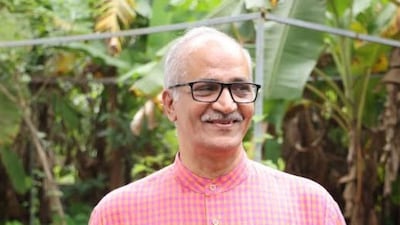
RSS worker and a nominated Rajya Sabha member, C Sadanandan Master
Prime Minister Narendra Modi’s letter to the veteran Rashtriya Swayamsevak Sangh (RSS) worker and now a nominated Rajya Sabha member, C Sadanandan Master, is more than a gesture of sympathy. This letter came in response to the Master’s powerful intervention in the House while speaking on the Motion of Thanks to the President of India’s address.
Sadanandan Master had placed his artificial limbs on the table and recalled an attack that took place 31 years ago against him in Kerala.
Recommended Stories
Violence As Political Instrument
The Rajya Sabha MP was ambushed by a group of communists while returning home, dragged to the ground, and had his legs hacked off. Speaking from his seat because of his disability, he attributed the brutal assault to CPI(M) cadres, highlighting the uncomfortable truth about Indian politics—the persistence of ideological violence against grassroots workers by communists who have historically treated dissent as treachery.
It isn’t only about the personal ordeal of C Sadanandan Master. It is about the often-ignored story of the systematic use of violence as a political instrument in certain ideological ecosystems.
PM Modi appropriately responded by writing to Sadanandan Master, praising his maiden speech in the House for its moral strength and conviction. Most importantly, the Prime Minister noted that many people found it hard to accept that a hardworking teacher could be attacked in a vibrant democracy by followers of a “retrograde ideology”.
Prime Minister Narendra Modi had also posted on social media after Sadanandan Master’s Rajya Sabha nomination was announced in July 2025: “C Sadanandan Master’s life is the epitome of courage and refusal to bow to injustice. Violence and intimidation couldn’t deter his spirit towards national development.”
He further said, “His efforts as a teacher and social worker are also commendable. He is extremely passionate towards youth empowerment. Congratulations to him for being nominated to the Rajya Sabha by Rashtrapati Ji. Best wishes for his role as MP.”
Sadanandan Master, born in Thrissur district of Kerala, got associated with the Rashtriya Swayamsevak Sangh (RSS) in the 1980s and later became actively involved in the Bharatiya Janata Party (BJP), where he rose through the ranks to become state vice-president.
His life took a tragic turn on 25 January 1994, when he was brutally attacked in Kannur district by communist workers. In this attack, both of his legs were severed. Rather than receding into silence, Sadanandan Master responded with fortitude. He returned to teaching, continued public engagement, and emerged as a symbol of courage and ideological commitment.
Ideological Battleground
The RSS had entered Kerala in 1942, and within a year, it expanded rapidly. The communists, who had a deep influence in Kerala’s political landscape, were wary of the RSS. Kerala became an ideological battleground by the late 1940s, and the communists started using violence against RSS cadres. Over the years, while violence against RSS workers continued in various parts of Kerala, Kannur became the hotbed of violence, bloodshed, and ideological killings.
The first RSS cadre to be murdered in Kannur was 36-year-old Vadikkal Ramakrishnan on 28 April 1969. He was a tailor by profession and the sole breadwinner of his family at Thalassery. Prof. AKM Das, Shabu Prasad, and VN Gopinath documented the killings of RSS workers in Kerala in a 2020 publication titled RSS in Kerala: Saga of a Struggle.
According to their estimates, around 300 RSS workers were killed in violence by communists till 2020, a substantial number of them in Kannur. Violence by communists in Kannur was also reported in 2025, when they attacked victory processions of political rivals who had defeated them in their strongholds in local elections.
According to Das, Prasad and Gopinath, “Almost all of them who were killed were innocent people without any criminal tendencies. Many of them were either former CPI(M) workers or once active in their feeder organisations. For instance, Panunda Chandran, killed in an attack by CPI(M) cadres on an RSS shakha, was at one time an activist of the Student Federation of India (SFI), who later joined the Akhil Bharatiya Vidyarthi Parishad (ABVP) and became an active swayamsevak of the RSS. His father Narayanan was active both in the CPI(M) and the CITU, the labour wing of the party.”
Incidentally, age has been no bar when it comes to targeting RSS workers. “Even aged people were not spared, as is evident from the murder of P.K. Vidyasagar of Emmad on 16 July 1996, who was 62 years old. He was a shopkeeper and the Mathilakam Panchayat president of the Bharatiya Janata Party (BJP),” noted Das, Prasad, and Gopinath in their documentation.
Communist Violence
Kerala isn’t an exception when it comes to Communist violence. When communists were ruling West Bengal (1977-2009), there was massive political violence unleashed on rivals.
In 1997, West Bengal Chief Minister Buddhadeb Bhattacharjee, replying to a question in the Assembly, stated that between 1977 (when the Left came to power) and 1996, 28,000 political murders were recorded. This translates to an average of 125.7 murders per month, about four per day, or one political killing every six hours over 19 years (D. Bandyopadhyay, “Census of Political Murders in West Bengal during CPI-M Rule—1977-2009,” Mainstream, Vol. XLVIII, No. 34, August 14, 2010).
For the period 1997-2009, using an annual average of 2,284 killings, the estimated total comes to 27,408. Thus, between 1977 and 2009, the cumulative figure became 55,408 political murders. This equals an average of 1,787 per year, 149 per month, and about five per day—or one political killing every four hours and 50 minutes in West Bengal.
What has happened in West Bengal and Kerala is a manifestation of using violence as a central tool by this “retrograde ideology” wherever it is present. Author Stéphane Courtois offers an approximate global count of deaths under communist regimes in The Black Book of Communism: USSR (20 million), China (65 million), Vietnam (1 million), North Korea (2 million), Cambodia (2 million), Eastern Europe (1 million), Latin America, Africa, and Afghanistan (3.4 million).
(The writer is an author and columnist. His X handle is @ArunAnandLive. Views expressed are personal and solely those of the author, and do not necessarily reflect News18’s views.)
February 11, 2026, 13:17 IST
Loading comments…
Read More
