
A fake cop station and more: How scammers in Cambodia are trapping Indians
Those who have been scammed often speak about how real it all seemed. Well, now we know why.
According to reports, authorities in Cambodia have uncovered a compound set up specifically to target Indian citizens. Officials say they have dismantled nearly 200 such scam centres in recent weeks.
“There are about 190 locations that we have sealed off now,” Chhay Sinarith, senior minister and chair of Cambodia’s Commission for Combating Online Scams, said. He added that authorities had arrested 173 senior crime figures linked to these centres and deported 10,000 workers since late last year.
The crackdown followed the indictment by the US and extradition by China of Ly Kuong, a China-born alleged scam kingpin.
But what exactly was happening inside these compounds? How did the operation work? Let’s take a closer look.
What we know
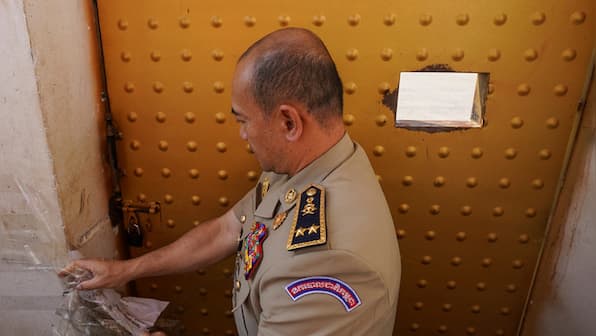
Authorities in Cambodia found an abandoned compound in Kampot used by scammers. The site contained fake signboards bearing the logos of the Mumbai Police and the Central Bureau of Investigation (CBI). That was not all.
Investigators also found pictures of Mahatma Gandhi and BR Ambedkar, along with the Indian flag. Authorities said the compound was used to carry out so-called “digital arrests” targeting Indian citizens. They believe the operation was being orchestrated by a China-born tycoon.
At the Kampot compound, reporters were shown large workrooms lined with computer stations, desks strewn with documents detailing how to scam Thai victims, studio booths for phone calls, and a mock-up of an Indian police station.
Authorities said no arrests were made inside the Kampot casino complex known as My Casino. Workers reportedly fled after the detention of the alleged boss, Ly Kuong, and police admitted they lacked the manpower to stop those leaving.
Editor’s Picks
“We have only about 1,000 policemen in the entire province and around 300 military police,” Kampot provincial police chief Mao Chanmothurith said during a government-organised tour. “Even with both forces combined, we still couldn’t stop them because there were about 6,000 to 7,000 of them when they left this place.”
The visit came a week after Thai officials led media and foreign delegates to a separate compound in Cambodian territory that Thai troops bombed and occupied during a border conflict in December. Similar material was found there too, including fake police stations from multiple countries, including Singapore and Australia, along with piles of documents.
Southeast Asia has emerged in recent years as an epicentre of the global cyber-fraud industry. Compounds, mostly run by Chinese criminal gangs and staffed partly by trafficked victims living in brutal conditions, have proliferated across Cambodia, Laos,
the Philippines and lawless stretches along the Myanmar–Thailand border.
Pakistani link emerges in earlier scam
Hundreds of thousands of people are believed to be trapped in forced labour across Southeast Asia, housed in large compounds and compelled to run scams designed solely to steal money.
These developments come two years after it emerged that around 5,000 Indians were trapped in Cambodia by criminal gangs who had lured them with promises of high-paying jobs. According to the BBC, many of these victims were young and tech-savvy.
In January, The Indian Express reported that a Pakistani link had emerged during the probe. Authorities found evidence suggesting that parts of the network responsible for luring Indian job-seekers abroad were operated or coordinated through contacts in Pakistan. This came after law enforcement agencies analysed digital communications linked to the recruitment of victims.
Victims said they were recruited via social media and messaging apps, and forensic checks revealed IP addresses and digital traces linked to handlers in Pakistan. The Central Bureau of Investigation (CBI) and the National Investigation Agency (NIA) have since expanded the scope of the investigation.
The Indian Cyber Crime Coordination Centre (I4C) has also added Pakistan-linked IP addresses to its suspect registry to help block fraudulent online accounts and transactions, particularly those linked to financial fraud.
Using data from the National Cyber Crime Reporting Portal, the registry has compiled details of 1.4 million cybercriminals involved in financial fraud and other cyber offences, and shared this information with banks. Authorities have frozen 554,865 bank accounts that received fraudulent funds, identified 1,510,800 unique accounts, and prevented losses worth Rs 7,980 crore by blocking nearly 20 lakh suspicious transactions.
Data show that Indians have suffered losses worth Rs 52,976 crore due to fraud and cheating over the past six years.
The scam network involved deceptive job offers, forced labour, threats and financial extortion. A source told the newspaper that the investigation uncovered a coordinated network targeting individuals in Uttar Pradesh, Punjab, Mumbai, Telangana and Kerala. The issue was also discussed during the two-day Anti-Terrorism Conference 2025 held in December.
“This is not just a cyber-fraud racket — it’s a targeted operation exploiting our youth,” the source said.
7,000 Indians rescued, says Centre
According to Scroll, the Union government has said that nearly 7,000 Indians have been rescued from cybercrime compounds in Cambodia, Myanmar and Laos since 2022. This includes 2,533 citizens from Cambodia, 2,297 from Laos and 2,168 from Myanmar.
Minister of State for External Affairs Kirti Vardhan Singh shared these figures in a written reply to a question from Trinamool Congress MP Saket Gokhale. He said the government was aware of “dubious firms” offering fake recruitment jobs and luring Indian nationals to Cambodia, Myanmar and Laos to carry out cybercrime and other fraudulent activities from scam centres.
“The exact number of Indian nationals stranded in these countries is not known, as many reach these scam centres through fraudulent or unscrupulous recruitment agents and illegal channels,” Singh told Parliament.
India has repeatedly warned its citizens against falling prey to schemes promising high-paying jobs abroad.
With inputs from agencies
End of Article
