
A new nuclear arms race is developing, under the radar
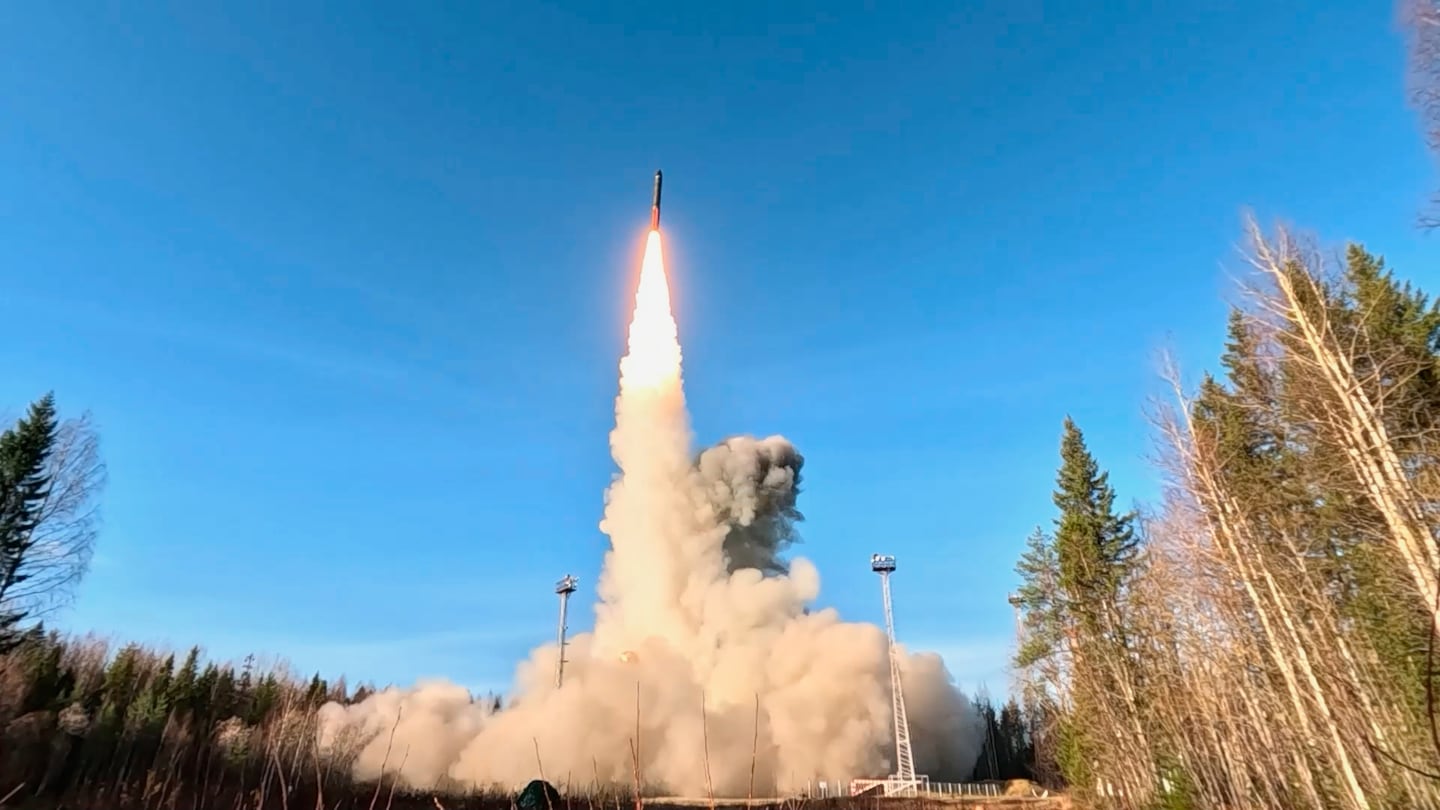
In the bleakest days of the Cold War, there was a terrifying yet oddly reassuring logic to the nuclear standoff between the United States and the Soviet Union. The two superpowers were constrained by a deterrence strategy and a fear of mutually assured destruction.
The media, then dominated by fewer but more widely watched TV networks, helped concentrate minds. “The Day After,” an ABC film depicting the deadly fallout from a nuclear exchange, was viewed by more than 100 million Americans in 1983, becoming one of the highest-rated TV movies ever. And activists pressed US and Soviet leaders to halt their arms race, including a team of Boston doctors who joined forces with Russian colleagues to graphically spell out the medical catastrophe of a nuclear war.
Is it too soon to feel nostalgia for that first nuclear arms race? Maybe not. It ended with the 1991 collapse of the Soviet Union and a string of arms control agreements that dismantled tens of thousands of warheads on each side.
Now a second nuclear arms race is revving up. When the Trump administration let America’s last nuclear arms control pact with Russia, called the New START treaty, lapse on Feb. 5, it lifted all restrictions on the size and makeup of both countries’ arsenals. The new race involves not only America and Russia, which are working to modernize their weapons, but also China and a half-dozen other nuclear nations stockpiling their own warheads.
Critics see the expiration of New START as highly destabilizing at a time when more than 3,000 existing warheads can already be fired from land, air, and sea. It also comes as tensions from the war in Ukraine, political divisions in the United States and Europe, and a potential breakup of the Atlantic alliance are pushing still more countries to consider joining the nuclear club.
“The lid is off,” warns Dr. John Pastore, a cardiologist at New England Baptist Hospital and former president of the Physicians for Social Responsibility, which has long called for the global abolition of nuclear weapons.
President Trump said he was willing to scrap the New START treaty with Russia to focus on “a better agreement” that includes China. China, however, is rapidly building its nuclear arsenal and won’t engage in arms control talks as it plays catch-up. All three countries are readying new launch modes and faster delivery systems — space-based, hypersonic, undersea — that are harder to detect.
Yet those seeking to contain the new arms race face stubborn obstacles. Memories are fading of the death and destruction wrought by US atom bombs dropped on Japan during World War II. Young people have grown up without having to think about nuclear war. The prospect of them taking to the streets in massive numbers, as Americans did in the 1980s, seems remote.
Still, antinuclear activists are stepping up their fight. Among other moves, Dr. James Muller, another Boston cardiologist who cofounded International Physicians for Prevention of Nuclear War (IPPNW) in 1980, is working with some United Nations representatives to organize a Forum on the Survival of Humanity later this year. It would invite delegates from the nine nuclear states — the United States, Russia, China, France, the United Kingdom, India, Pakistan, North Korea, and Israel — to discuss joint steps to safeguard their nuclear arsenals against accidental misfires prompted by deployment of artificial intelligence.
The biggest challenge for today’s activists may be a multipolar arms race that is taking shape in an age of distractions. Young people are hooked on social media where sobering news must compete with Bad Bunny videos. Sounding the alarm about the nuclear peril — the biggest threat of all — now means competing with bearers of other grim tidings about climate change or new pandemics.
“People are overwhelmed by the multiple intersecting crises,” says Dr. Joseph Hodgkin, an attending physician at Massachusetts General Hospital who is part of a new generation of doctors working to rouse public sentiment against the resurgent nuclear threat. “But one thing that’s fundamentally the same as in previous generations is that these weapons continue to pose a threat to life on earth.”
Pastore took up the antinuclear cause during the Cold War when a grassroots movement spread worldwide. He visited Hiroshima in the 1960s and chronicled the effects of radiation on Japanese survivors of the first US atom bomb, which killed at least 90,000 people when it was dropped on the city in 1945.
Today’s threat is at once more complex and harder to convey. Americans who came of age in the aftermath of World War II and the Cold War don’t remember ducking under desks at school in civil defense drills that were common before and during the Cuban missile crisis.
“We’re 80 years away from Hiroshima,” says Muller. “Young people today did not grow up with the nuclear threat.”
But important lessons can be learned from the earlier antinuclear movement. More than 750,000 people rallied in New York’s Central Park in the spring of 1982 to call for nuclear disarmament. Later that year, Muller and Pastore joined other American and Russian doctors in a broadcast seen by millions on US and Russian television, seeking a halt to the arms race. In 1985, their organization, IPPNW, was awarded the Nobel Peace Prize for fueling, in the Nobel committee’s words, “an awareness of the catastrophic consequences of atomic warfare.”
That awareness has receded today. So arms race opponents are pushing new disarmament resolutions in Congress and in Massachusetts and other state legislatures. They’re lobbying lawmakers and US, Russian, and Vatican officials to rein in the new arms race. Such efforts are a far cry from the mass movement of the Cold War era, but they’re a start.
Last fall, Hodgkin and physicians from more than a dozen countries gathered in Nagasaki to pay tribute to the victims of the second US atom bomb, which caused the deaths of more than 70,000 from severe burns and radiation sickness. Among his Russian colleagues in today’s antinuclear campaign is Dr. Olga Trushina, granddaughter of Dr. Yevgeny Chazov, an IPPNW cofounder who was personal physician to Soviet leaders.
The death and destruction from a nuclear war today would dwarf that of Hiroshima and Nagasaki. One IPPNW study suggests that even a limited exchange would kill millions of people, shatter the global economy, and trigger climate disruption, crop failure, famine, and mass starvation.
But ordinary citizens can again mobilize to pressure leaders to defuse that threat, says Dr. Ira Helfand, a Northampton activist who is part of the Back from the Brink campaign, made up of physicians, scientists, labor and environmental groups, and faith leaders.
“People tend to think of nuclear weapons as part of the natural order,” Helfand says. “They can’t imagine a world without nuclear weapons. Well, we couldn’t imagine the Cold War ending, but it did. We need to have the audacity to be hopeful that we can replicate that.”
