
I’ve lived with chronic pain for 30 years – sometimes even brushing my hair hurts too much
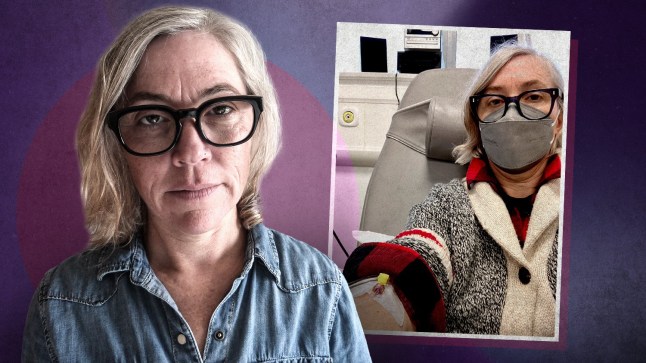
Gillian Best was getting ready to head off to university when she was suddenly overwhelmed by searing, stabbing pains in her bones. It was unlike any pain she’d experienced before.
Until that moment, the teenager had been looking forward to her first taste of independence away from home and excited to start her degree in creative writing and English literature.
‘I tried to move but I couldn’t. I was lying in my bed and I just couldn’t sit up, so I had to cantilever myself up. I was crying and wanted to sob – but it was too painful.’
Desperate for the loo, Gillian, then 19, called her mum who asked her younger brother Dave to carry her to the bathroom. However, being touched was agonising. Instead, he helped her manoeuvre onto his skateboard, which she sat on in agony as he carefully wheeled her to the toilet.
‘I was in too much pain to be scared. Pain like that – it really focuses you. The rest of the world doesn’t exist,’ she remembers. Later that day, Gillian was taken to hospital for a one-off pain relief shot and gradually the agony subsided.
It would turn out to be the first flare up of many that she would endure due to a raft of painful conditions that have blighted her life for 30 years.
It was in her teens, that Gillian, now 50, was diagnosed with ankylosing spondylitis (AS), an autoimmune inflammatory form of arthritis that affected her hips and spine. Then, in her twenties, after years of diarrhoea and weight loss, she was also diagnosed with Crohn’s disease.
‘With chronic illness, pain includes all sorts of things like fatigue, bad sleep, low mood, and those in turn all make the pain harder to bear,’ explains the Bristol-based writer.
‘One day I’m totally fine, and the next day, it hurts to sit, to stand, to walk, to breathe. As my mum would say – “It’s up and down like a toilet seat.”’
‘It’s difficult to put into words the vastness, the sheer enormity, of chronic pain and the strange world it can plunge or drag you into.’

It’s estimated that 1.5 billion people live with chronic pain around the world, and Gillian’s began while she was still in school. A skilled swimmer, she was in the pool one day in her early-teens when a shocking spasm of pain rendered her immobile.
‘I remember this horrible pain going down my bum and back of my leg, and I couldn’t kick, I couldn’t move, and I kind of fell. I remember pulling myself out of the pool and just being in agony and having to get helped into the change room. I had to ask a teacher to help me get dressed, because I couldn’t move. That’s really not what you want at that age – a teacher come and help you get dressed. That’s not fun.
‘We had no idea what was going on. And then it disappeared as quickly as it came on,’ she remembers. But the pain later returned to the point whereby Gillian was carrying a cane and pulling herself upstairs at the age of 21. She went to her family GP and burst into tears in the consulting room. The doctor was empathetic and promised Gillian she would get to the bottom of what was bothering her and referred her for tests.
‘When I was diagnosed a few years later, I looked up AS and read that in some cases, your spine can stiffen, and your ribs can deform in and crush your heart, chest and lungs. It felt like my life was over. I thought it was a death sentence.
‘Afterwards, I went through a grieving period. I felt really sorry for myself, and I didn’t think I was going to amount to anything. I managed it badly because I didn’t do the exercises that I now realise I needed to do. I relied on taking anti-inflammatories, which years later gave me ulcers.’

Since then, Gillian has lived with daily pain that changes like the weather. She has many ‘good days’ – and a personal pharmacy of pain medications for the bad ones.
She takes the maximum dose of paracetamol and naproxen during the day, and then something called amitriptyline at night, and relies heavily on heat pads. She has also received the frustrating advice from medical professionals, to try paracetamol and a hot bath, and been accused of being a ‘drug-seeker’ on a few occasions.
However, she admits that it’s when well-meaning people say ‘feel better!’ to her, that really irritates Gillian.
‘It’s one of those things people say without really thinking – everyone says it,’ she explains. ‘But it grates on me because though I might get over a flare, I’ll never be rid of my disease. And when you’re in pain and haven’t had a good sleep, it’s difficult to have the perspective you’d normally have.
‘You get crabby, and snappy, and have no patience for anything. Living with a chronic condition makes everything in your life hard. It’s exhausting. It’s another full-time job – managing doctors’ appointments, tests, scans, scheduling medication deliveries, doing cardio exercise, strength training, stretches, and balance exercises. Planning activities around what’s impossible to move, and what I want to do, and building in enough time to rest, which is frustrating.
‘It’s learning to understand the disease’s nuances, anticipating flares, and learning to live with a kind of low-key background flu-ish feeling. It’s a bit like wearing a heavy backpack for life. Everything takes a bit more energy.’
The illness has affected Gillian’s social life, and she has had to rely heavily on her friends and loved ones – calling her best friend to pick her up in the street in her twenties when the pain became too much.

‘For me and my disease I know that exercise and stretching will help, but that means I have to get dressed and get out the door to go for a walk. And I live at the top of a hill, so that’s an added challenge. When I have a flare, I’m afraid I’ll get stuck, so I have to rely on my partner Connor to come with me. It takes your independence.
‘But normally, I walk 8km everyday and I am just fine. I regularly swim 8km a week. But recently I had a mini flare and I was too stiff and sore to brush my own hair.
Gillian can’t remember a life before pain. She describes it as ‘relentless and grindingly monotonous. It’s another thing to deal with and care for – like a really s*** pet.’
She has turned down her dream to work in Japan for fear that she wouldn’t be able to advocate for herself adequately during a flare, and as a writer, she has to adapt her days to her illness – turning the camera off on meetings on days when she is too sore to shower or dress.
Despite a cabinet full of medicine, Gillian says that she’s found that the most reliable remedy for her conditions is stretching and exercise and she has just returned from a two-week rehab course at the hospital that she says was life-changing.

She has also written a book, Chronic: Understanding Pain, to explore why, when millions live with chronic pain, treatment remains so unreliable and many drugs still don’t work.
As part of her exploration of what she calls one of the ‘great public health crises of our age,’ Gillian has spoken to neuroscientists, medical doctors, academics, psychiatrists and psychologists about upcoming scientific advances and medical developments, and examined those that have transformed many people’s health.
‘I am optimistic, and eager to see what the next game changer will be. I feel like there is going to be something big for people with cancer, diabetes, long covid, migraines, autoimmune diseases and post surgical pain.
‘There are all these amazing researchers who are truly the unsung heroes of our world. These people are extraordinary, and so many of them have an experience of chronic pain.’
‘Facebook likes to serve me cures like drinking apple cider vinegar and standing on my head to the east in the morning. But science is going to cure it.
‘We’re never going to be rid of pain, but we’re going to figure out ways to manage it better, to diagnose it faster and more accurately, and extraordinary people who are going to change all our lives for the better. It’s amazing.’
Chronic: Understanding Pain, by Gillian Best, is out in March
MORE: ‘I donated my kidney to save a stranger – I’ve had worse hangovers’
MORE: I’ve had over a dozen panic attacks across the globe – this is how I manage anxiety
MORE: The social media trend leaving Soho sex workers fearing for their lives
