
Takaichi willing to help ensure Hormuz safety but tells Trump there are legal limits
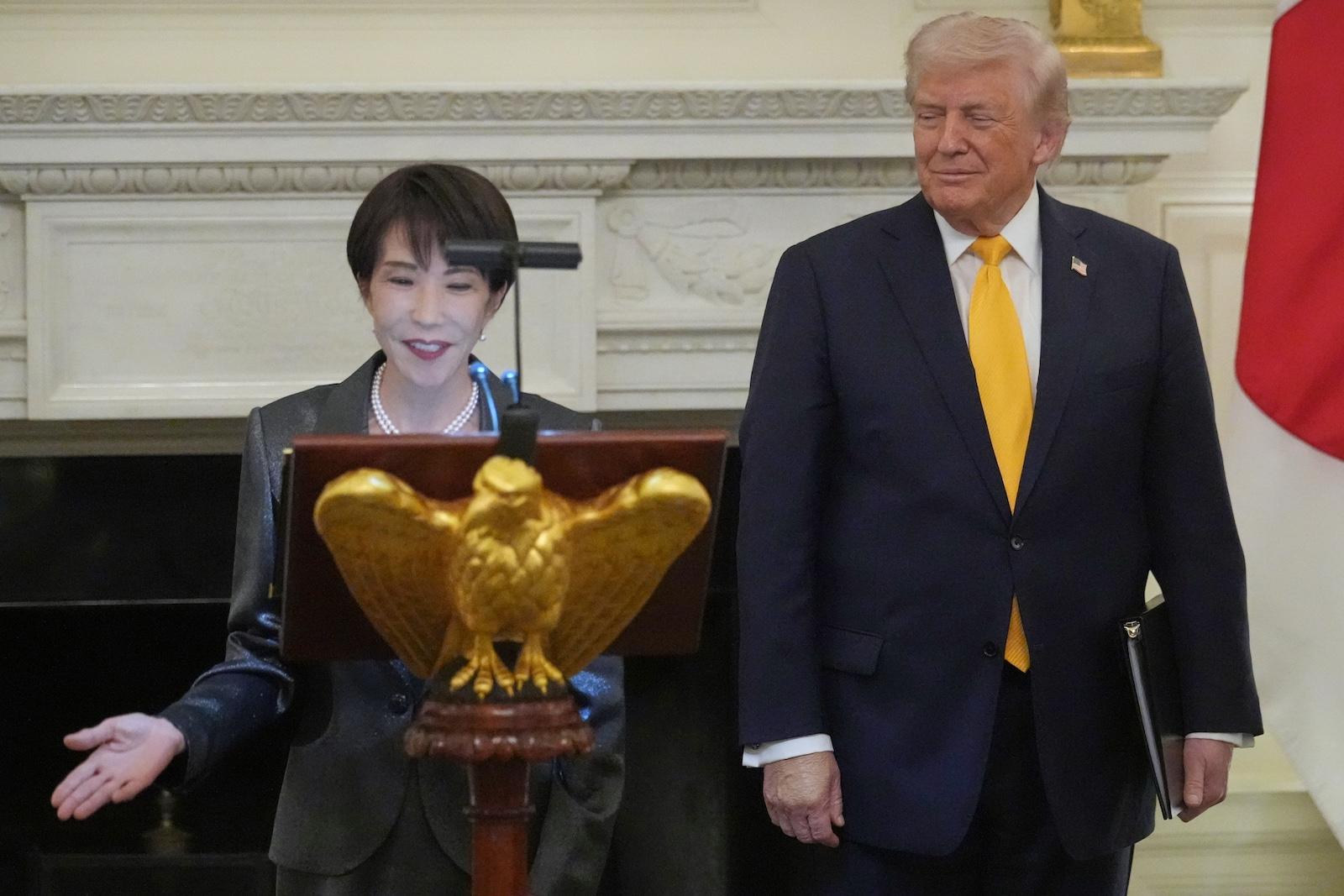
Prime Minister Sanae Takaichi told U.S. President Donald Trump on Thursday that Japan is ready to contribute to the safety of the Strait of Hormuz as the U.S.-Israeli war on Iran intensifies, while explaining Tokyo’s legal constraints on sending ships from its defense forces to the region.
Takaichi told reporters after her meeting at the White House with Trump that she told the U.S. leader “in detail what Japan can do and cannot do” from a legal perspective under the country’s war-renouncing Constitution.
Trump, for his part, reiterated his expectation that Japan would be engaged, while saying during the part of their talks open to media that he believes Japan has been “stepping up to the plate” in recent days over the Iran war, “unlike NATO.”
The U.S. leader has made public his dissatisfaction with Washington’s allies, including Tokyo and members of the trans-Atlantic alliance, over their reluctance to pitch in to help secure the Hormuz strait, a vital waterway for global oil transportation now largely blocked by Iran.
“I expect Japan to step up, because, you know, we have that kind of relationship,” he said. “We have 45,000 soldiers in Japan. We have, we spend a lot of money on Japan…so I expect, I’m not surprised that they would step up.”
Noting also that more than 90 percent of Japan’s crude oil imports normally pass through the strait, Trump said Japan has a “big reason” to do more.
In affirming Japan-U.S. collaboration on expanding U.S. energy production, Takaichi said she proposed to Trump a joint oil-reserve project to ease supply concerns driven by the Middle East conflict.
At the talks, Takaichi praised Trump’s “peace” efforts, expressing readiness to assist by reaching out to other countries. “Donald is the only person who can bring peace and prosperity across the world,” she said.
Takaichi emphasized that the prospect of Iran developing nuclear weapons is unacceptable. Trump alluded earlier to Iran’s nuclear program to explain the U.S. decision to launch its military campaign against the country.
Facing an increasingly assertive China, Takaichi also reminded Trump that the security environment remains severe in the Indo-Pacific, at a time when reports have emerged that some U.S. military assets are being moved from the region to the Middle East.
The two leaders confirmed that their nations will work closely on issues regarding Taiwan and China and oppose measures threatening critical mineral supplies such as export controls, senior Japanese government officials told reporters, apparently referring to Beijing’s tighter regulations on rare earths exports.
They agreed to advance broad defense cooperation, including joint missile development and production, and promote a free and open Indo-Pacific, according to Takaichi.
“We were able to affirm many concrete forms of cooperation that will further enhance the quality of our alliance in wide-ranging fields,” Takaichi said, adding that she and Trump are aiming to elevate bilateral ties to “a higher level” together.
Trump welcomed Japan buying “a lot of” U.S. military equipment. He further stressed that he has a “very fine relationship” with Takaichi, describing her as “a very special person” who is doing a “fantastic job.”
The U.S. side did not bring up fresh demands for Japan to spend more on its defense, the officials said.
New projects worth 473 billion yen
The two coumtries unveiled a plan to build small modular nuclear reactors as one of three new business projects worth a total of $73 billion under Tokyo’s $550 billion commitment made last year in exchange for tariff relief.
The second batch of joint projects also includes the construction of natural gas generation facilities in Pennsylvania and Texas.
Although the U.S. Supreme Court invalidated the Trump administration’s sweeping tariffs last month, Japan has stuck to the terms of a trade deal the two countries reached in July.
Under the agreement, Japan has committed $550 billion to U.S.-based projects in strategic industries through investments, loans and loan guarantees until the end of Trump’s second term, despite the unpredictability stemming from his administration’s aggressive, transactional approach to international relations.
In mid-February, Japan and the United States announced the first three projects, including building a gas-fired generating facility in Ohio, the largest of its kind in U.S. history, to power artificial intelligence data centers.
On Thursday, the two countries said the construction of small modular reactors by GE Vernova Inc. and Hitachi Ltd. in Tennessee and Alabama, estimated to cost up to $40 billion, will be “groundbreaking” in the United States.
They said it will serve as a “tremendous next-generation stable power source,” leading to more stable electricity prices for Americans and an enhancement of their leadership in global technological competition.
Among many other objectives, the two allies said they will explore a plurilateral trade framework regarding critical minerals with border-adjusted price floors or other measures to help ensure supply chains are not vulnerable to disruptions, including “economic coercion.”
They also signed a memorandum of understanding to advance joint efforts to develop deep-sea mineral resources.
By setting up a working group, areas of cooperation under consideration include sharing information on Japan’s project near Minamitori Island, where it recently succeeded in collecting mud containing rare earth elements from the seabed at a depth of about 5,600 meters.
Strengthen personal ties
Takaichi’s main goals in her first trip to the United States since taking office in October were to strengthen the personal trust in her ties with Trump and reaffirm the U.S. security commitment to the Indo-Pacific region as China’s influence grows.
The meeting came amid increasing concerns within Japan that the U.S. focus in terms of policy and military assets could shift from the Indo-Pacific to the Middle East if the U.S.-Israeli war with Iran drags on, a development that would work in China’s favor.
The U.S. military has reportedly begun relocating the amphibious assault ship Tripoli and over 2,000 Marines from their bases in southwestern and southern Japan to the Middle East.
Takaichi got off to a positive start in building personal ties with Trump when they met in person for the first time in October in Tokyo, shortly after she became Japan’s first female prime minister.
Since the outbreak of the Middle East conflict, Tokyo has sought to strike a delicate balance between maintaining its strong alliance with Washington and its friendly relations with Tehran.
Trump had pressured countries such as Japan, South Korea, and NATO members to send warships to the Strait of Hormuz to ensure safe navigation before announcing on social media Tuesday that their naval support is no longer needed while voicing his displeasure at their response.
On Friday, Takaichi will visit Arlington National Cemetery in Virginia, which honors unidentified war dead. She will return to Japan on Saturday after wrapping up her three-day stay in Washington.
© KYODO
