

In underrated Chinese cities Nanning and Liuzhou, rice noodles offer a window into local life
NANNING, Guangxi – On my first morning in Nanning, the capital of Guangxi in south-west China, I wake up excited to discover one of its most well-known dishes – rice noodles.
But my travel companion and I are floored by the abundance of choice. We have looked up too many online guides promising “locally approved”, no-frills joints named after their owners.
Usually overlooked by international tourists, Nanning has long served as a quick transit for visitors en route to Guilin, a city known for karst peaks and turquoise waters that are depicted on China’s 20-yuan (S$3.75) notes.
As a regional capital, Nanning draws migrants from all over Guangxi and, with them, their noodles. The cooling, vinegary flavours from Binyang county, chilli oil broth from the hilly terrains of Quanzhou county, and the master stock and braised toppings from Guilin can be found here.
Nanning’s new energy is fuelled, at least partially, by the rise of “reverse tourism”. Since the end of China’s zero-Covid policy in 2023, more domestic travellers are seeking out less-frequented destinations to escape the crowds.
In Nanning, they delight in its old streets and unhurried pace, flooding Chinese social-media platform Xiaohongshu with hole-in-the-wall finds.
Along residential streets, elderly vendors occupy bicycle lanes with carts of tangerines, fences of sugar canes and bunches of home-grown dewy greens. A woman stands behind a few makeshift tables, spreading a ladle of rice batter on a steaming pan.
With skilful turns of her wrist, she wraps pork and green beans inside a chubby rice roll and dunks it in a sauce of chilli and wampee, a tangy, aromatic fruit. Biting into it reveals a savoury crunch from the fillings and the silkiness of the rice wrap, all at five yuan a plate. We ask the chef where we should go next.
She shrugs vaguely towards the next street, and we march off. Thus begins our culinary journey, one we discover through word of mouth rather than social media. Rice noodles become a way for me to move through Nanning and Liuzhou, tracing how local life, history and tourism development collide.
There is no consensus on how many varieties of noodles Guangxi, a rice-growing region, has. Surrounded by mountains, bordering Vietnam and historically inhabited by multiple ethnic groups, it was described by well-known Chinese food documentary director Chen Xiaoqing in a 2015 interview as the most culinarily complex region of China.
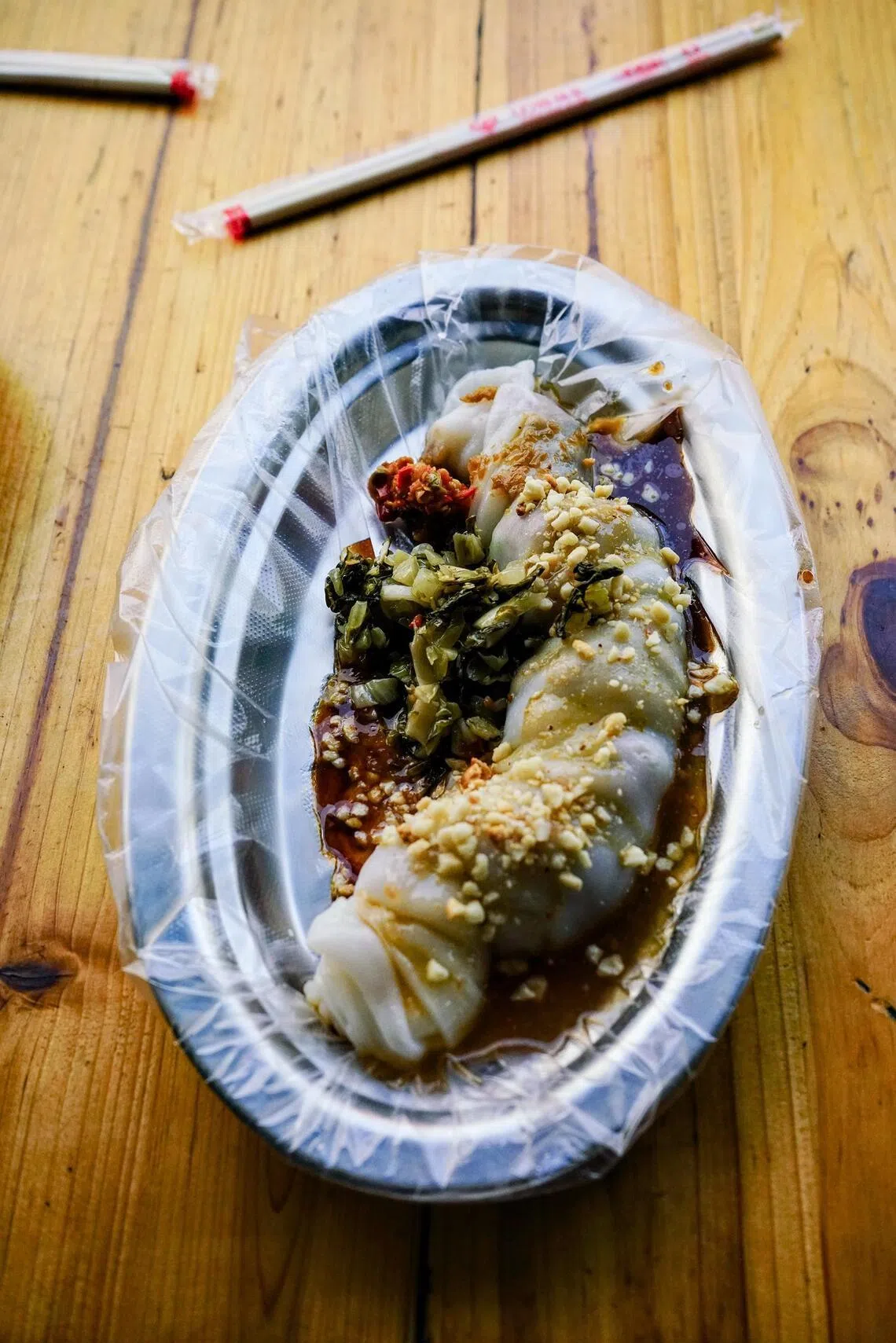
A rice roll from a street vendor.
PHOTO: SIYI CHU
The rice noodles offer a glimpse of that complexity. The first one I taste, from the street stall, is often attributed to ethnic Chinese from Vietnam who resettled here while fleeing conflicts in the late 1970s.
At the next shop, we find noodles freshly pressed from a fermented dough, swimming in bone broth and topped with fried pork trotters and fresh shiso (15 yuan).
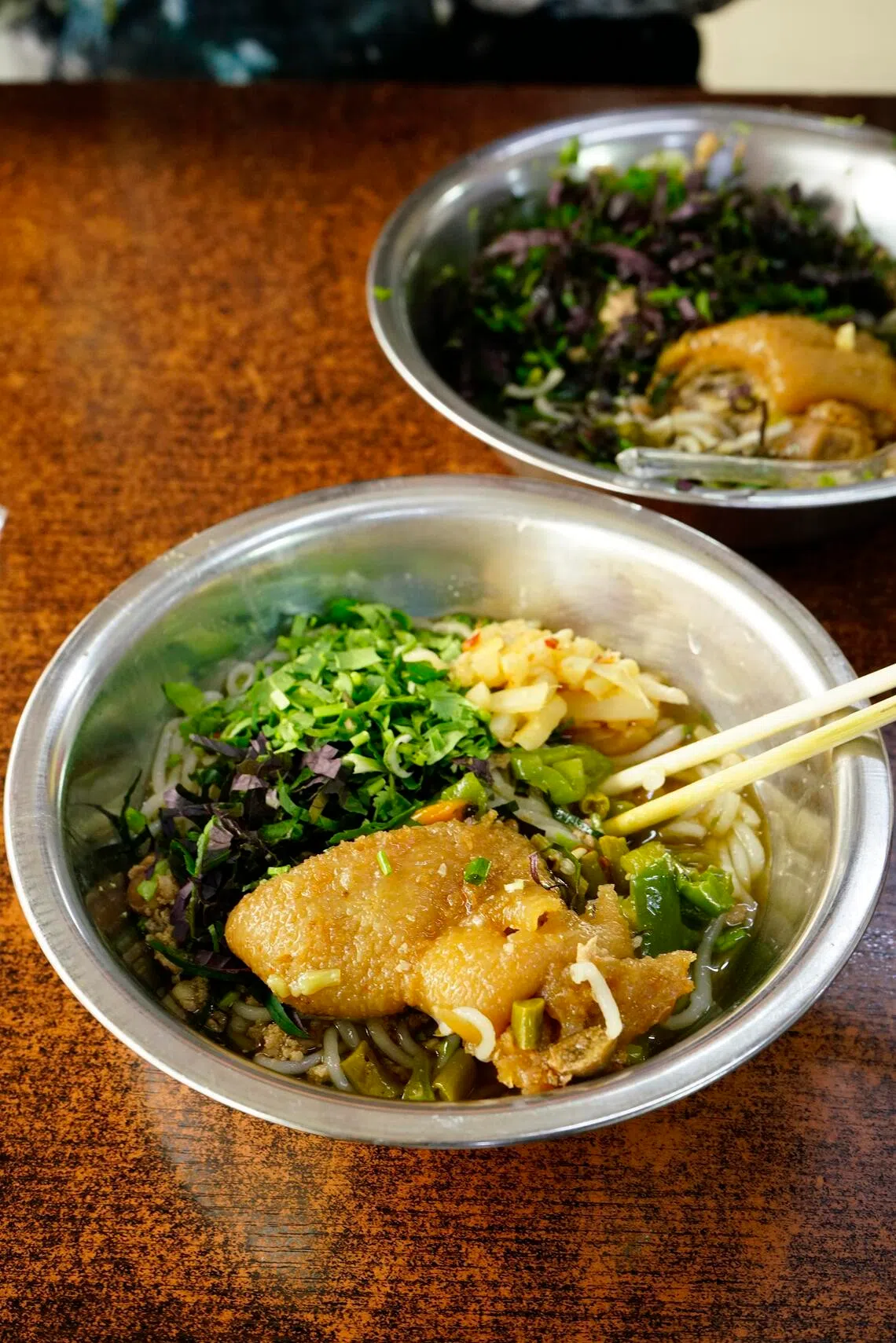
Fermented noodles with pork trotters.
PHOTO: SIYI CHU
Elsewhere, cooks toss fiery woks of Nanning’s speciality – “old friend” rice noodles, with fermented bamboo and beans fried with garlic and made into a broth. According to legend, a teahouse owner created the sour-spicy broth to revive the appetite of an ailing old friend, giving the dish its name.
Between bowls, we enter an old residential compound where tangled electric wires cover its peeling facade. Inside is Wanmingtang, an unassuming massage parlour with the scent of ginger.
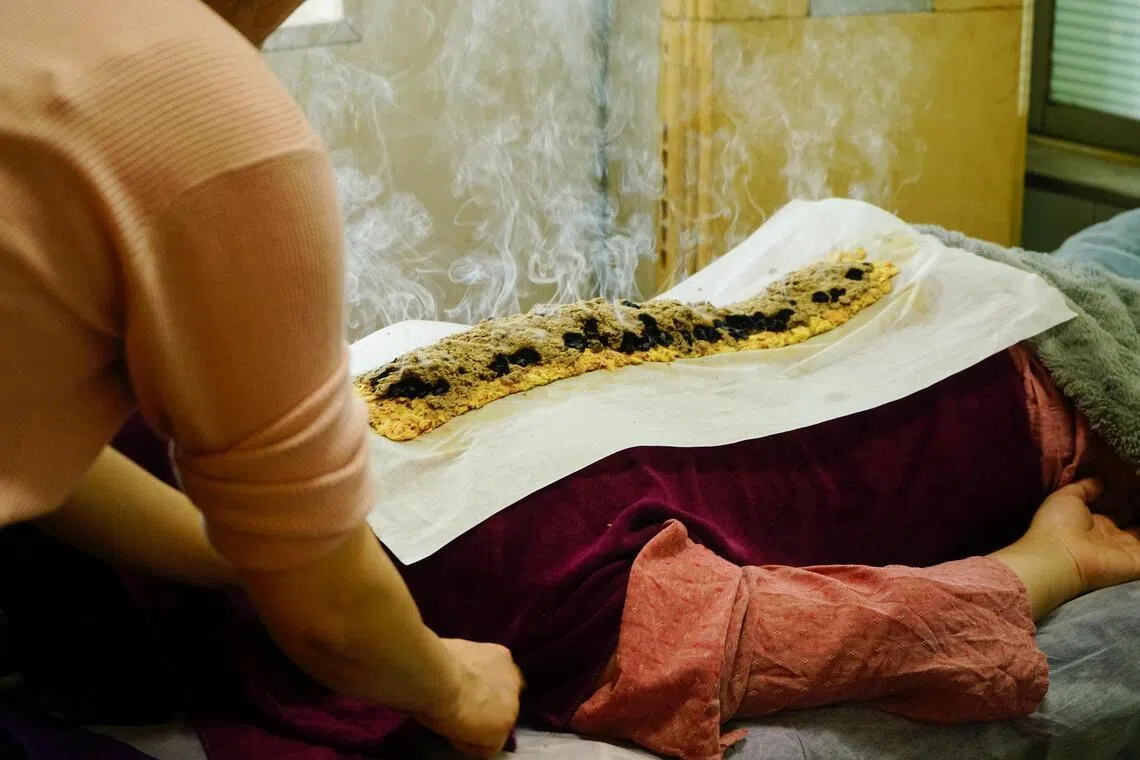
“Dragon spine heat therapy” involves a strip of smouldering ground ginger and mugwort laid on the customer’s back, atop layers of blankets.
PHOTO: SIYI CHU
My therapist Lu Suhua, 49, who goes by Sister Hua, douses my right shoulder with herbal alcohol, then presses my aching muscles with unflinching precision. In tears, I barely register her running explanation of traditional Chinese massage techniques.
But as she lays a strip of smouldering ground ginger and mugwort on my back atop layers of blankets – for the “dragon spine heat therapy” the parlour is known for – my body and mind soften. My 90-minute massage costs 187 yuan, after a discount coupon from consumer app Dianping.
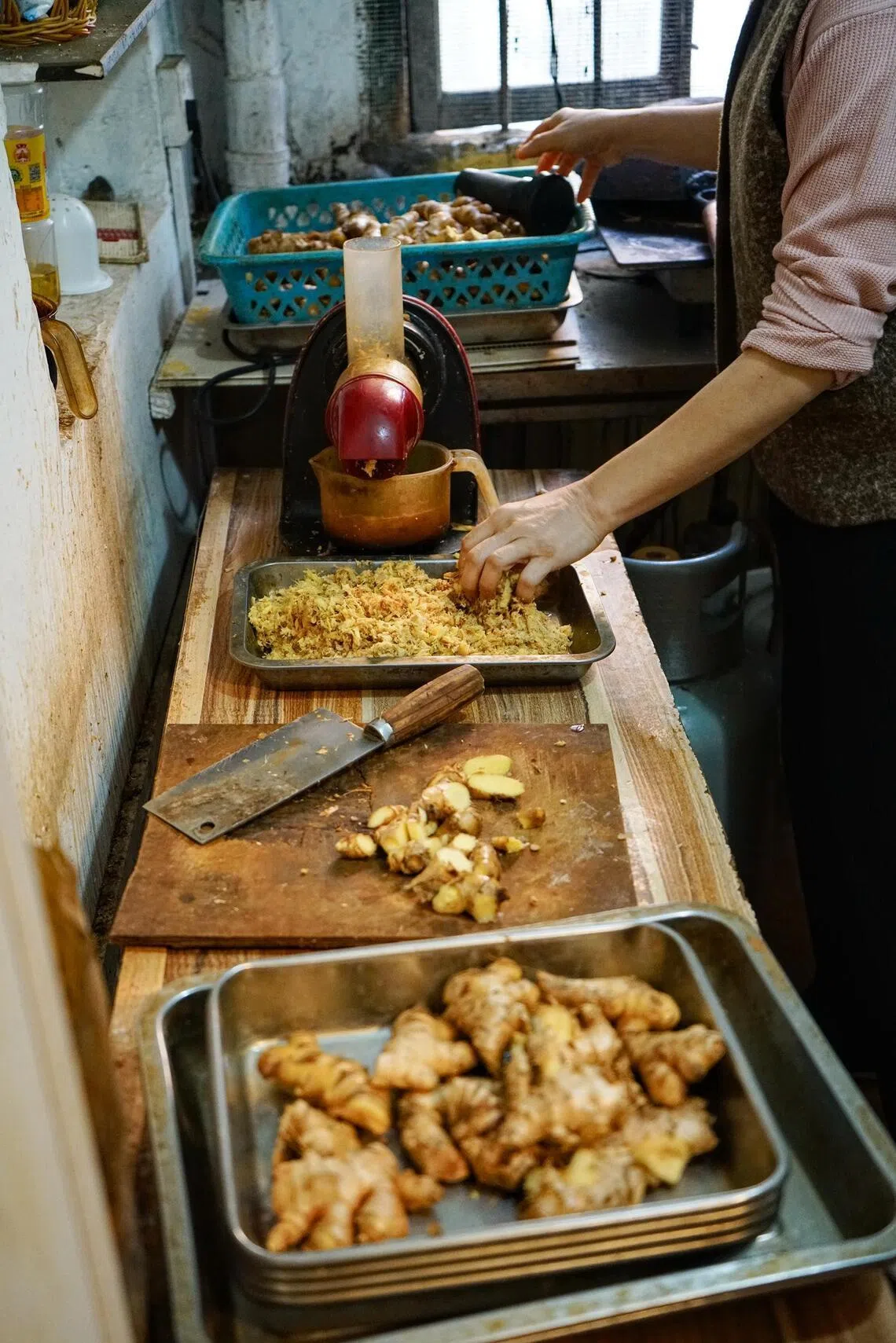
Staff at massage joint Wanmingtang preparing ground ginger for “dragon spine heat therapy”.
PHOTO: SIYI CHU
Hopping on scan-and-go scooters, we head to Guantang Market, which Sister Hua says she visits daily. There, clothes racks advertising bargain prices sit beside vegetable vendors and jade sellers.
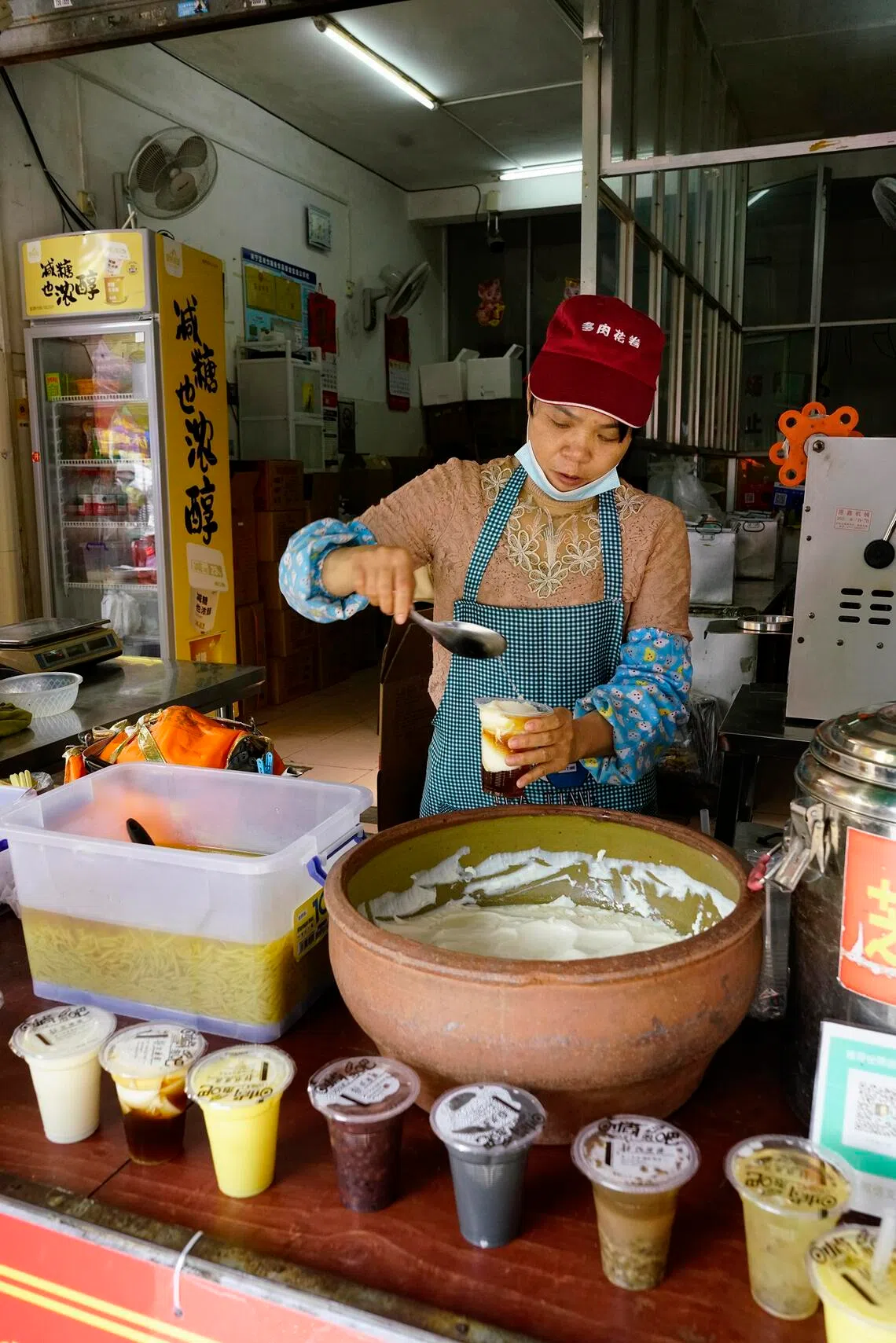
Tofu dessert at Guantang Market.
PHOTO: SIYI CHU
We buy tofu dessert to strike up a conversation with a vendor for noodle recommendations and end up at a small joint near the entrance of the market, where we inhale a satisfying 17-yuan bowl of “old friend” noodles piled with pork offal.
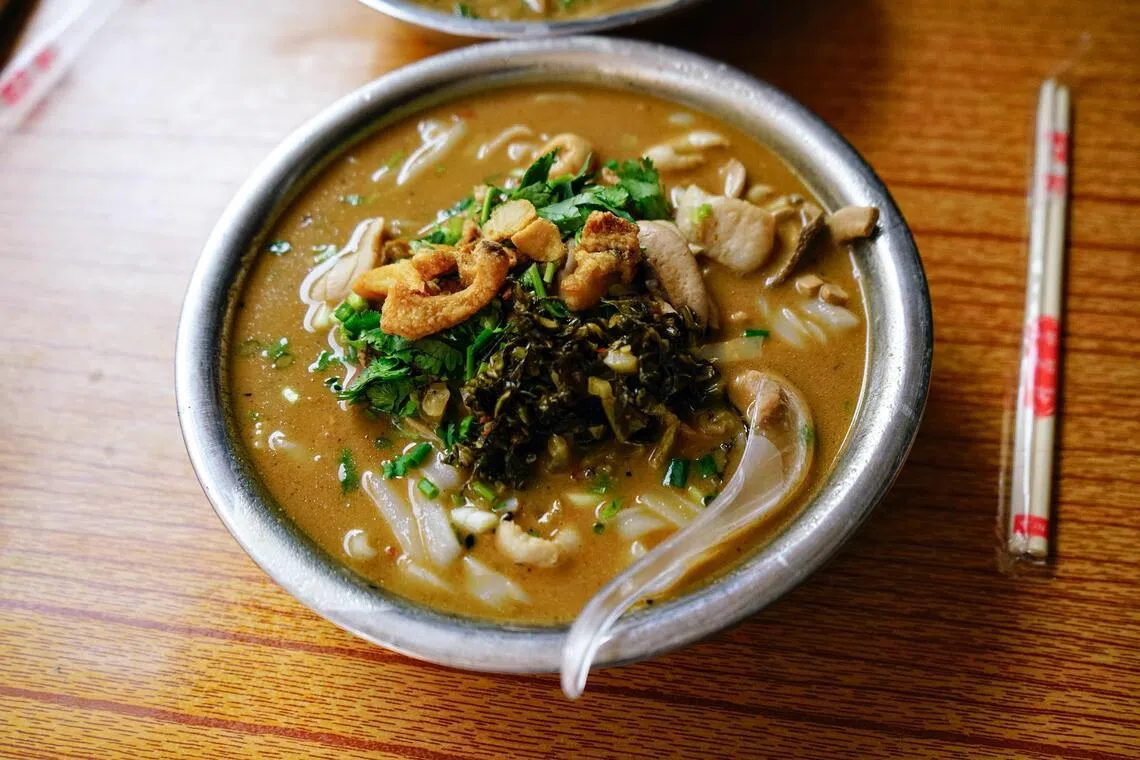
“Old friend” noodles at Guantang Market.
PHOTO: SIYI CHU
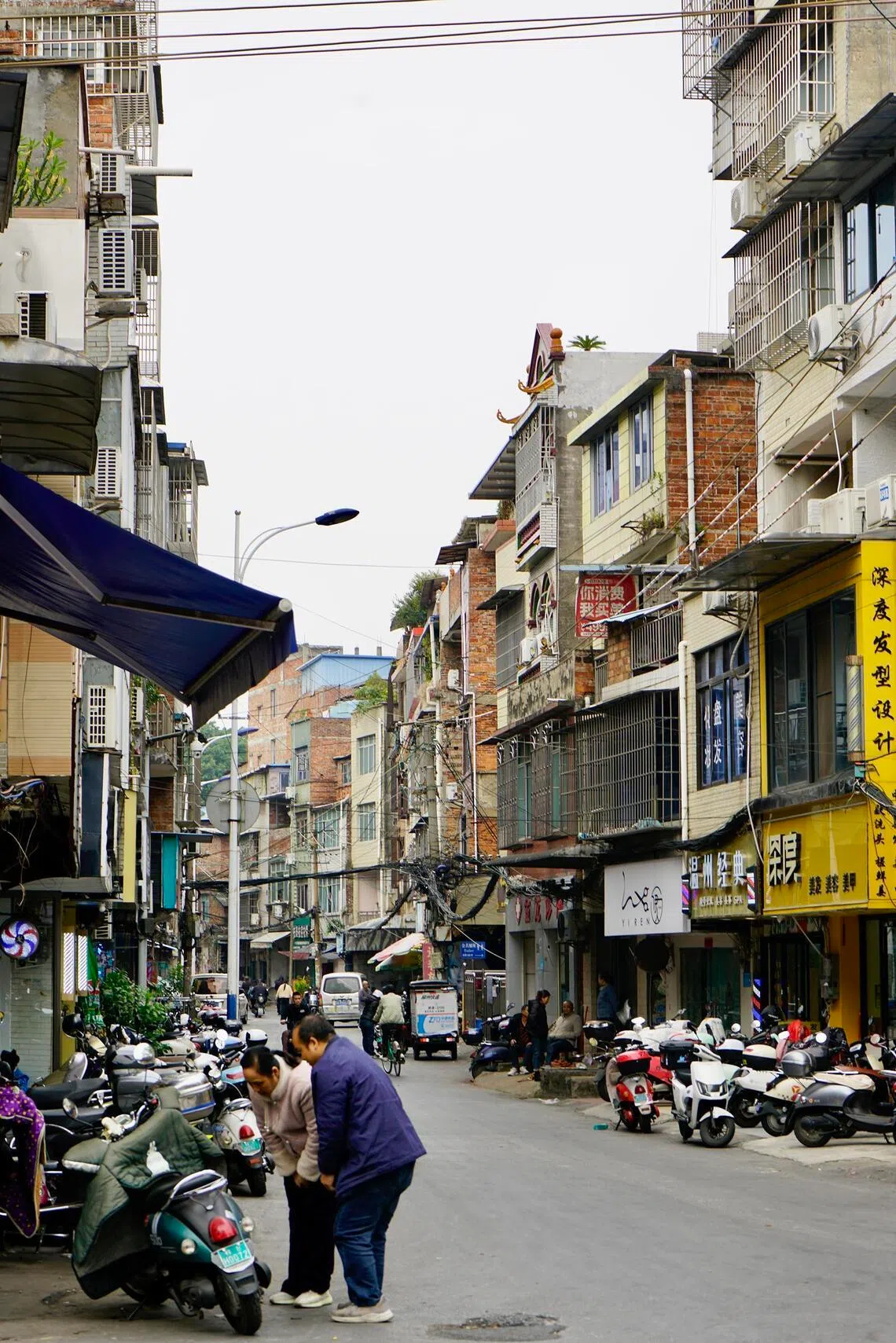
Luosifen – rice noodles in a broth simmered with river snails and infamous for the funk from fermented sour bamboo shoots – can be found at stalls in Liuzhou’s streets.
PHOTO: SIYI CHU
In Liuzhou, a city in Guangxi around an hour away from Nanning by train, we are welcomed to our home-stay by an energetic woman with a short red bob.
“Have you eaten? What do you want to eat?” asks Ms Vivi Zou, 33, who started hosting female tourists in her apartment in May 2023, at the peak of Liuzhou’s virality.
We pay around 300 yuan a night for two private rooms with a shared bathroom, which is well stocked and comes with a squat toilet. The cosy living space has a lived-in warmth that suits Ms Zou’s openness and easy hospitality.
Many guests come to the city for luosifen – rice noodles in a broth simmered with river snails and infamous for the funk from fermented sour bamboo shoots. Toppings include fried tofu skin and peanuts; the snails are typically not served in the soup.
A good bowl should be “sour, spicy, umami-forward, palate-lifting, fragrant and piping hot,” says Liuzhou local Mo Zhihua, a digital media professional in his 40s who has been researching the dish as a passion project for years.
The city’s identity is on display in the Liuzhou Industrial Museum, where entry is free. Gigantic machines line the halls, recalling its stature as one of southern China’s key industrial hubs. A 1970s photo depicting the “full automation of rice noodle production” illustrates how the noodles snake through its history.
The decline of state-owned enterprises in the 1990s threw Liuzhou into an unemployment crisis, like many other former industrial cities in China. Amid the current industrial revival, the rise of luosifen now seems to be a chance to rewrite the city’s identity.
During the early months of the Covid-19 pandemic in 2020, luosifen mukbang videos – of people eating while interacting with viewers – drew tens of millions of viewers. Demand for instant versions of the noodles surged.
In 2023, the first Chinese New Year holiday after pandemic restrictions eased, Liuzhou received 3.7 million visitors – almost its population size. Official 2025 data from the city’s bureau of commerce estimates that Liuzhou’s luosifen industry is worth more than 80 billion yuan, more than a quarter of the city’s overall gross domestic product.
“Some numbers must be inflated,” says Mr Mo, but he believes the hype reflects reality.
Ms Zou says her home, which can host up to four guests, was fully booked every day following its opening in 2023, which gave her the courage to quit her full-time job as an architect.
“I was an introvert, but I opened up a lot with the girls I’ve met,” she says as we sit wrapped in a blanket on her couch, her cat purring on my lap.
Growing up in a nearby county, Ms Zou remembers her father buying her a small bowl of river snails to snack on. Luosifen grew popular in her pre-teen years, and she remembers favourite joints near her secondary school after moving to Liuzhou.
“Here, the luosifen does not stink like the packaged ones tourists are used to,” she says.
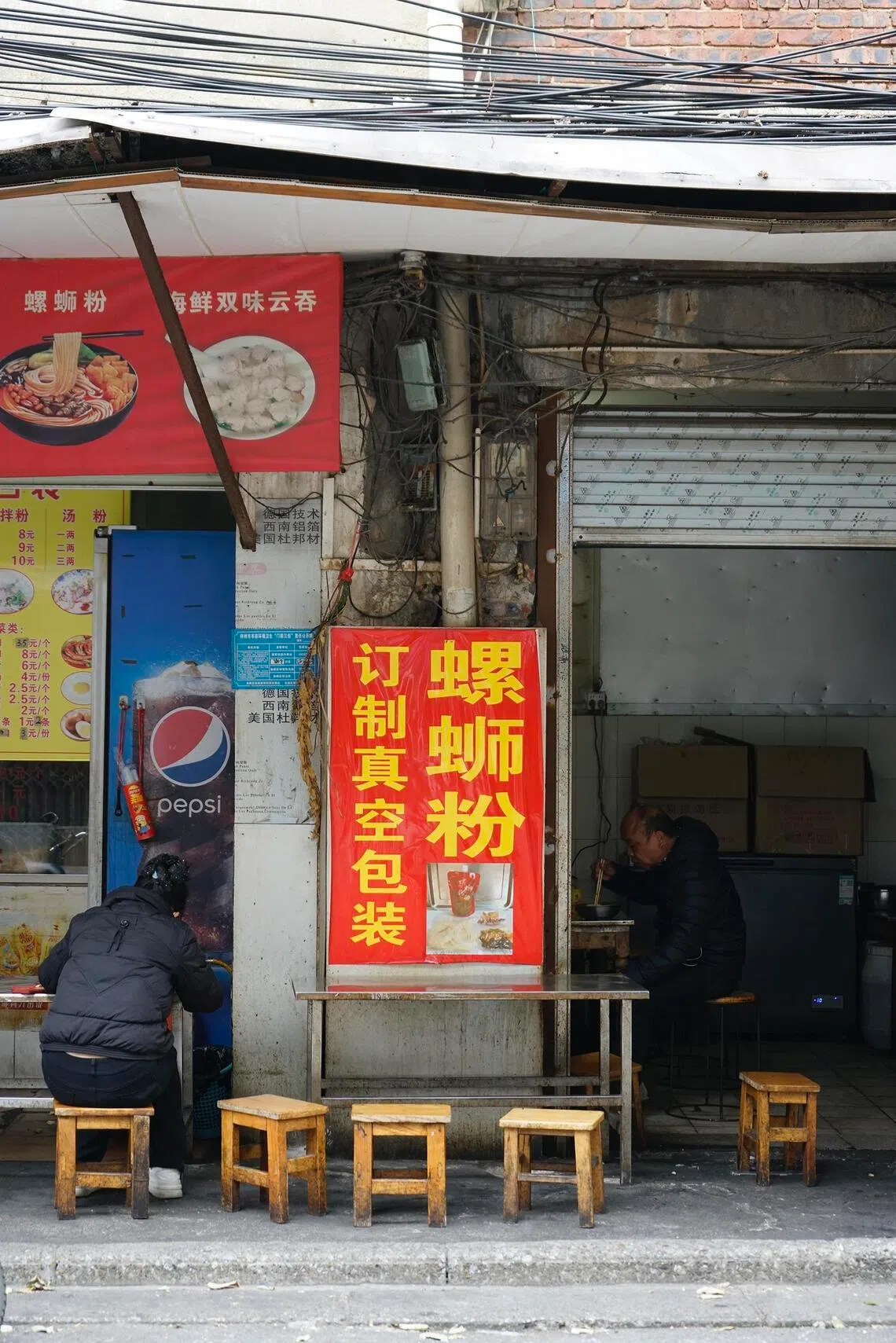
A luosifen joint in Liuzhou, known for the noodles in a broth simmered with river snails and infamous for the funk from fermented sour bamboo shoots.
PHOTO: SIYI CHU
Luosifen is said to have come about in the 1980s from locals combining two popular staples: snails and noodles. According to his research, Mr Mo believes this took place near Gubu, today an Instagrammable area with circular buildings housing numerous hair salons. A bronze statue there memorialises the story.
Debates about the best stalls remain fierce on social media, which Mr Mo sometimes partakes in on his Xiaohongshu account, called Liuzhou Ultimate Food Guide.
He started the project in 2005, when he attended university in Guangzhou. He garnered a following on the Liuzhou local forum by frequently posting his opinions on local and regional developments and reforms.
On summer breaks home, he organised teams of volunteers to survey categories of local food around Liuzhou and record stories from vendors. He posted these on the locally influential forum Red Bean Community, and published a brief history of the dishes in local newspapers.
When he restarted the food guide in 2024, he reposted content across social-media platforms such as Xiaohongshu, Douyin and WeChat.
But Mr Mo says too much hype from social and mainstream media around a handful of eateries has resulted in hyper commercialisation and “too many people chasing short-term gains”. He believes the solution involves cleaning up the market by evaluating shops more rigorously, to prevent a drop in food quality as eateries pursue online buzz.
Ms Zou faces similar pressure on her home-stay, which is decorated with her paintings, Polaroids and handwritten notes from past guests. She says professional operators in the city centre, armed with slick digital marketing, are drawing customers from residential areas like hers.
Drawing a parallel to luosifen, she says she has been let down by famous shops, as well as old favourites that have relocated.
“Maybe it’s the environment and the memory that make the taste for me,” she adds.
She introduces us to other foods that have been overshadowed by luosifen, such as beef and offal hotpot (from 32 yuan a person with Dianping coupons), also boiled in snail soup and paired with a spicy sauce that has a refreshing kick from lime leaves.
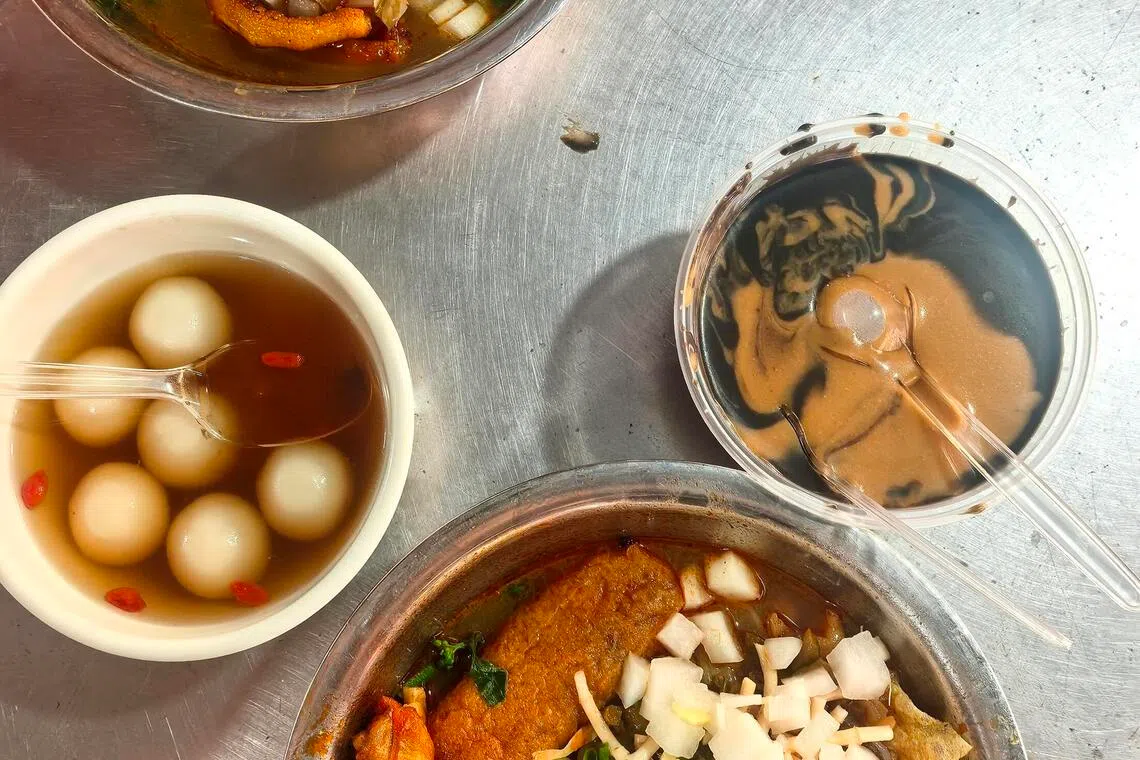
Luosifen in Liuzhou. The rice noodles in a broth are simmered with river snails. Toppings include fried tofu skin and peanuts.
PHOTO: LIU DEJIA
We cannot leave without trying the snail noodles. At the old market in the Gubu neighbourhood, we cast about for local recommendations from stallholders, and sit down at a luosifen joint where the toppings are running out for the day.
Watching the bustle of the market as I tuck into my steaming meal, I enjoy every bite. Not every local might approve, but it is good enough for this tourist.
From Singapore, Scoot flies non-stop to Nanning in four hours. Round-trip flights in July cost around $500, based on checks by The Straits Times. From there, catch a high-speed train to Liuzhou, which takes about an hour and costs between 78 and 94 yuan.
Instead of Google Maps, use Dianping and Xiaohongshu to search for food recommendations. To look up directions and book a ride, use the Amap and DiDi apps.
-
Siyi Chu is a Zhejiang-born, Bangkok-based freelance writer and researcher interested in culture, migration and memory.
-
Now Boarding is a series on destinations that are taking off. For more travel stories, go to str.sg/travel
