
‘It’s time for China and India to really start providing foreign aid’
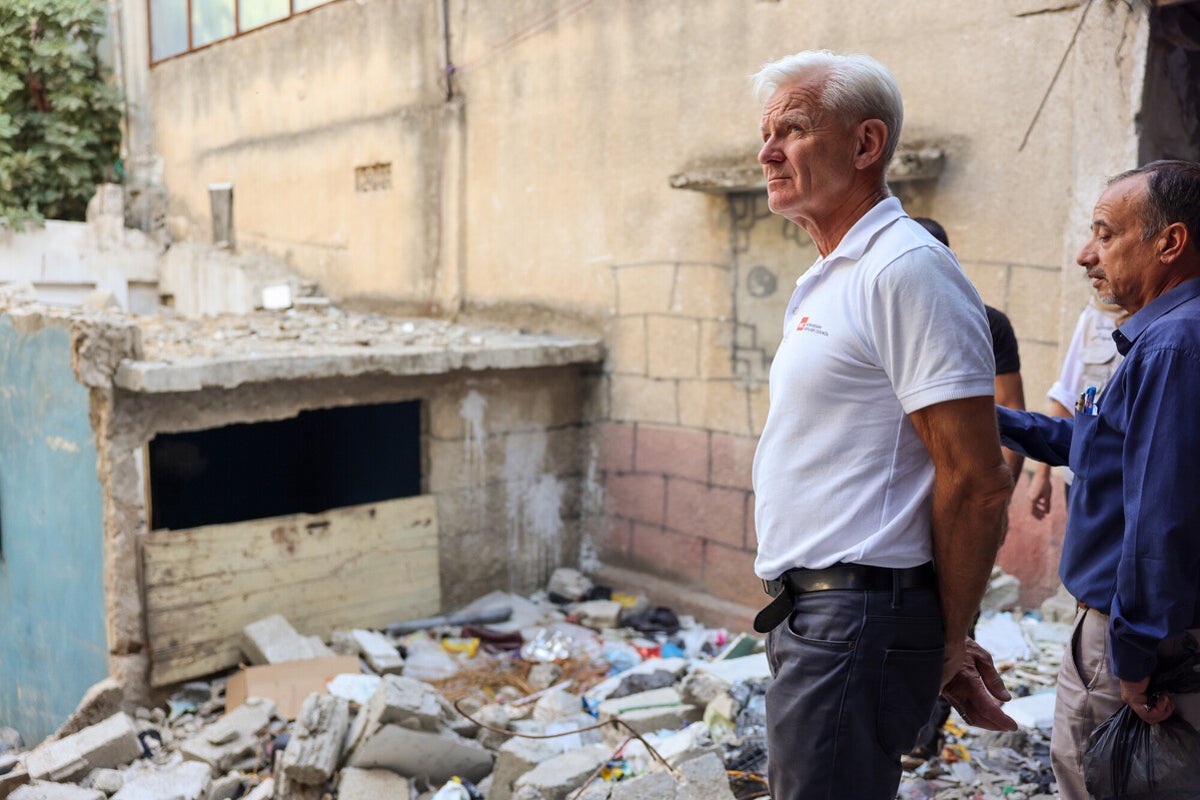
Too much focus is being given to the impact of US aid cuts and not enough to the fact that countries like China and India continue to provide very little foreign aid, the head of the Norwegian Refugee Council (NRC), one of the world’s largest humanitarian groups, has told The Independent.
In a wide-ranging interview held at the NGO’s headquarters in Oslo, Jan Egeland, NRC secretary general, also warned that not enough attention was being given to the climate crisis, and suggested that current plans to boost NATO military spending to five per cent of GDP at the expense of foreign aid is “a major strategic mistake” that countries will live to regret.
Mr Egeland – who formerly served as the UN’s humanitarian aid chief in the 2000s, and as state secretary in the Norwegian Foreign Ministry in the 1990s – said that NRC had been seriously impacted by President Trump’s gutting of US foreign aid programmes, with the NGO’s global headcount shrinking from 15,000 to 14,000 as a result.
“Until last year, the US was our largest donor, followed by the Norwegian government. Then the US funding was frozen overnight,” he said. The months that followed were extremely chaotic, Mr Egeland added, with US government stop and re-start orders often being received several times over for the same programmes.
Despite the US more recently once again signalling support for foreign aid after a year of global upheaval, Mr Egeland said that there remains a “huge question mark” over the level of funding NRC will receive from the US in the future.
Major humanitarian projects, including one providing cash transfers for thousands of victims of the war in Ukraine and another providing free flour to 500 bakeries in Sudan so that they can produced subsidised bread, have now been permanently cut for 2026, after receiving several stop- and re-start orders over the course of 2025.
But while US actions have caused mayhem for NGOs like NRC, Egeland believes there should equally be criticism of industrialised Asian countries that – beyond Japan and South Korea – currently provide minimal foreign aid.
“There has to be a much more aggressive calling out not just the US, but also other countries like China and the nations of Southeast Asia,” he said. “I think we can be far too obsessed with what Trump has been doing over the past few hours, and we can ignore the bigger picture.
“How can it be that India can carry out a moon landing on the dark side of the moon, but not provide aid for our operations in Sudan,” he continued. “Russia has hundreds of billions to wage a senseless war in Ukraine, but no money for our relief efforts,”
Norway, Mr Egeland added, is a country of just 5.5 million people, with no seat on the UN Security Council nor G20 membership, yet it has become the world’s ninth biggest national donor of humanitarian aid, as a result of its continued commitment to provide foreign aid worth one per cent of its Gross National Income (GNI). The country might have made a fortune from oil in recent decades, but other equally wealthy countries are contributing significantly less.
The UN target for foreign assistance is for wealthy countries to provide aid worth 0.7 per cent of GNI. The UK, by contrast, is set to provide only 0.3 per cent of GNI following cuts that were announced last year.
Still often classified as “developing countries” in some UN frameworks, China and India are not formally obligated under agreements such as the 1992 climate convention to provide foreign aid to poorer countries, even though their economies have grown substantially since those classifications were made.
Last year, China made a $16 million (£12m) contribution to humanitarian aid plans coordinated by the UN, while India contributed nothing. Norway and the UK contributed $921m and $1.9bn respectively.
‘We will live to regret aid cuts’
Mr Egeland also warned that the strategy adopted by countries including the UK, Germany and France of slashing foreign aid to significantly boost military spending will not achieve its intended aims of stabilising Europe’s security situation.
“I understand that countries feel threatened by what Russia is doing in Ukraine, but if we forget about what is needed to bring stability to other parts of the world, we will live to regret it,” he said.
The would-be target that Nato countries have agreed with Donald Trump of spending five per cent of GDP on defence was described as both “astronomic” and “unprecedented” by Mr Egeland.
“You have to go back to previous world wars to see spending anything like that,” he said. “We are seeking stability in Europe, but really we are just becoming more introverted and nationalistic.”
Maintaining foreign aid should very much be seen as in the interests of wealthy nations, and not simply selflessness, he continued.
During the European migration crisis of 2015, sparked in part by Syria’s civil war, many Western politicians looked forward to a time when the war would be over, and Syrians could return home, Mr Egeland said. But now that the war is over there has so far been little money pledged effort to help rebuild Syria, and so Syrians then have to remain in Europe.
Equally, Mr Egeland described a recent visit to a refugee camp in Eastern Chad, where Sudanese refugees described their intention to cross into Europe on small boats due the total absence of economic opportunity where they were, and despite the risks that the trip will involve.
“‘We are scraping together enough money to make the journey across to the Mediterranean’, they told me. This was despite the fact that they had followed on social media 20 friends who had attempted to make that the journey the previous year, of whom 19 had drowned,” Mr Egeland said.
“I told them that these deaths were clearly a signal that they should not go,” Mr Egeland continued. “But they told me: ‘We have been waiting for so long here for something to happen, but nothing has happened. Yes, the trip might be dangerous, but there is a glimmer of hope, while here there is nothing.’”
On the subject of the climate crisis, Mr Egeland also called out the hypocrisy of politicians who are continuing to call for climate action in public, while cutting aid for climate programmes overseas.
“In most parts of the world, there is the same positive rhetoric around climate change, but in fact when it comes to the people most impacted by the climate crisis, rather than receiving more money to help them survive, they are in fact receiving less,” he said.
His comments came just before the UK announced that it would cut its climate aid to £6 billion over the next three years – roughly £2bn a year, down from £2.3bn annually under the previous five-year arrangement – in a move that was described as a “huge betrayal”.
Mr Egeland continued: “If we want to avoid uncontrolled migration fueled by conflict and the climate crisis, and if we want to avoid unchecked epidemics coming from displaced people in least developed countries, then we need to provide more support.”
Looking ahead, he warned that expected further cuts means that there was a risk that the world could return to the “dark days of the 1980s” when the world experienced “Biblical famines” that killed many thousands.
“At the moment we are dropping very hungry people to prioritise those on the brink of famine. We are having to drop so many vulnerable communities, and I am very concerned what the consequences of all of this might end up being,” Mr Egeland said.
This article has been produced as part of The Independent’s Rethinking Global Aid project
