
CT-based cancer researcher helped create app while fighting disease
Alessandro Hammond is a cancer researcher and the co-creator of a social media application that helped save his life.
Late year, the 25-year-old was in Beijing, China completing a master’s degree on a Schwarzman Scholarship and he noticed a lump on his body while he was in the shower. Hammond went for an MRI in Beijing and physicians recommended emergency surgery.
“Around November, I noticed a lump on my body that kept growing,” Hammond said. “I ignored it because I wasn’t in any pain. I felt a little bit of discomfort sometimes when I was walking, but I always thought that that was because I was so active. I’d run a lot. I’d swim a lot. Then in January I noticed that it had gotten almost the size of a tennis ball. It was so big and so I got extremely concerned.”
The first thing Hammond remember hearing the doctor say was “‘This is a big problem.’ My Chinese is really good, but my medical Chinese is a whole other story,” Hammond said. “He explained to me that I had a possible case of a solid-state tumor inside my body and that it was largely spreading. I was extremely scared.”
The doctor in China wanted to perform the surgery that day, but Hammond wanted to fly back to Connecticut because he knew it would be a long journey with lots of follow up. Hammond, who was born in Florida and grew up in Texas, lives in New Haven. The Harvard graduate plans on attending Yale University beginning in August, where he will be starting in the MD-PhD Program.
Hammond flew back to Connecticut and was treated at Yale New Haven Hospital. The doctors confirmed the Stage 3 testicular cancer diagnosis with spreading to his lymph nodes and lungs.
“I was just devastated. I was crying. I was very upset,” Hammond said. “It was one of the worst things I could ever have in my life. The doctor said that we were going to go into surgery. I remember being up until 3 a.m. not being able to sleep because they wanted to give me the first available surgery.”
The doctors at Yale New Haven Hospital performed a radical orchiectomy on Hammond on Jan. 19. “I just remember waking up, feeling in a lot of pain and really disoriented. I didn’t know what was next and that was the scariest part because the doctors kept telling me, well, we don’t know what’s next. They said let’s wait to see their tumor markers,” he said.
Months later, Hammond said his tumor markers were returning to normal, and he believed he had beaten the disease. That’s when Hammond began building NxtCure, an AI-powered matching platform to help patients find clinical trials they’d otherwise never know existed.
Hammond became the app’s first user when it initially went live in December. He found a trial at Memorial Sloan Kettering Cancer Center. Through the clinical trial, Hammond learned that he still had an active tumor in his body.
Hammond said the process of the clinical trial was seamless. He was contacted by the trial organizer and, within a couple of days, a phlebotomist came to his New Haven home and drew his blood. He said insurance covered the trial and he paid about $25 total for the process. According to Hammond, the results were available online shortly after, which found that his tumor markers were still soaring.
Following the results, Hammond was told to start chemotherapy immediately with the regimen of Bleomycin, Cisplatin and Etoposide. Hammond said the first day of chemotherapy “was among the hardest” of his life. Hammond said he has completed two of the three chemotherapy cycles and is approaching the finish line.
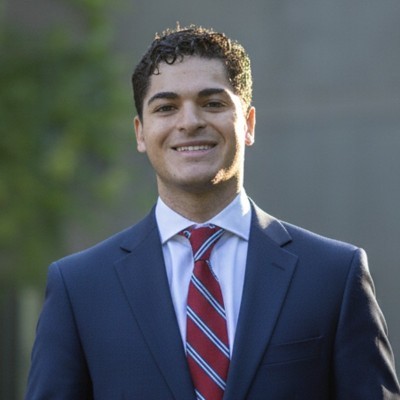
Courtesy of Alessandro Hammond
Harvard graduate Alessandro Hammond will be attending Yale University beginning in August, where he will be starting in the MD-PhD Program. (Courtesy of
Alessandro Hammond)
Motivation for change
Hammond said he grew up in a family with a lot of health issues and a history of cancer.
“I came into college already knowing that I wanted to pursue a career in oncology. The formative years of my education were shaped a lot by doing research and oncology and doing a lot of computational work,” Hammond said. “I realized that the research is fantastic, but it has to be paired with mobile outreach, or it has to be paired with ways to reach communities to share about the new fantastic work that’s being done with the research. So that’s around the same time that I had started building NxtCure. Then this tragedy started in January of this year.”
Hammond graduated from Harvard University last May and, in June, was involved in a breakthrough study that would be able to trace cancer cells through the body. He has researched in oncology and used single-cell multiomics and lineage tracing to understand how cancer evolves in individuals. He studied how socioeconomic factors shape treatment, access and outcomes, including breast, prostate, colon, liver and brain cancers.
“I have always been very intimately connected to cancer,” Hammond said. “I really want to help cancer patients, so I started building NxtCure. Never in my life would I have thought that I would ever have to face cancer.”
Hammond said the app was really made when he went through the journey himself.
“I’m 25 years old. How could I ever have cancer? And how could it be so progressed? And so, these are all the things that I’ve received input for, from all the other cancer patients and I used myself as a model for this app,” he said.
In order to use the app, the user must put in information about themselves and what kind of cancer they have as well as the stage and biomarkers. The app uses information from National Institutes of Health or published medical research and is in line with AMA guidelines.
“My cancer was Stage 3, but if I would have caught it at Stage 1 it would have been only surgery that would have been done,” Hammond said. “There would have been no need for chemotherapy.”
The app discusses screenings and walks people through how to do self-exams. “There’s also many features like health and lifestyle recommendations,” Hammond said. “We flagged several of the carcinogen exposures that do kind of lead to an increased risk for cancer like asbestos, smoking and sedentary lifestyle.”
There is also a feature that reminds people to take their medications and when to start screenings like colonoscopies and individual risks of each type of cancer.
As far as cancer prevention, the user can learn information about screenings and lifestyle management. For those with cancer, there is information about getting into clinical trials.
“One of the things my doctor told me is that I have an elevated risk for additional cancer, one of them being leukemia, other one being stomach cancer and pancreatic,” Hammond said. “Just being very mindful of these additional cancers that can pop up because I was on chemotherapy. Screening is going to be a big thing for me for the next five years or so.”
During the his cancer experience, Hammond realized how important NxtCure’s mission became to him. “Had it not been for this clinical trial, I would have never known that I had active residual cancer that was still spreading,” Hammond said.
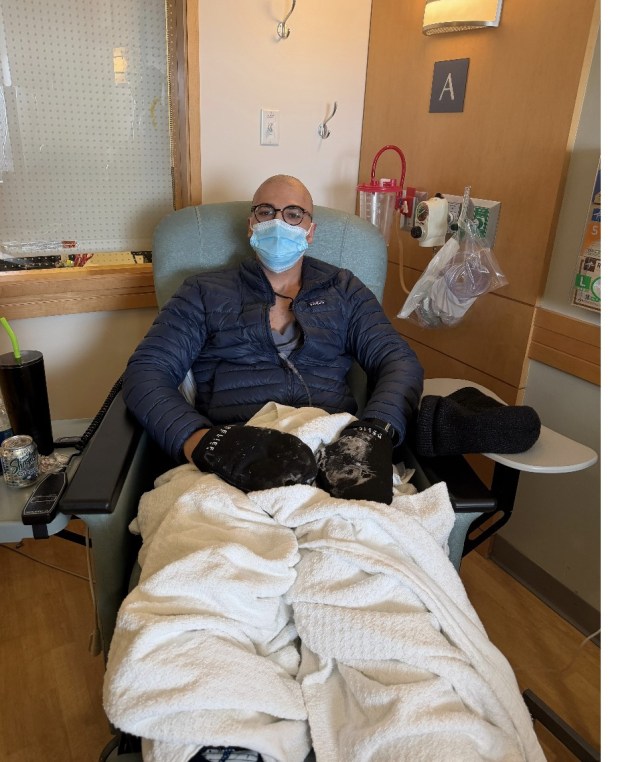
Courtesy of Alessandro Hammond
Alessandro Hammond, a cancer survivor, co-created an app called NxtCure. It is an AI-powered matching platform to help cancer patients find clinical trials. (Courtesy of Alessandro Hammond)
Next steps
During his first week of chemotherapy, Hammond and NxtCure’s co-founder Keanu Clark interviewed with Y Combinator, a three-month program which “helps startups really take off,” according to its website. Y Combinator has backed early versions of DoorDash, AirBnB and OpenAI.
“Y Combinator is harder to get into than Harvard, Yale or Stanford or any other school. It is the apex of Silicon Valley investing. And I actually interviewed for it on the first week of chemotherapy, the first cycle,” Hammond said. “I was actually going to delay my chemotherapy for a week to go to the interview because this is a once in a life opportunity. I’ve dreamt about working with Y Combinator for forever, but my health was more important.
“My co-founder went to San Francisco, and I took the meeting virtually on Zoom. It was a quick interview, but we weren’t sure we won it,” Hammond said. “I got a call from my YC partner on my last day of chemotherapy and he said, ‘Congratulations, you just got YC.’ I started crying. A whole lot of emotions came out. They gave us a $500,000 investment.”
Hammond said that NxtCure was accepted into the spring 2026 “batch.”
Hammond is continuing his chemotherapy, and he is happy to report one of his lung nodules has already disappeared. He will complete his Schwarzman classes virtually and will graduate in late June. Around that time, he will be heading to San Francisco to meet with Y Combinator. He is hoping the app can partner with the National Cancer Institute.
“We have several pilots with a lot of private practice offices to get them to use our clinical trial AI matching platforms. We have a clinical trial AI matching platform that matches patients in a clinical trial with about a 93% accuracy,” Hammond said. “That’s going to be a big-time savings for a lot of clinics because doing it manually takes several hours. The goal here is that a lot of these private practice clinics can actually screen their patients for these clinical trials very early on with our platform.
“We’re going to continue giving more talks as well to kind of spread the word about the app and we are hoping to work with major academic hospitals,” he added. “The patient journey motivates you a lot more when you go through it yourself.”
