
Shillong has a new claim to music fame
Scenes like these have become common across Shillong, where choirs have grown far beyond extracurricular exercise. From convents to private schools to neighbourhood institutions, children are learning harmony, arrangement, stagecraft, and musical discipline from a young age, often under mentors they speak of with uncommon affection.
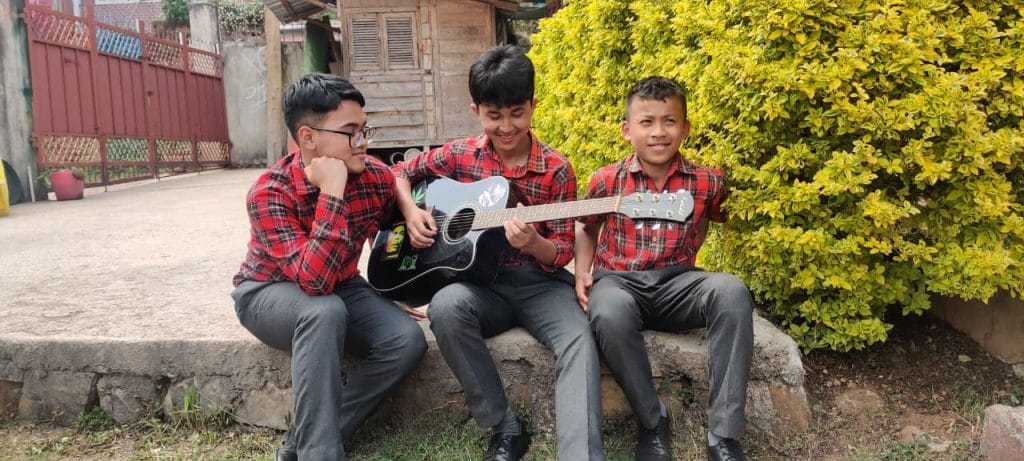
Outside Meghalaya, Shillong is celebrated as India’s “rock capital”, where live music spills through churches, cafes and concert grounds. But another tradition — rooted in school campuses and older Khasi church harmonies — has become just as central to how many in the state imagine themselves. Teachers and officials say this fertile ground has made choir music a defining part of Meghalaya’s cultural identity, visible today in viral school performances and international competitions as a generation of children begin to treat music as a serious career.
Meghalaya’s insurgent decades, particularly from the 1980s into the early 2000s, once shaped how the state was viewed from outside. Many now speak of music as part of a remaking of that image.
I want people to know the music in Meghalaya. I want to show a person from India can become successful through dedication to music
-Mia Dkhar, a member of KC Lights choir
The choral traditions in Khasi society long predate the present moment. Born of church hymnody introduced by Welsh missionaries and reshaped over generations through Khasi sensibilities, school choirs have long been integral to Meghalaya’s musical character. But the watershed moment came in 2001, when the late Neil Nongkynrih founded the Shillong Chamber Choir. It put Khasi choral music on the national and international stage and fired up the ambitions of young singers across the state.
In schools, that ambition has become a movement, backed by state support.
“What exists here is a musical base unlike anywhere else,” said Dr Vijay Kumar D, Commissioner and Secretary of the Meghalaya government overseeing tourism, finance, and other departments. “The role of the state has been to build on that — through choir competitions, grants, festivals and grassroots support — and let this energy grow.”
Also Read: How Shillong Chamber Choir went from shutdown streets to sold-out shows
At St Mary’s, music as friendship and ambition
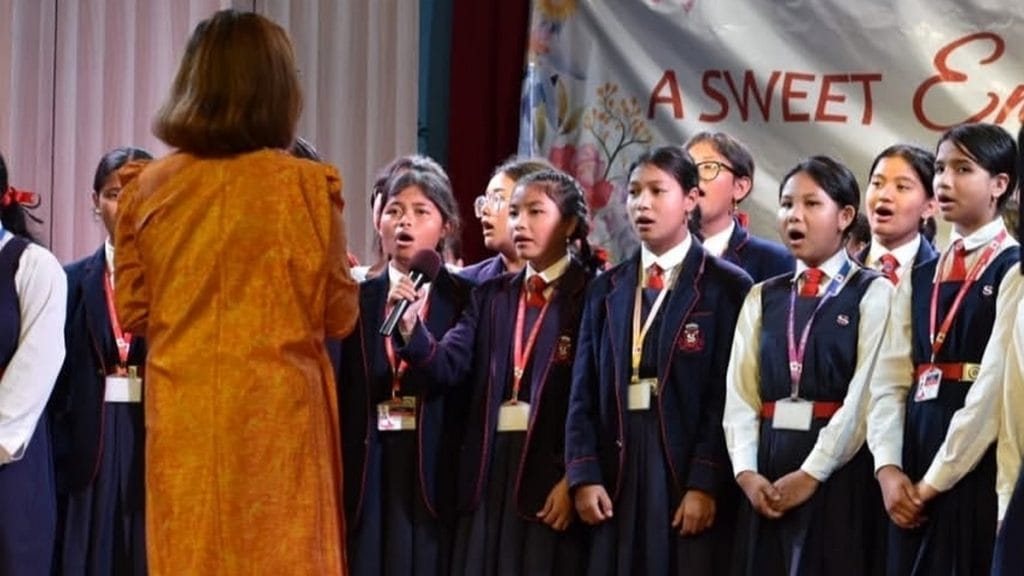
If this larger cultural movement has a young face, it may well be that of Class 10 student Phidashisha L Mawlong, who moves easily between choir discipline and teenage exuberance. She’s seen the Instagram Reel that made St Mary’s choir famous beyond Meghalaya, and is slightly amazed by the attention.
“I’m really happy people know us now,” she smiled. “And I’m so happy it was our school.”
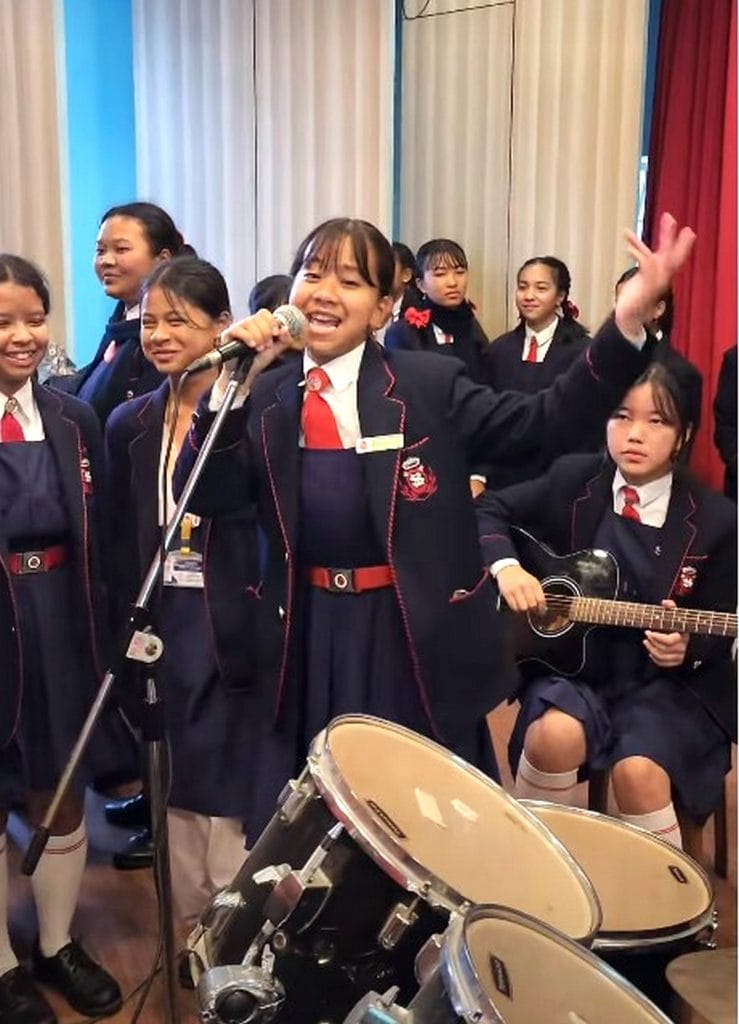
But what makes St Mary’s compelling is not social media success. It is the atmosphere in which that music is made.
The choir, made up of 30 to 40 girls, operates less like a hierarchical school ensemble than a close artistic community. Students move fluidly between vocals and instruments, cheer one another on, and speak of rehearsal as something closer to belonging than obligation. In conversation after conversation, they return to friendship as much as they do to music.
Much of that atmosphere flows from Risaka Pyrbot’s presence. Barely a year into leading the choir, she has become both conductor and catalyst, pushing the ensemble musically while giving its long-standing culture fresh confidence — and, through the now-famous Reel she uploaded, unexpected visibility.
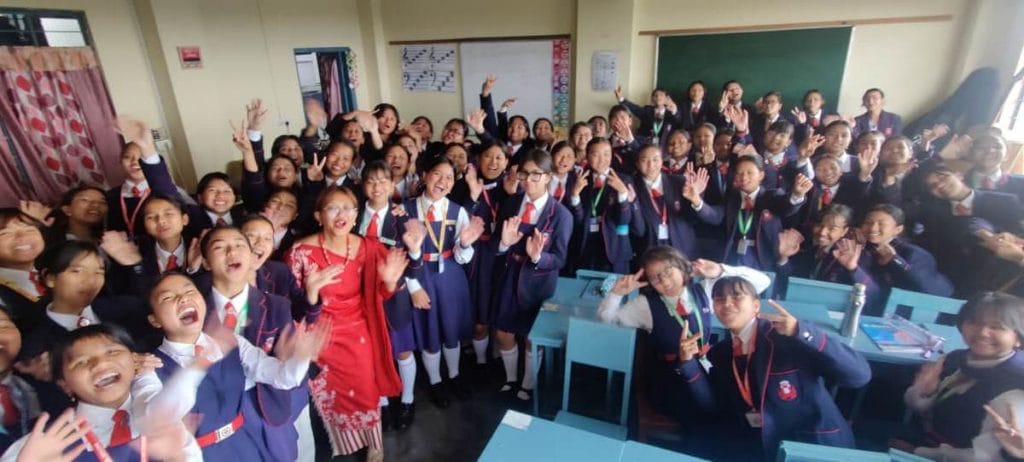
A sense of collective pride runs through how Phidashisha describes the choir’s success. Even when speaking of her own aspirations, she returns repeatedly to “all of us” — her classmates, fellow singers, and friends.
“It’s not just my hard work,” she said. “It’s everyone’s collective hard work.”
Phidashisha lights up when speaking of American singer Olivia Dean, whose songs she calls deeply relatable. At one point she sings a few lines from It’s So Easy and winks at the camera. Performance inhabits these students naturally.
Even when I was on the verge of giving up, [my mother] told me, no — you have to pursue music
-Phidashisha Mawlong, member of St Mary’s choir
Her work in the choir has awakened big dreams in her. She says she wants to study abroad and pursue music seriously, tracing that certainty to the moment she realised singing was more than talent. There were moments when she wanted to quit. Her mother refused to let her.
“Even when I was on the verge of giving up, she told me, no — you have to pursue music.”
Several students described similar parental encouragement, suggesting something larger is changing around them: music is being taken seriously not only by children, but increasingly at home. Students now talk about music careers the way their peers elsewhere talk about engineering or medicine.
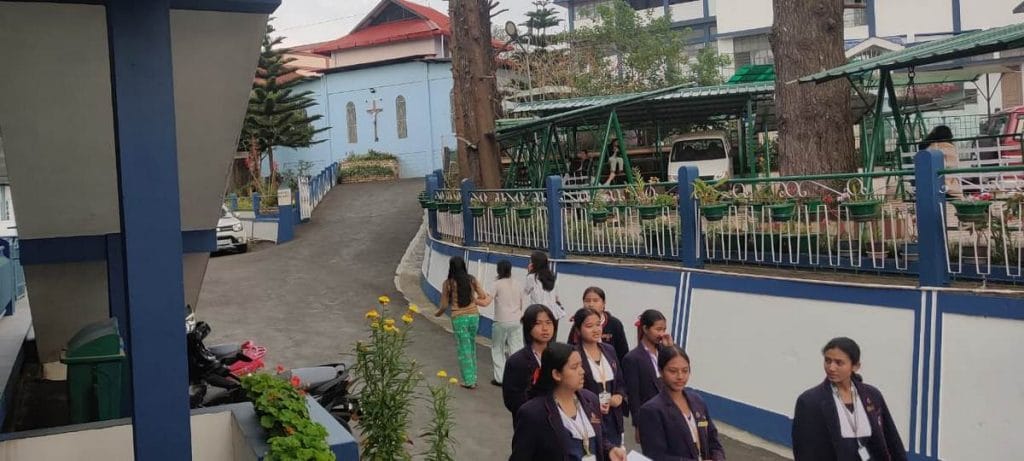
At KC Lights, harmony is hard work
If St Mary’s reveals choir as camaraderie and aspiration, KC Lights reveals its rigour.
On a cloudy Thursday morning, the students, who are in Classes 8 to 12, practice and record The World Will Be A Better Place at an almost improvised recording setup at a weathered little house uphill functioning as a studio, rehearsal room, and dream factory.
Some sit cross-legged on the grass outside, casually singing Lori Lieberman’s Killing Me Softly, in effortless harmony. They talk about their favourite artists in between breaks: Lewis Capaldi, Frank Ocean, Ed Sheeran, Billie Eilish.
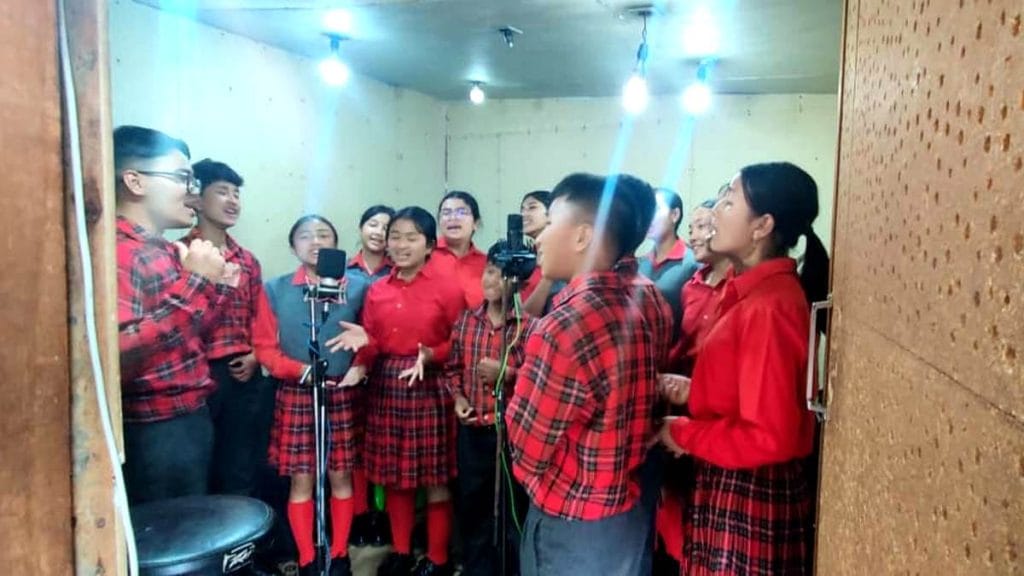
Brian Wallang, principal of the school and choir director, is constantly in motion — adjusting phrasing, directing entries, discussing travel plans, worrying over funding, and strategising for the next competition.
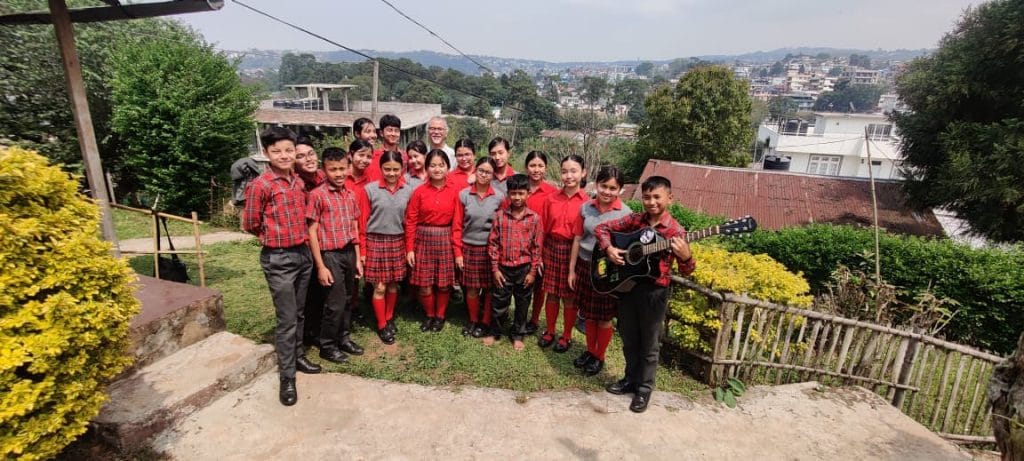
KC Lights began almost accidentally in 2013, after a school musical left students wanting more. Wallang recalls children telling him they were “really bored” once the production ended and asking what came next. His answer was simple: form a choir. What began with singers and dancers gathering to rehearse after school gradually evolved into one of India’s most decorated children’s choirs.
To compete with 25 voices against 120 and still come back with gold—that says something
-Brian Wallang, director of KC Lights
At the recording, much of the room’s energy gathers around 15-year-old Mia Dkhar, whose ambitions feel at once startlingly expansive and matter-of-fact. She wants to become a “one-woman show”. By that, she means everything at once: producer, composer, vocalist, songwriter, DJ.
“When I see someone performing and the crowd looks so happy, I think: what if I can make a crowd jump to my music?” she said.
She wants to study audio engineering, pursue DJing, and release her own original music. She has already written around 40 songs.
Music, she says, is not extracurricular to her life but how she processes emotion: “Whenever I feel sad or doubt anything, I go to the piano and write songs.”
There is an emotional seriousness to these school choirs, beneath all the youthful energy. And also a higher purpose.
Mia’s ambitions do not stop at personal success. She repeatedly returns to the idea of carrying music from Meghalaya outward.
“I want people to know the music in Meghalaya,” she said. “I want to show a person from India can become successful through dedication to music.”
Many of her songs are in English, some in Khasi. She says English sometimes gives her a greater expressive range.
Mia naturally speaks of artistic futures that would sound improbable in many Indian school settings. She does not speak of music as a dream deferred until practical life is sorted out. It is already the centre.

She spent a year studying music at the Shillong Chamber Choir’s school and still marvels at how effortlessly its singers hold harmony.
“I really wish our choir could do that too,” she said, before correcting herself. “But with time and practice, we will reach that level for sure.”
It is less envy than aspiration.
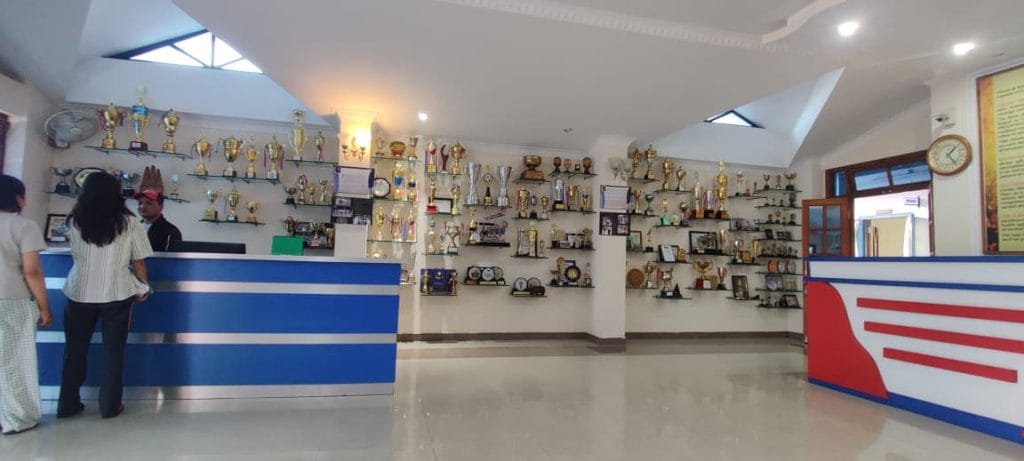
That sense of outward movement runs through KC Lights itself. The choir has won seven medals at international competitions, including in Malaysia in 2023 and Indonesia in 2020. The group is especially proud of its Silver Diploma X at the Asia Pacific Choir Games in Colombo in 2017. KC Lights is now preparing for Thailand in August, where it will represent India at the International Choral Festival for the second time.
Wallang speaks with both pride and frustration about competing against much larger state-backed choirs while often scraping together resources for his own students. Yet he returns repeatedly to the extraordinary fact that 25 voices from Shillong can hold their own against choirs four times their size.
He recalls performing a Khasi song in Thailand and later hearing a Malaysian choir adopt it. For him, that was proof local music can travel.
“What a fantastic thing — a Malaysian choir singing Khasi songs. That’s what we are here for, to spread our music to the world and also learn from them. So, now we are learning Thai songs,” Wallang said.
The mentors behind the music
Behind every voice in a choir is a teacher who made the harmony come to life.
Risaka Pyrbot and Brian Wallang belong to different generations and inhabit very different worlds. She’s 28, a young choir director barely a year at St Mary’s while also teaching music at a college in Dimapur. He’s 61, a veteran conductor who has spent years building KC Lights. Yet both are animated by the same conviction: that music can expand the horizons available to children.
They function as far more than instructors. They are mentors, organisers, talent scouts and, crucially, custodians of continuity. School choirs renew themselves constantly as older students leave and younger singers take their place; without a firm hand willing to keep rebuilding, the culture frays.
What also distinguishes these choirs is the unusual way in which students speak of their conductors. They describe teachers they can approach with private anxieties as easily as wrong notes — part disciplinarian, part guide, part confidant. In environments built around performance, there is remarkably little sense of rivalry or hierarchy. Instead, there is camaraderie, and among many students, a palpable desire to give their mentors their very best in return.
They deserve to go places. National first, maybe international
-Risaka Pyrbot, St Mary’s choir teacher
For Pyrbot, mentorship often begins with making students imagine bigger futures. It was she who casually filmed St Mary’s rehearsals and uploaded the reel that took off, though for her, the moment was less about social media breakthrough than about validation for the music itself. If parents recognise talent, they should nurture it, according to her.
“They deserve to go places,” she said of her students. “National first, maybe international.”
Her own story partly explains that instinct. Coming from a family without musicians, she understands what it means for talent to be encouraged rather than taken for granted. It is why she speaks often of parents. She says Phidashisha’s mother, who pushed her daughter not to abandon music, is the kind of example more parents should follow.
While the ever-smiling Pyrbot embodies mentorship as youthful propulsion, Wallang brings a well-weathered pragmatism. Before music became his life’s work, he spent nine months in Mumbai as a young flight attendant. Then his mother called him home. In Meghalaya’s matrilineal society, the summons was enough. He returned. His brother Keith was already a musician; music drew him in, then children did.

He describes the annual challenge of retraining voices as students graduate as part of his vocation.
“It is a challenge,” he said. “But I love challenges.”
That attitude runs through his larger philosophy of what the choir can do. International competitions, he argues, expose children to worlds beyond their own.
“This is real education,” he said. “You’re travelling to so many places, you are learning geography, culture, language, everything.”
That idealism, however, sits alongside constant logistical struggle. Funding remains Wallang’s recurring frustration. He had reached out to the state government for monetary support in 2023 for the choir’s international travel but the funds have yet to come through.
“They said they would help us, so we are waiting. We are hoping it will come this year,” he said. For now, much of the funding comes from Wallang’s own pocket.
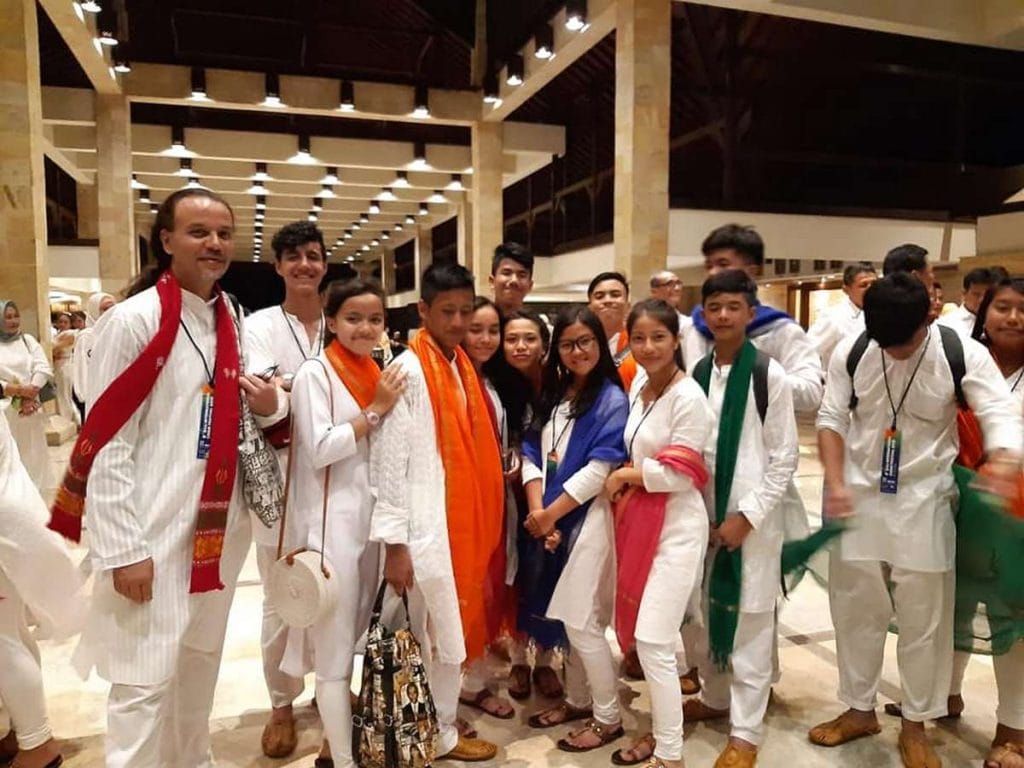
KC Lights often travel with barely 25 singers to compete against choirs from China, South Korea or South Africa that sometimes arrive a hundred strong, often with institutional backing.
“To compete with 25 voices against 120 and still come back with gold — that says something,” he smiled.
For Wallang, a children’s choir representing India abroad should not have to struggle this hard for support. Yet even while speaking of funding shortfalls, he talks about striving for the next big prize. This year, he says, the aim is not just another gold medal.
“We want to come back as grand champions,” he grinned.
A state backing the sound
If these school choirs are sustained by individual mentors, they are also emerging within a state that has increasingly tried to treat culture as policy.
Dr Vijay Kumar argues Meghalaya has consciously built on a musical culture that has already existed through an ecosystem of support, from annual choir competitions and grants to grassroots busking programmes and cafe gigs funded under government initiatives. It is part of a larger attempt, he says, to support not just headline events but smaller artists and community music too.
“We have to activate the energy in the system,” he said.
That philosophy, officials argue, has helped turn Shillong into a live-music capital whose ambitions now keep time with those of larger metros. Kumar points to performances by Ed Sheeran in February 2025 and the recently cancelled Scorpions concert.
“These big artists are performing in Bengaluru, Mumbai, and then Shillong. We have made the city a concert capital on par with other major metros,” he said.
What makes the model unusual is that public support extends even to smaller performers. In tourist spaces, he says, the state has funded musicians for local gigs in ways few governments do; artists get Rs 25,000 for local performances. Choirs, too, are part of that thinking, whether through tourism-led competitions or grant mechanisms that, Kumar insists, are meant to be accessible even to school ensembles seeking exposure.
He also offered a counter to Brian Wallang’s concerns over delayed support. Kumar acknowledges that systems can sometimes move slowly, but that efforts are being made to make processes more efficient.
“The government exists to help everyone who is capable,” he said. “I will call Brian myself to see to this issue.”
Also Read: Meet the 1st all-girl Arunachal band. Gilithigreams is singing for Northeast
Power singing
Back at St Mary’s, Class 12 student Batti Meki Khongsngi dreams of a diplomacy career but refuses to imagine music as a secondary hobby.
“In India, people often think other careers give you a better future,” she said. “But if you have the passion for music, you can continue it.”
For Batti, the viral success of her school choir mattered because it widened the horizon of what young musicians in Shillong might imagine for themselves. “As they say, where there is a will, there is a way.”
Brian Wallang has another reason that keeps him going.
“When we sing together, it brings people closer. That is the power of choir music.”
(Edited by Asavari Singh)
