
Xi summit mean for the rest of us?
It’s worth paying close attention when the leaders of the two most powerful countries on the planet meet next week.
Because what China’s Xi Jinping and America’s Donald Trump decide in Beijing could have major implications for us all.
It comes at a time when speculation swirls about which country – China or the United States – will win the race to dominate this century’s key technologies, like artificial intelligence, thereby cementing global primacy.
Hawks in Beijing see the US as an ailing hegemon, beset by runaway national debt, fractured alliances, debilitating political polarisation and walking wounded from yet another Middle Eastern military misadventure.
As Mr Xi once pointedly said, “the East is rising and the West is declining”.
There are hawks in Washington too, of course, and many of them fret about the US being “leapfrogged” by China.
Other DC policymakers, though, focus on a different picture – one showing American military tech supremacy on the battlefield, in Venezuela and Iran, China’s ongoing dependence on American-designed advanced chips and China’s own internal economic, political and demographic strain.
It’s well known that after decades of China’s strict enforcement of the One-Child Policy, its population is in sharp decline and the double-digit growth that powered China’s breakneck economic rise is over.
China, it is said, is getting old before it gets rich.
Sweeping purges inside the Communist Party, meanwhile, including of senior military personnel, point to political turmoil at the top.
But as China and the US appear to vie for the top superpower spot, economically intertwined yet trying to exploit each other’s weaknesses, other countries, like Ireland, watch from the sidelines – wondering where the chips will fall.
This is, after all, a time of historic global change – alliances are shifting, new economic groupings are forming and the old rules, so long fundamental to the success of smaller powers, are falling away.
We are in “might makes right” territory now.
A G2 carve-up?
Some Europeans are worried that Beijing and Washington could decide to strike a deal on trade that cuts them – and everyone else – out.
As the adage goes, if you’re not at the table, you’re on the menu.
“I think all third countries need to watch the summit and its outcomes very, very carefully,” Wendy Cutler, former US trade negotiator told the Geoeconomic Competition podcast this week.
Ahead of this summit, the US side floated the idea of a so-called ‘Board of Trade’, a mechanism to streamline trade in non-critical areas, thereby bolstering the notion of a ‘G2’ grouping comprising just China and the US.
If China and the US agree on significant US export targets to China, in areas like medical technology, airplanes or chemicals, they could displace exports from other countries, including Europe, Ms Cutler said.
“On the flip side, if the US continues to restrict Chinese imports further, then we could see increased Chinese exports to Europe and third countries, who are already suffering from huge inflows of Chinese imports due to overcapacity in China, and its failure to really boost domestic demand,” added Ms Cutler, now vice president of the Asia Society Policy Institute in Washington DC.
If the world’s biggest economies buy into the idea of managing trade between them, what does that mean for other members of the World Trade Organisation?
“That sends a message to Geneva that, you know what, in this new world, the rules of the WTO are becoming more and more obsolete,” she said.
China makes no secret of its strategy to pursue “self-reliance” – a state-driven effort to reduce dependency on the rest of the world for things it needs like high-end computer chips, food and water and, of course, energy.
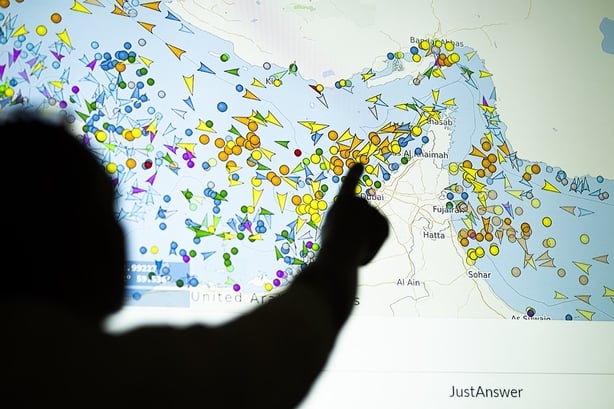
The bottleneck in the Strait of Hormuz is the latest accelerator of a long-standing plan.
But to reach self-sufficiency, China still needs the rest of the world to carry on buying Chinese-made goods for now.
Hence Beijing’s ire whenever trading partners look to ape China’s approach and reduce their own dependency on China, as RTÉ News reported here last week.
“The clunky phrase they use for it is dual circulation,” said Jonathan Czin, former director for China at the National Security Council, now with the Brookings Institution think tank in Washington DC.
“They want the rest of the world to be dependent on China and for China not to be dependent on the rest of the world,” he said.
That’s why the main strategic objective for China next week will be “to get time and space from the administration and continue to fortify themselves,” he said.
Because while self-reliance is the goal, it’s still some way off.
In the meantime, “China cannot live without Europe, the Global South or really the global system,” said Ms Mei, “because the Chinese economy remains an export-led model, which largely still relies on big consumer markets outside of China – and United States remains one of those,” she added.
This knowledge gives the US side confidence as President Trump goes to China, despite the decidedly messy backdrop of the Iran war.
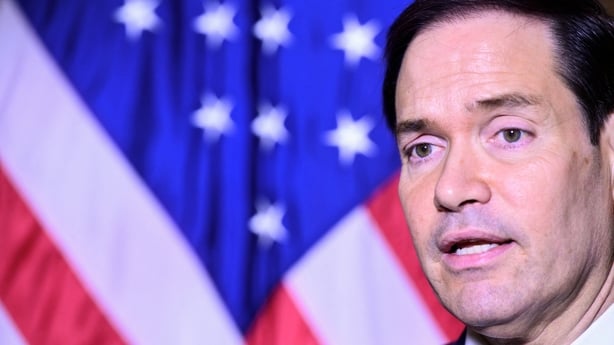
Listen to Marco Rubio, the Secretary of State, who said on Tuesday that “China is an export-driven economy”.
“That means they depend on other countries to buy from them,” he went on.
“Well, you can’t buy from them if you can’t ship it there, and you can’t buy from them if your economy is being destroyed by what Iran is doing… it is in China’s interest that Iran stop closing the Strait – it’s harming China as well”.
And there he has a point, because overcapacity is a major problem for China.
Production far outpaces domestic demand, squeezing corporate profits and driving up local government debt at home, while flooding foreign markets with low-cost subsided goods, leading then to trade friction.
But China is confident that other countries will struggle to wean themselves off Chinese goods, keeping trading relations firmly tilted in Beijing’s direction for some time to come.
“I asked a well-connected Chinese academic if they were concerned about European pushback,” Mr Czin told RTÉ News, “and his verbatim response was: what are they going to do about it?”
The power of diplomacy
Meanwhile, China is also flexing its diplomatic muscle.
It’s well noted in Beijing that the US has been urging China to use its leverage over Tehran, to help end a war that the United States started.
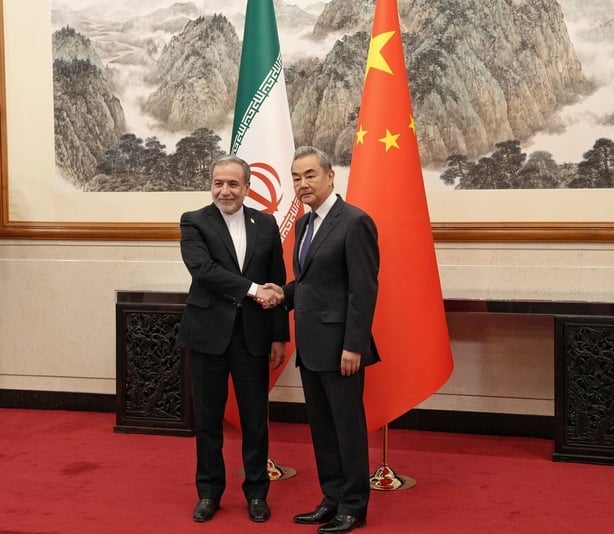
And indeed, this week, the Iranian Foreign Minister Abbas Araghchi travelled to China to meet Foreign Minister Wang Yi. He pressed Iran, who sells 90% of its crude exports to China, to negotiate an end to the war and called for a “prompt resumption of shipping traffic through the Strait of Hormuz”.
But this meeting serves a twin purpose.
No doubt China wants a resumption of smooth trading routes through the Middle East – who doesn’t?
But it also burnishes Beijing’s desired credentials as a calm and considered peacemaker, in an increasingly chaotic world.
That’s not a bad position for Mr Xi to be as he prepares to welcome his American counterpart.
“The Chinese side will show it as evidence of yet another foreign leader traipsing to Beijing to see to Xi Jinping, on the heels of Friedrich Merz, Keir Starmer, Emmanuel Macron, Pedro Sanchez, Michéal Martin – all of these leaders have been beating a path to see him,” said Anna Fifield, former Asia Editor at the Washington Post, now a non-resident fellow with the Center for Strategic and International Studies based in New Zealand.
“So, it plays very nicely into Xi Jinping’s hands and helps him portray this image that he is the reliable, stable, global statesman,” she added.
Experts warned, though, that third nations would be foolish to get carried away with the idea that a China-led global order would be any better for them.
After all, China maintains vital economic and dual-use technological support for Russia, as it continues its assault on Ukraine.
According to Michael Kovrig of the International Crisis Group – who was arbitrarily detained in China for nearly three years, in apparent retaliation for the arrest of a Huawei executive in Canada – China will seek to preserve the global institutions that give it “regularity, access and influence”, while “hollowing out the liberal and free-market rules and principles that constrain authoritarian influence and Chinese power”.
“That points toward a more state-centric, hierarchical and transactional order, with more pressure on smaller countries, more CCP (Chinese Communist Party) influence over standards and rules, and less room for human rights, independent media, civil society, democracy, and individual choices,” he wrote in a social media post.
“And forget about transparency and accountability,” he added.
A Tremendous Guy
Mr Trump has often expressed his admiration for the Chinese leader calling him “brilliant” and even “good-looking”.
This week he said he was a “tremendous guy”.
And while the US President talks tough on trade with China, he’s often taken a softer line on China’s human rights record, to the dismay of some of his cabinet members.
John Bolton, who was Mr Trump’s national security adviser during his first term and now a staunch critic, alleged that his former boss told the Chinese leader that building camps to detain hundreds of thousands of Uyghurs and other minorities in Xinjiang was “exactly the right thing to do”.
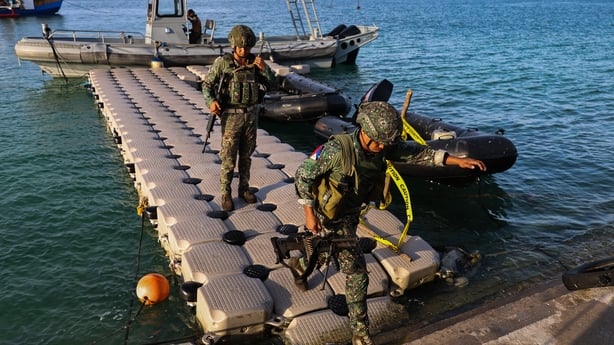
And so far, this administration has said little about China’s ongoing militarisation of the South China Sea and encroachment on territory belonging to key US allies, such as the Philippines, in contravention of international law.
Like the Strait of Hormuz, the South China Sea is a vital global shipping artery – but much bigger, with a third of the world’s maritime trade passing through.
And Taiwan still produces some 90% of the world’s most advanced computer chips, most of them designed by American companies.
If Beijing believes the US is in trouble over a war that it’s struggling to end, it may calculate this is a good moment to extract concessions from Washington over Taiwan, analysts said.
It wouldn’t be the first time.
In 1971 Henry Kissinger, then national security adviser in Richard Nixon’s administration, pledged the US would not support Taiwanese independence, in exchange for China’s help in ending the Vietnam War.
The question now is whether Beijing spies an opportunity with Mr Trump in the White House to press for a long-awaited US change of tone on Taiwan – more specifically a rhetorical shift that the US “opposes” rather than “does not support” Taiwanese independence.
This may seem like a small detail, but it would represent a massive coup for China, which claims Taiwan as its own territory and wants the rest of the world to agree.
A massive US arms sale to the democratic self-ruling island in December, which drew stern condemnation from Beijing, appeared to underline America’s continued willingness to defend the island from a Chinese takeover.
But after a February phone conversation with the US President, during which Mr Xi reportedly expressed his displeasure, the shipment was paused.
Meanwhile, Chinese commentators are openly expressing scepticism that the US would be able to help defend Taiwan anyway – given the rapid depletion of US military hardware in Iran and diversion of supplies and logistics away from the Indo-Pacific to the Middle East.
“It is truly amusing that some American elites are still talking grandly about taking on the PLA (People’s Liberation Army) in the Taiwan Strait,” wrote Hu Xijin, one of China’s most outspoken nationalist commentators.
So, could Mr Trump be talked into a position that previous presidents have resisted?
Again, it wouldn’t be the first time – at least, if commentators like Trump supporter-turned-critic Tucker Carlson, who claims that Israel’s prime minister Benjamin Netanyahu persuaded Mr Trump to strike Iran, are to be believed.
Mr Trump denies the claim, saying the decision was all his and it was to make sure Iran could never get a nuclear weapon.
Where hubris meets hubris
President Donald Trump likes to talk about cards and who holds them.
He famously told the Ukrainian wartime leader Volodymyr Zelensky he had none.
He’s repeatedly said that Iran hasn’t got any either, sparking an internet meme depicting Iranian officials with oversized UNO cards.
But China has cards and has been willing to play them – most notably with the rare earth restrictions implemented at the height of the trade war last year.
America’s military equipment, for example, like precision-guided missiles and F-35 fighter jets depend on Chinese-made high-performance magnets to fly.
No small consideration for a country at war.
But America has plenty of cards too, in the form of advanced semiconductors, operating system software and chip manufacturing which China cannot do without, especially as the AI race heats up.
If you speak to people in Washington close to the US administration, Mr Czin told RTÉ News, and suggest to them that time is on China’s side, they will say: “We think time is on our side too”.
Who is telling the truth?
“I think they’re both telling the truth, but it’s like that old line – the most dangerous lies are the ones you tell yourself”.
Ultimately this summit is all about playing for time, which is in the interest of both big players as they grapple with their own challenges.
That leaves the rest of the world looking on, hoping some sort of workable world order will emerge.
“Small countries or middle-sized countries like Ireland and New Zealand really care about the rule of law, the international order and these rules that keep middle and smaller sized countries able to fight fairly and protect themselves on the world stage,” Ms Fifield said.
The two leaders are due to meet again later this year, which leads experts to conclude that next week will be little more than a curtain-raiser, with the can of difficult negotiations kicked further down the road.
That won’t please observers who want to see the world’s most powerful nations come up with some sensible policies on today’s pressing global challenges like nuclear weapon proliferation, artificial intelligence and climate change.
But at least it gives other countries a little time to work out what role they are going to play in this century’s great power game.
