
Exclusive: China Ambassador Talks Trump Visit, Iran War and ‘Chinamaxxing’
In an exclusive interview with Newsweek, Chinese Ambassador to the United States Xie Feng discussed hopes for improved relations between the two nations as well as a need to address sources of bilateral tension as U.S. President Donald Trump prepares to embark on a trip to Beijing later this week amid Washington’s ongoing war with Iran.
It’s one of several major items likely to be on the agenda when Trump meets with Chinese President Xi Jinping in what will mark the first visit of a U.S. leader to China since Trump’s last travel there in 2017.
Xie stated that the encounter will mark a crucial opportunity for Trump and Xi to build upon past positive interactions in order to promote “a stable and constructive China-U.S. relationship” in what the ambassador described as “an increasingly turbulent world.”
With the seismic conflict in the Middle East causing ripple effects extending across the globe, Xie reiterated his nation’s appeal for peace and discussed the fallout of the war for China and the international community, while firmly rejecting what he called “fake news” regarding allegations Beijing was aiding Tehran militarily.
Xie also discussed other key topics in one of his lengthiest and most wide-ranging interviews to date, including trade ties between Beijing and Washington, the geopolitically sensitive issue of Taiwan and viral social media trends promoting China and Chinese customs gaining traction in the West.
The following transcript has been adapted from a conversation and edited for length and clarity.
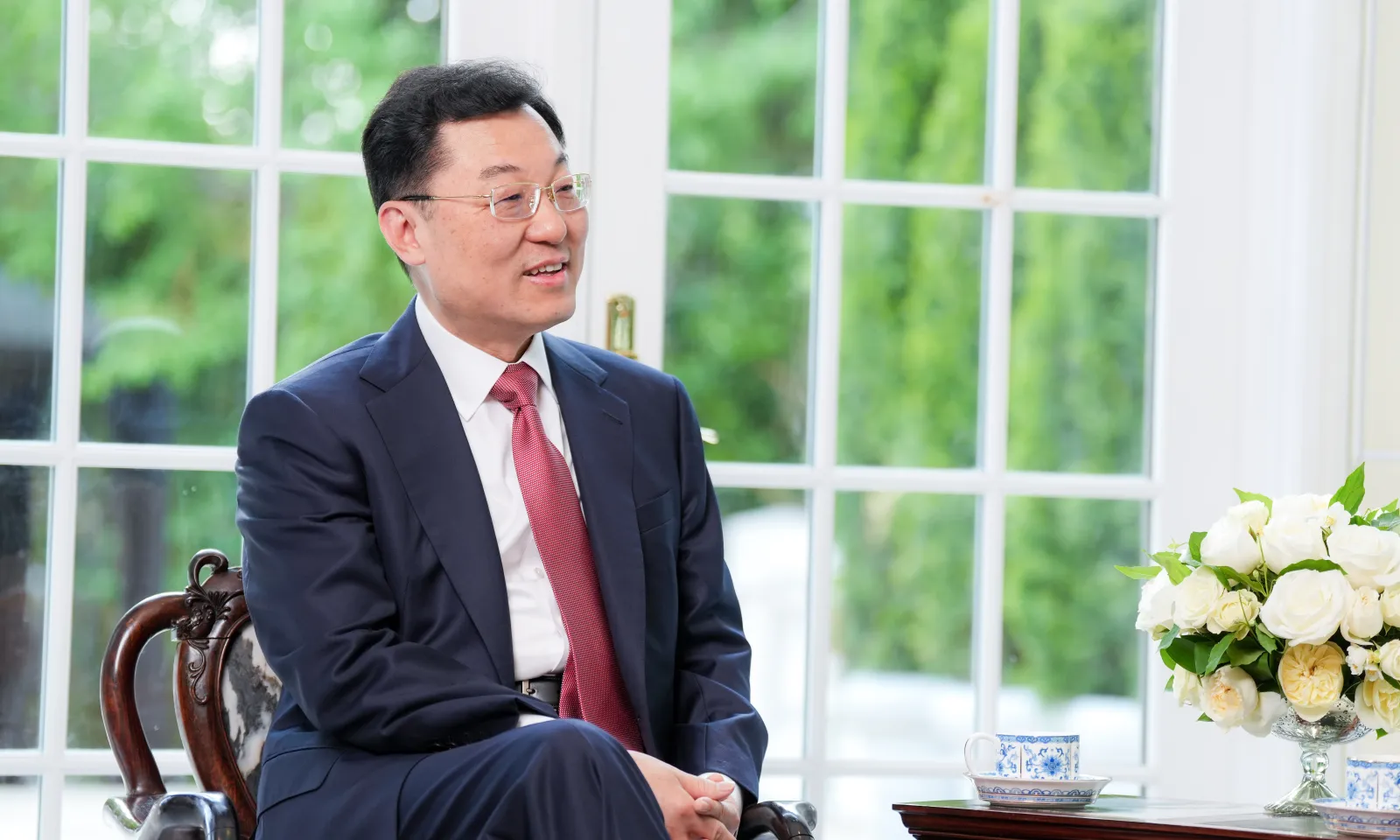
Newsweek: How are the interactions between the leaders as President Trump often praises President Xi? As President Trump plans to visit China from May 13 to 15, what expectations does China have for the upcoming summit in Beijing?
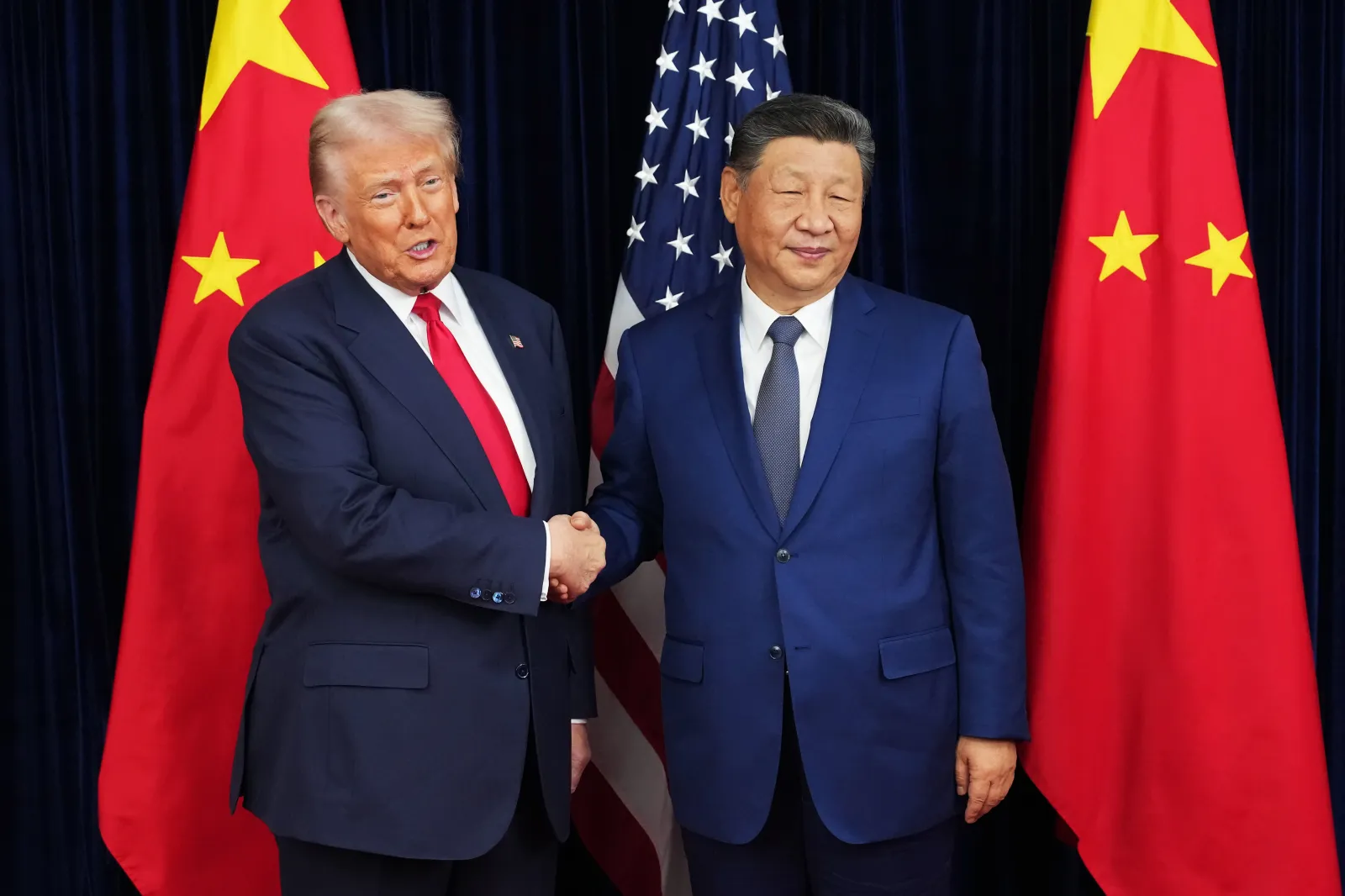
Xie Feng: Interactions between the heads of state provide irreplaceable strategic guidance for China-U.S. relations. President Xi Jinping and President Donald Trump respect each other, and have maintained close communication. Since last year, the two leaders have spoken on the phone five times and exchanged multiple letters, and held a successful summit in Busan, the Republic of Korea, recalibrating the course of the China-U.S. relationship and steering it toward overall stability.
President Trump has expressed his wish to revisit China on multiple occasions. President Xi welcomed this and invited him to visit China again. The two sides are stepping up the preparations.
In an increasingly turbulent world, the strategic value of China-U.S. relations becomes more prominent. A stable and constructive China-U.S. relationship not only serves the fundamental interests of both our peoples, but also meets the shared expectation of the international community.
It is our hope that with the joint efforts of both sides, the upcoming summit in Beijing will be a successful one, which will chart the right course for the future development of China-U.S. relations, and pave the way for making the list of dialogue and cooperation longer and advancing the positive agenda, while shortening the list of problems and properly managing differences, so that we cannot only promote the steady, sound, and sustainable development of bilateral relations this year, but also explore a right way for China and the U.S. to get along in the new era based on mutual respect, peaceful coexistence, and win-win cooperation.
Has China, as some alleged, benefited from the war in Iran, or supported Iran militarily? What role has China played in the war so far?
For people of all countries, peace is paramount, life is most precious, and stability is most needed. China always follows an independent foreign policy of peace, and opposes the arbitrary use of force in international relations.
From the first day of the fighting, China has steadfastly stood on the side of peace, and has been committed to promoting talks for peace and the cessation of hostilities. President Xi Jinping made four propositions, calling on all parties to stay committed to the principles of peaceful coexistence, national sovereignty and international rule of law, as well as a balanced approach to development and security. This is China’s solution to resolving the crisis in the Middle East. Foreign Minister Wang Yi and Foreign Minister of Pakistan jointly put forward a five-point initiative, facilitating negotiations between the U.S. and Iran. China’s just, responsible, and constructive role has been widely acclaimed by the international community.
Unfortunately, some individuals seem to feel the world is not chaotic enough, and have spread rumors that ‘China has benefited from the conflict’ and that ‘China is supporting Iran militarily.’ Their aim is to smear China, incite confrontation between China and the U.S., and sabotage bilateral high-level interactions. All of this is fake news driven by ulterior motives. We hope that people with discernment around the world will see through these lies and avoid being misled by them, let alone circulating them.
For China and the rest of the world alike, the blockade of the Strait of Hormuz, the disruption of the international energy market, and the shocks to global industrial and supply chains are a disaster. This is a war that should not have happened, and should be immediately stopped. China hopes the U.S. and Iran will maintain the momentum of negotiation, and we support all efforts that help to bring the fighting to an end and restore peace and stability at an early date. We will continue making unremitting efforts for peace.
Foreign leaders, including those of Western countries, have been visiting China. Are there potential opportunities for China to capitalize on possible setbacks for U.S. soft power influence abroad?
As a Chinese proverb goes, ‘Peaches and plums do not talk, yet a path is formed beneath them.’ China’s domestic and foreign policies are consistent, and we always do the right thing.
At home, we are committed to pursuing Chinese modernization on all fronts, focusing on managing our own affairs well, and becoming a better version of ourselves, so that our people can lead a better life. Internationally, we are committed to forging a community with a shared future for humanity, and joining hands with all countries to follow the path of peaceful development, implement the four global initiatives on development, security, civilization, and governance, and advance the development and progress of human society. As a result, a growing number of countries are seeing China as a cornerstone of certainty, a harbor of stability, and a friend worth having. That is why China’s ‘community of friends’ keeps expanding.
In March, the annual ‘two sessions’ of China adopted the 15th Five-Year Plan, which has not only outlined a road map for advancing Chinese modernization in the next five years, but also brought rare and major benefits to the world. China has contributed over 30 percent to global economic growth annually for years. In the next five years, a China that continues to pursue high-quality development and high-standard opening-up will inject steady momentum into the global economy, and provide valuable development opportunities to all.
The plan will also open up vast room for mutually beneficial cooperation between China and the U.S. China has a steadily growing market, a sound ecosystem of innovation and an enabling business environment. In the next five years, China will further expand opening-up trials for value-added telecom services, biotechnology, wholly foreign-owned hospitals and other fields, thus further unleashing the enormous benefits of its trillion-yuan-scale market. As a prime arena for the new round of scientific and technological revolution and industrial transformation, China will provide a testing ground for new ideas and a frontier for value growth.
China will also continue to foster a first-class business environment that is market-oriented, law-based and internationalized, so that foreign businesses can feel at ease in China. We welcome the American business community to seize the historical opportunities, and work together with China to usher in a brighter future of mutual benefit.
China and the U.S. clashed on tariffs last year. The tensions have lowered over the past months, but some remain concerned that the problem of trade imbalance has yet to be fundamentally resolved, and China’s industrial overcapacity is continuing to increase. What’s your response?
History has proven it once and again that a tariff war or trade war produces no winner, damages the interests of both sides, and hurts the whole world. Under the guidance of the two presidents, China and the U.S. have reached a series of common understandings through six rounds of economic and trade consultations, and have stabilized bilateral economic and trade relations. This has not come easily and should be cherished. But it is still far from enough. We hope the U.S. side will move further ahead, and completely remove the unilateral tariffs and other restrictive measures.
The issue of imbalance is a highly complex one, and should be viewed from a comprehensive perspective. There are imbalances both in goods trade, and in service trade; imbalances both in the current account, and in the capital account; and also imbalances in the development stages of different countries and regions. Therefore, it would be unfair to stress only imbalances in goods trade. For instance, in terms of trade in services, the U.S. runs a surplus with most economies.
In frontier technology sectors, based on capital market valuation trends, the AI industry alone is expected to generate a surplus of over US$1 trillion annually in U.S. services trade over the next decade. In terms of the capital account, the U.S. is also running a huge surplus annually as a primary destination for global capital inflows. At recent G20 meetings, some members already warned that the issue of financial imbalances should not be dismissed.
The allegation regarding so-called ‘China’s industrial overcapacity’ is equally untenable. The internationally accepted core metrics for identifying overcapacity are the capacity utilization rate, inventory levels, and profit margins. In China in the first quarter of this year, the capacity utilization rate of industrial enterprises above the designated size nationwide was 73.6 percent, with inventory levels remaining stable and industrial profits growing 15.5 percent year-over-year. All the indicators were generally within a reasonable range.
Despite tariff pressure, China’s foreign trade expanded last year, with total goods imports and exports reaching a record high, which speaks to the irrepressible demand of the global market for China’s industrial capacity. For Global South countries, in particular, high-quality industrial capacity is not excessive, but in dire scarcity. The more, the better.
Amid the global green transition, China’s flagship products such as electric vehicles, lithium-ion batteries and photovoltaic products are all much-needed high-quality industrial goods, which not only meet China’s domestic demand, but also help bridge the global gap between renewable energy supply and demand, and make a significant contribution to energy conservation, emission reduction and decarbonization. Such industrial output serves the interests of all and should be welcomed, rather than questioned or suppressed.
Are there concerns over continued U.S. political and military support for Taiwan? How have tensions in the world order affected the Taiwan situation?
There is only one China in the world, Taiwan is an inalienable part of China’s territory and the government of the People’s Republic of China is the sole legal government representing the whole of China.
The one-China principle as defined above is an integral part of the postwar international order, a basic norm of international relations and a broad international consensus solemnly confirmed by UNGA Resolution 2758, and also the prerequisite and the political foundation for all countries, including the U.S., to establish and develop diplomatic relations with China. Adhering to the 1992 Consensus that embodies the one-China principle and opposing ‘Taiwan independence’ is the foundation for cross-strait communication and dialogue, and the anchor of peace and stability in the strait.
In the Joint Communiqué on the Establishment of Diplomatic Relations between China and the U.S., the U.S. side pledged that ‘the United States of America recognizes the government of the People’s Republic of China as the sole legal government of China. Within this context, the people of the United States will maintain cultural, commercial and other unofficial relations with the people of Taiwan.’ It is only natural that China should oppose any form of official interactions or military contacts between the U.S. and Taiwan.
Just imagine: If a foreign country sold weapons to a U.S. state seeking ‘independence,’ and even sent a leader to visit the state to show support regardless of the U.S. federal government’s strong opposition, could the American people accept it? President Abraham Lincoln stated that ‘A house divided against itself cannot stand,’ and chose to fight to keep the country united. I believe the American people, who faced the danger of division and had a Civil War in history, can understand China’s will and determination to safeguard national unity.
Last month, General Secretary Xi Jinping met with Cheng Li-wun, chairwoman of the Chinese Kuomintang (KMT) party, and made important remarks, calling for fostering heart-to-heart connection on the basis of correct identity, safeguarding the common homeland through peaceful development, improving public well-being through exchanges and closer ties and striving together for the great rejuvenation of the Chinese nation. This has set the direction for the peaceful development of cross-strait relations in the new situation.
Following the meeting, the Chinese mainland announced 10 policies and measures to boost cross-strait exchanges and cooperation. This has proven once again that, the Chinese people on both sides of the Taiwan Strait have sufficient wisdom and capability to handle our own affairs properly, and as long as it is recognized that both sides of the Taiwan Strait belong to one China and that ‘Taiwan independence’ should be opposed, there will be no obstacle to enhancing exchanges and dialogue between the mainland and various communities in Taiwan, and there will be no problem with peace and stability in the Taiwan Strait and the Asia-Pacific.
We urge the U.S. side to commit to the one-China principle and the three Sino-U.S. Joint Communiqués with concrete actions, make the right choice as early as possible, fundamentally remove the biggest obstacle to China-U.S. relations, which is the Taiwan question, a burden that risks dragging our two countries into confrontation and conflict, and open up broader room for developing bilateral ties.
How does China view the U.S. designation of fentanyl as a ‘weapon of mass destruction’ and accusations toward China regarding the flow of fentanyl precursors?
Illegal drugs are a common enemy of humanity. As the biggest victim of opium in history, the Chinese people feel for the American public suffering from fentanyl abuse. To tackle the drug problem, it is important to reduce both the demand and the supply, and enhance domestic governance while conducting international cooperation, so as to address both the symptoms and the root causes.
The fentanyl crisis in the U.S. was not created by China. But out of the humanitarian spirit and for the sake of China-U.S. friendship, we have been doing our utmost to provide assistance with the greatest goodwill. At the request of the U.S. side, China scheduled fentanyl-related substances as a whole class as early as in 2019, the first country to do so in the world. After the San Francisco summit between the two heads of state in 2023, our two countries launched a Counternarcotics Working Group, and carried out cooperation in areas including substance scheduling, joint handling of cases, technological exchanges, multilateral cooperation, and removal of online ads.
Since the Busan summit in 2025, China has been faithfully implementing the common understandings reached by both sides, including tightening export controls on 13 fentanyl precursor chemicals to North America, issuing a circular warning businesses and individuals to prevent legal chemicals and equipment from being diverted to illicit drug production, and launching a nationwide campaign to crack down on chemical trafficking. We also conducted joint investigations with the U.S. side into major cases involving drug-related money laundering and drug smuggling. The cooperation between the two sides has achieved notable progress.
The current U.S. administration has strengthened legislation, law enforcement and regulatory control to combat fentanyl. The number of fentanyl-involved deaths in the U.S. has fallen by 37.5 percent. China also made important and positive contributions to this. Articles in the Science journal and the Foreign Affairs magazine this year pointed out that China’s efforts to tighten control over fentanyl precursors have been an important factor contributing to the significant decline in drug overdose deaths in the U.S.
We hope the U.S. side will appreciate and cherish China’s goodwill, view our cooperation outcomes in a just manner, stop shifting the blame for the fentanyl issue, avoid imposing alternative tariffs as substitutes for fentanyl-related tariffs, remove China from the list of so-called ‘major drug source countries’ as soon as possible and advance bilateral cooperation in counternarcotics and other law enforcement areas based on mutual respect, equality and mutual benefit.
Many Democrats and Republicans alike believe the China-U.S. relationship is essentially defined by competition. While competition is viewed by many here in the U.S. as a vehicle for progress, there have been real concerns about the ability of the two nations properly managing this competition in order to avoid confrontation. What’s your take on this?
Indeed, China and the U.S. have competition in areas such as economy and trade. We never shy away from this. Meanwhile, we believe that in competition, the playing field should be level, and the rules should be observed. One should not apply double standards, for example, extolling ‘free trade’ when they are competitive yet stressing ‘fair trade’ when outcompeted. Still less should one seek an unfair advantage by imposing restrictions on others or tying their hands.
Since World War II, the international community has established a number of rules, systems, and mechanisms in trade and other sectors, which have proven effective. They form the foundation for the stability and sustained growth of the global economy, and ensure that the interests of all countries are accommodated in a balanced manner. No country should put itself above everyone else and apply the rules selectively. Otherwise, human society could risk slipping back into a jungle.
Ultimately, competition should not be a zero-sum boxing match, but a track-and-field race toward mutual excellence. Last month, I made a trip to the state of Indiana, during which I visited a renowned American enterprise that entered the Chinese market as early as in the 1970s. At the start, with absolute advantage in the Chinese market and basically no competitor, the company could make money almost effortlessly. In recent years, though, its Chinese peers are rapidly rising, producing highly competitive products. But instead of exiting the market under pressure, the company has chosen to confront the challenge head-on, think outside the box and set up its second-largest R&D center in China.
In this way, it is able to collaborate with its Chinese partners, and combine its strength in technological innovation with China’s huge market, fully-fledged industrial chains and deep pool of tech talent.
The choice has proven wise. It has enabled the company not only to achieve 10 percent revenue growth in China while its U.S. revenue fell 40 percent last year, but also to expand its business to other developing countries and sell its products globally with its Chinese partners serving as a bridge. Therefore, it has achieved a ‘1+1>2’ effect, serving China, the U.S. and the world with its presence in China, and also providing quality products and efficient services to global consumers at affordable prices, thus finding a new pathway in which both China and the U.S. win, and the world as a whole benefits.
Let our two countries compete to offer more public goods to the world, to better help developing nations reduce and eliminate poverty, and to contribute more to the sustained and inclusive development of the global economy. This is the kind of competition all parties wish to see.
With the explosive growth in AI technology, many in the international community are expecting China and the U.S., two leaders in the sector, to strengthen cooperation. What scenarios do you foresee for China-U.S. AI interactions: cooperation, competition or confrontation?
Artificial intelligence (AI) is leading the new wave of scientific and technological revolution and industrial transformation. While profoundly reshaping the ways humans work and live, it has also brought unprecedented risks and challenges. After my arrival in the U.S. in 2023, I had seven in-depth discussions with Dr. Henry Kissinger. The AI issue was one of the topics every time. With the strong support of our heads of state, Dr. Kissinger initiated China-U.S. Track II dialogue on AI together with experts from both countries, and two rounds of intergovernmental dialogue on AI have also been held.
China’s competitiveness in AI does not come out of nowhere; it is grounded in China’s strengths in system, market, industry, and talent pool, and rooted in the wisdom and hard work of the Chinese people. Today, China has become the world’s largest holder of AI patents and an important engine driving the global intelligent transformation. Following Seedance 2.0’s global viral success in video generation and MiniMax’s Full-Stack Model Matrix, DeepSeek-V4 has arrived with a comprehensive upgrade. During China’s 15th Five-Year Plan period, AI will empower industries across the board and benefit households nationwide.
China advocates AI for good and for all, and opposes turning AI into a game of only a few countries and the wealthy. In 2023, President Xi Jinping put forth the Global AI Governance Initiative. China has also proposed establishing a world AI cooperation organization, launched the AI+ International Cooperation Initiative, and held the World Artificial Intelligence Conference in Shanghai for eight years in a row, the latest edition of which will be held in July.
It is only natural that China and the U.S., as leading countries in AI, should compete in the sector. But the two sides should engage in a race to the top, put equal emphasis on development and security, check brakes before setting off, and live up to our responsibilities as major countries through cooperation. The world does not want to see an ‘Iron Curtain’ in AI, nor attempts at technological enclosure, let alone a Star Wars-style rivalry in AI. China-U.S. coordination on AI bears on the future of both our countries and the entire humanity. We hope the U.S. side will work with us in the same direction, to enhance dialogue, manage competition, and conduct cooperation, so that AI will become a new frontier for China-U.S. cooperation and a new ladder for human progress.
Are you aware of the ‘Becoming Chinese’ and ‘Chinamaxxing’ trends involving Western users adopting Chinese culture as fashionable? What does this mean for China-U.S. people-to-people interactions and relations?
Both the ‘Becoming Chinese’ trend that emerged at the end of last year and ‘Chinamaxxing’ this year reflect the growing eagerness of our two peoples to reach out to one another. President Xi Jinping pointed out that the hope of the China-U.S. relationship lies in the people, its foundation is in our societies, its future depends on the youth, and its vitality comes from exchanges at subnational levels.
The ‘50,000 in five years’ initiative announced by President Xi in 2023 to invite 50,000 young Americans to China on exchange and study programs in five years has been completed and exceeded its targets in less than three years. Since last year, we have witnessed a positive rebound in U.S. public opinion toward China for the first time in five years, and a poll by the Chicago Council on Global Affairs showed that 53 percent of Americans favor friendly cooperation and engagement with China. According to a latest Pew Research Center survey, the proportion of Americans having a positive opinion of China has nearly doubled since 2023. The desire of our two peoples to build closer ties is simply unstoppable.
In fact, this is not the first time ‘Chinamaxxing’ has occurred.
As early as over 1,000 years ago, envoys, caravans, and scholars from more than 300 countries traveled to Chang’an, the capital of China’s Tang dynasty, to live, study, and work there, writing an epic chapter of history in which diverse cultures met, blended, and resonated in perfect harmony. Today, Generation Z are sharing online their fascinating experience of drinking hot water, and marveling at speedy food delivery and efficient mobile payments in China. In admiring everyday joys of modern China, young people are expressing their love for life and their interest in learning more about each other’s cultures. It is really heartwarming to see such vibrant cultural exchanges happening.
Earlier this month, our embassy hosted an open house again, which attracted over 7,000 American visitors. Some of them complained to us that, one day is far from enough to experience the rich program, and they wish the Embassy could open its doors every day. While this is challenging, the doors of our country are open 24 hours a day. We welcome more American students to study in China, and more American people to take advantage of our 240-hour visa-free transit policy and online visa application system to travel to China and have a wonderful journey.
At the same time, the potential of China-U.S. people-to-people exchanges is yet to be fully unlocked. We hope the U.S. side will remove bottlenecks in visa application and border entry for Chinese citizens as soon as possible, stop taking selective and discriminatory measures toward Chinese visitors and further increase direct flights, so that together we can open up a fast track for two-way engagement between our peoples.
