
The cult of Khan Sir and Patna’s coaching war
On the face of it, the incident was an outcome of a business rivalry between two coaching kings of Bihar. But in reality, it marks the beginning of a slow crumbling of a myth built over six years: the carefully cultivated image of a youth icon and the deliverer of government-job dreams. He is the man who democratised education for small-town Indians. He was unputdownable. Until now.
But this isn’t a typical gang war or corporate feud. Their rivalry was rooted in the economics of Patna’s coaching industry. Both positioned themselves as champions of the poor aspirant, claimed extraordinary results and relied on personality as much as pedagogy. They have had a history of fights in the past but it never escalated to this level.
Anand also had little patience for criticism directed at Khan Sir, which seems to be coming from every direction these days.
“He is a fabulous teacher,” he said, anger creeping into his voice. “Whatever is happening is affecting students and our studies. Khan Sir should return to his earlier role—that of a teacher. We worship him like a god. He has always helped students and ordinary people. That’s how he became what he is.”
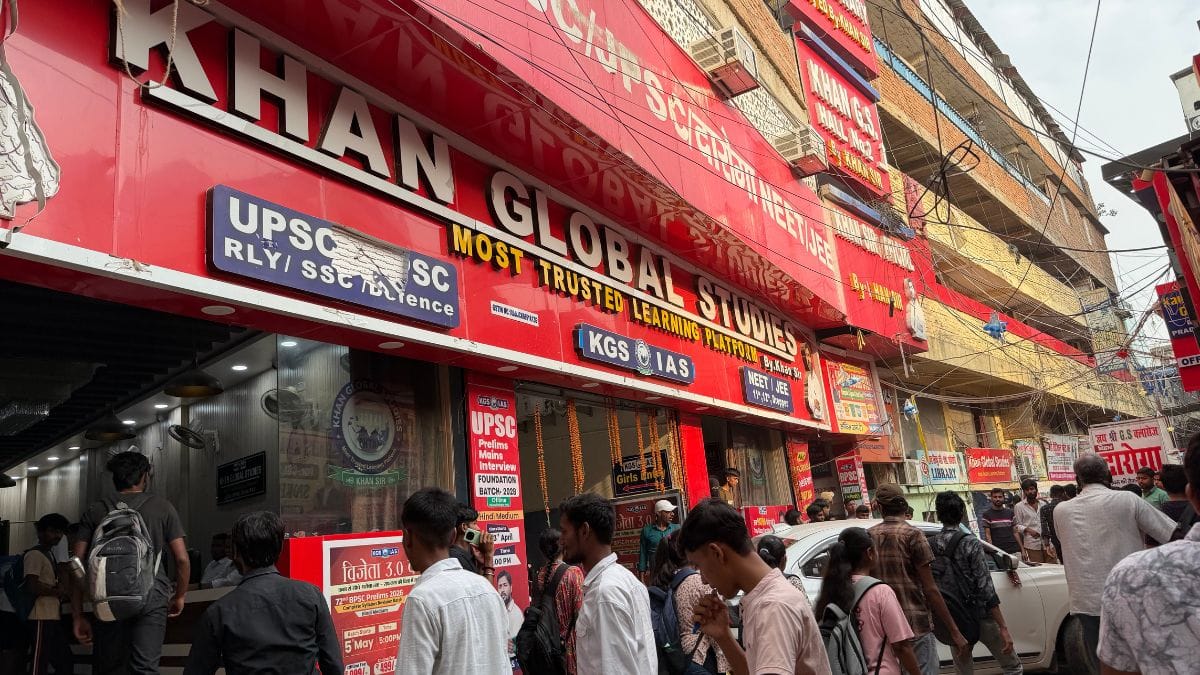
The ongoing controversy between Khan sir and Gyan Bindu’s Raushan sir has left students defending their respective teachers. Both educators have faced criticism, but neither side’s supporters are ready to hear it.
“He helps several people on a daily basis. After completing his class in the morning, he engages with people here at the institute. For hours, he listens to their grievances. That is the man they’re talking about and trying to spoil,” said Rahul Kushwaha, a member of Khan’s management team.
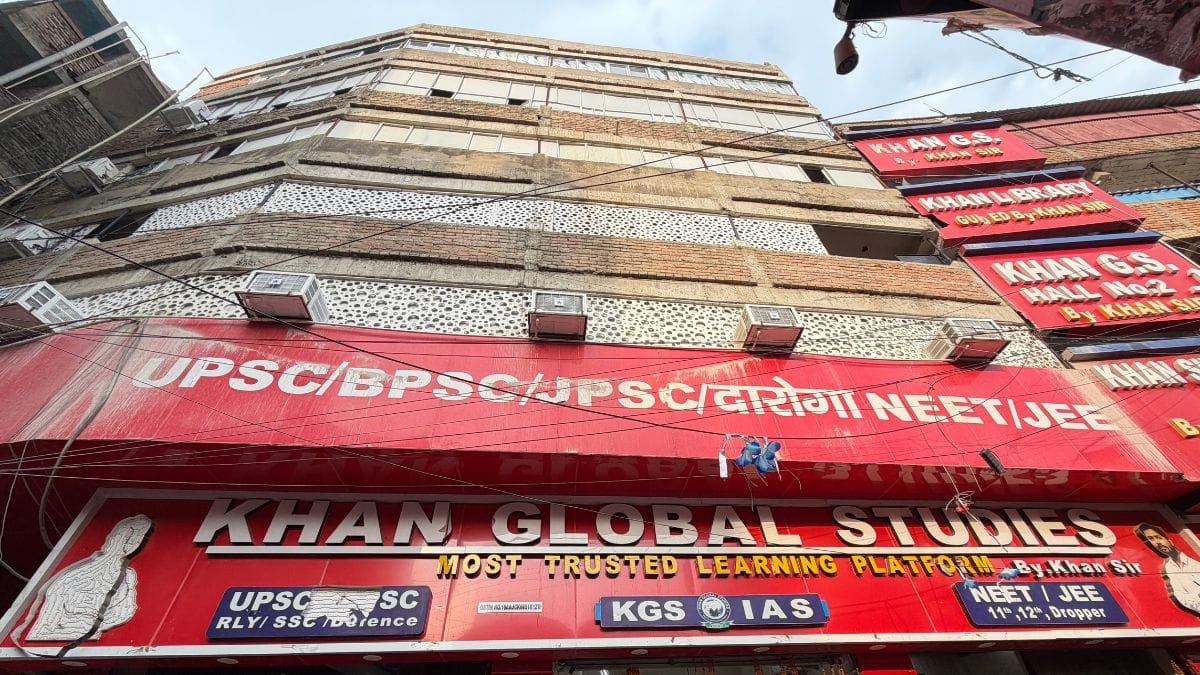
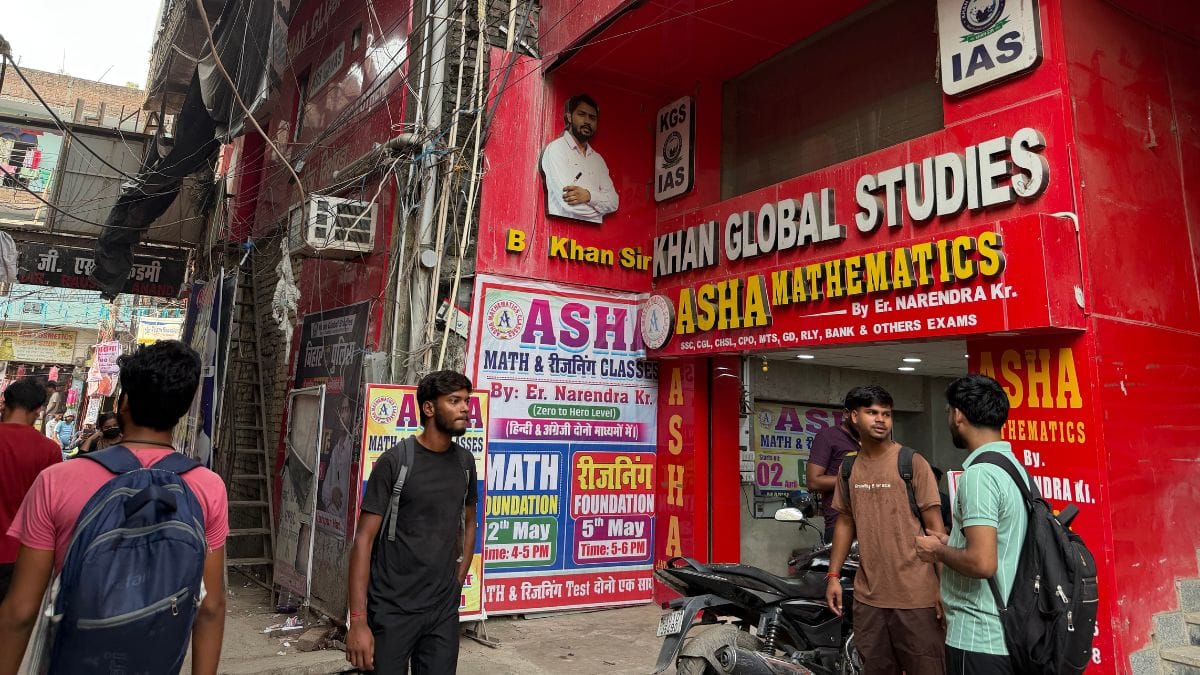
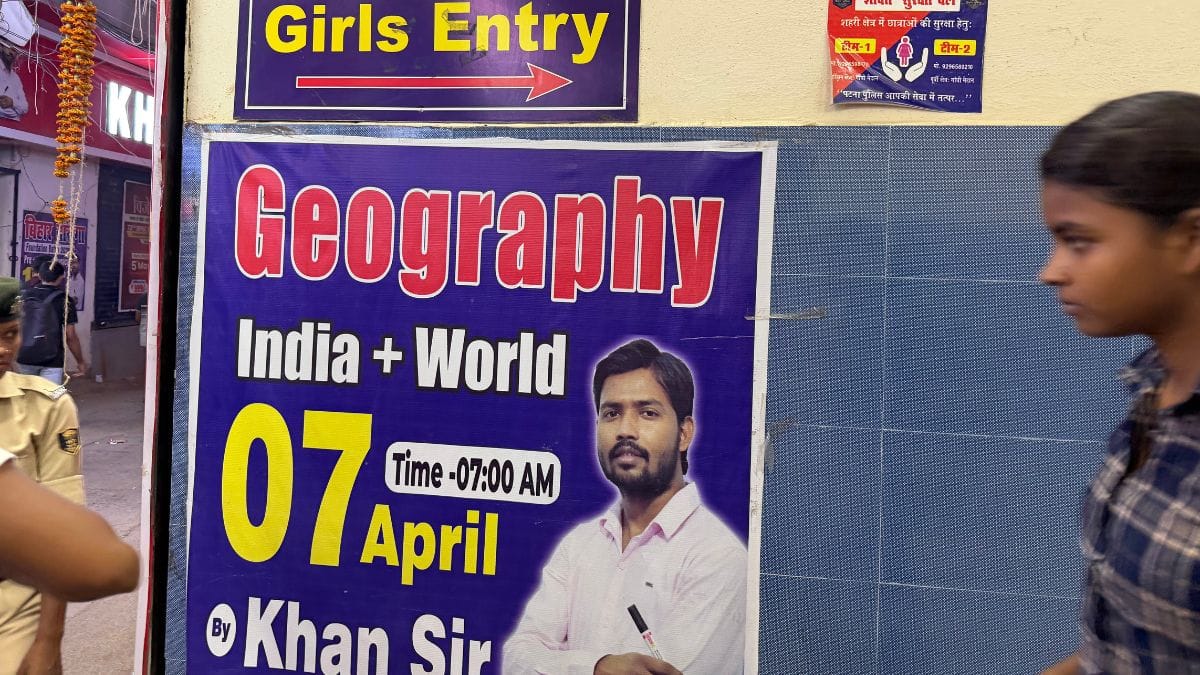
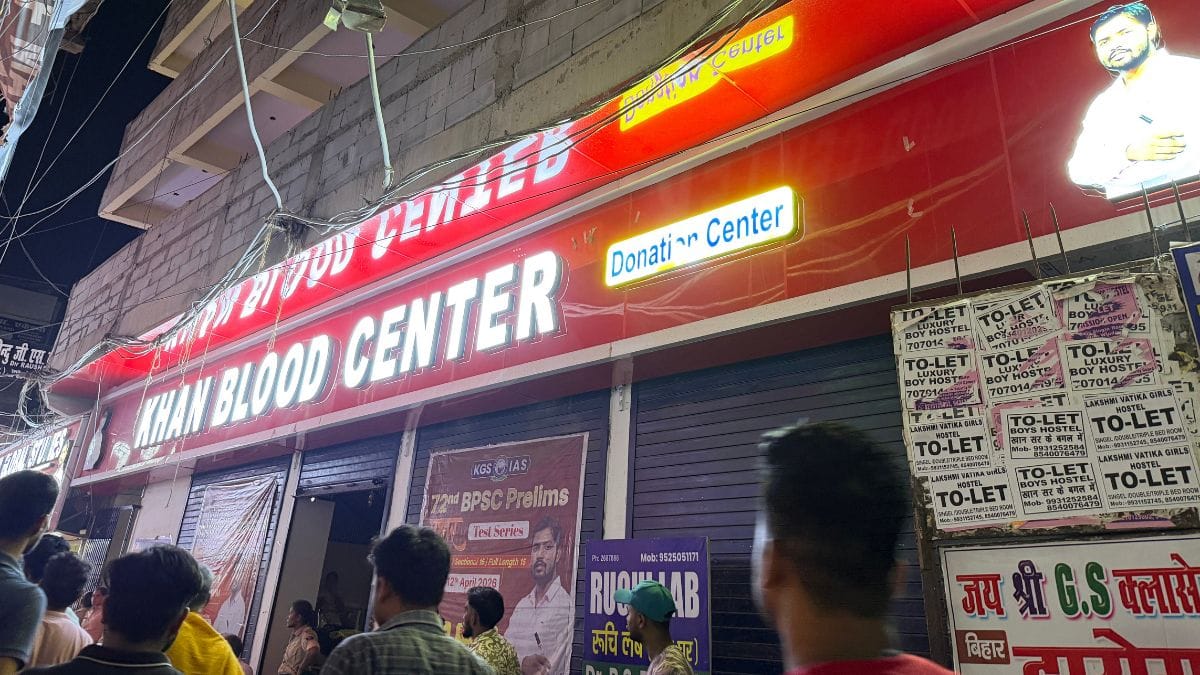
In Patna’s Mussallahpur Haat, Khan Sir is impossible to miss. His face stares down from shopfronts, hoardings and peeling wall posters, turning an unremarkable coaching hub into a shrine to one man. To millions of students across India, he is more than a teacher: a phenomenon.
What began as classes for Bihar Police aspirants evolved into one of the country’s most influential educational empires, spanning preparation for everything from BPSC and UPSC examinations to railways, JEE and NEET. His offline centres draw thousands of students each day, while his digital reach extends to nearly 50 million subscribers.
But Khan Sir’s rise has been neither linear nor uncontested. Before 2017, Faisal Khan was just another teacher in Patna’s crowded education market. He started his own coaching centre with only a handful of Bihar Police aspirants in 2017. Two years later, he launched his YouTube channel that transformed him into a national figure. Today, he runs two centres in Patna and one each in Dehradun, Prayagraj and Delhi.
His trademark style—mixing humour, nationalism and current affairs—made even geopolitics classroom material. But it also attracted criticism for factual inaccuracies and provocative commentary. He has survived controversies ranging from comments on the France-Pakistan diplomatic row to lectures on India’s ties with Iran and Pakistan. Critics have repeatedly accused him of factual inaccuracies, sweeping geopolitical claims and a tendency to collapse complex issues into punchy nationalist narratives. His supporters dismiss such criticism as nitpicking.
In one of his videos, he suggested resolving Kashmir’s unrest by adopting China’s Tibet model: splitting up families and dispersing them across India so that “stone-pelters” would have little time left for protest. In another lecture, he compared Pakistan’s map to a dog, declaring that “even the dog would be insulted by the comparison.” He also frames his lectures with appeals such as, “If you are a nationalist, watch this video till the end.”
Today, Patna’s coaching capital is divided between those who see Khan Sir as a self-made messiah and those who view him as the face of an increasingly aggressive, personality-driven coaching industry. Behind the cult of loyalty, clashes with rival teachers and the mobilisation of students lies a larger story: how education became spectacle, teachers became influencers, and a coaching entrepreneur turned himself into one of the most powerful brands in contemporary India.
“He is a geography teacher and teaches current affairs also. He started his coaching from Bihar Police aspirants and now he teaches almost everything under the sun. His humour and teaching style attracted people, but this rivalry has created problems not only for students but also for other coaching institutes,” said Guru Rahman, one of Patna’s oldest coaching entrepreneurs, who opened his institute in 2004.
Rahman said the latest controversy stemmed from a dispute over examination results and a hoarding.
“The whole fight is about results. Khan claimed 12,000 selections in the police recruitment examination and Raushan claimed 10,000. The total number of vacancies was 21,800. If they got all the selections, then what are the rest of us doing?” asked Rahman.
Current controversy
It all began with a poster war.
Both Khan Global Studies and Gyan Bindu GS Academy had planned felicitation ceremonies to celebrate their students’ success in the Bihar Police recruitment examination. In Musallahpur Haat, results are not only a marketing tool but also a matter of prestige. Giant hoardings announcing selections had come up across the neighbourhood.
Tensions escalated after a poster put up by Gyan Bindu was allegedly torn down, triggering retaliation.
All of this quickly turned into violence. A group of men allegedly arrived outside Khan Global Studies and vandalised signboards and posters. They also assaulted a security guard, leaving him seriously injured.
Soon after, Khan Sir alleged that those involved in the attack had opened fire outside his coaching institute.
“The poor also have the right to study. The fact that so many results are being produced at such low fees is troubling some people. My institute was attacked and firing also took place,” Khan Sir told reporters on the night of the incident.
An FIR was registered and, within hours, Raushan Sir was arrested. But as investigators began piecing together the sequence of events, the police version started to differ from the public narrative that had already taken hold publicly.
“There was no mention of firing in the FIR, nor did Khan tell us about it during the initial stages of the investigation,” a senior police officer, speaking on condition of anonymity, told ThePrint. “It was later that we came across a video in which a security guard associated with the institute was seen firing. That then became part of the investigation.”
The controversy took another turn after the police registered a separate FIR naming Khan sir. While investigators searched for him, a Patna court granted him interim protection from arrest and barred coercive action until the next hearing on 20 June.
The episode laid bare the competition that runs through Patna’s booming coaching industry, where results are currency, hoardings are advertisements and rival teachers command loyal followings.
Students from both sides hit the streets in protest. Khan sir’s students opposed the FIR filed against him, while Raushan Sir’s students protested his arrest. Across Musallahpur Hat, students, teachers and coaching staff are divided into two camps.
Yet those associated with Khan Sir’s institute are not willing to accept the allegation that he could have lied about the firing incident.
“Gunshots were fired, that’s true. It’s just that we are not able to give video evidence, but there is audio proof. The whole narrative has now become media versus Khan Sir, but we trust the investigation and believe the truth will come out,” said Sumit Shukla, a science teacher at Khan Sir’s coaching institute in Patna.
Yet, amid the FIRs, court proceedings and competing claims, another sentiment was running through Patna’s coaching hostels and tea stalls: exhaustion.
Many students who came to Musallahpur Haat chasing government jobs said they were tired of being forced to choose sides in a rivalry they never signed up for.
Khan Sir’s content and cult
That loyalty is visible across Musallahpur Haat. Students, teachers and coaching staff may disagree about the controversy, but they agree on one thing: Khan Sir inspires an unusual degree of devotion. But his popularity is difficult to explain through examination results alone.
At Khan Global Studies, students and staff repeatedly return to the same point: they believe he understands them.
His classes are built around current affairs, humour and colloquial Hindi. A lecture can move from monsoon winds to India-China tensions or Iran-US conflicts, from mocking bureaucracy to the frustrations of unemployed youth preparing for government jobs.
“He speaks our language. The words we grew up hearing in our villages,” said Sonu Anand. “Other teachers teach from books. Khan Sir talks about the world outside the classroom and puts it in a context that is interesting and easy to understand.”
That style has helped him build an audience across age groups. From an 80-year-old man to a school-going child, everyone watches his videos.
Much of the appeal lies in the way he presents current affairs. He often begins videos with provocative hooks.
“Agar aap rashtravadi hain to iss video ko end tak dekhna, Koi Pakistani ya Chinese iss video ko na dekhe (If you are a nationalist, watch this video till the end. No Pakistani or Chinese should watch it),” he says at the beginning of one lecture before moving into a discussion on India-Pakistan wars.
In another lecture, he says:
“Pakistan ke log yahan ke logon ko, purvi pakistan ke logon ko pasand nahi karte the. Bolte the tum gadhe ho, kisi kaam layak nahi ho, kaale ho. (People in Pakistan did not like the people of East Pakistan. They would say, ‘You are donkeys, you are good for nothing, you are dark-skinned).”
While these videos have drawn criticism from some viewers and praise from others, the formula has proved enormously successful. It has helped make Khan Sir one of India’s biggest educational brands.
“Khan Sir talks about issues that even Rahul Gandhi doesn’t talk about,” said a member of the institute’s management. “He raises issues that matter to ordinary students and common people.”
The bond between Khan Sir and his students goes beyond the classroom.
Every year on Rakhsha Bandhan, thousands of girls visit the institute to tie Rakhi on his wrist. Videos of the event go viral every year. When he got married, he hosted a three -day buffet for students.
Many students say they approach him with problems that have little to do with studies.
“If any girl faces any issue, she comes to Khan Sir. If someone is troubling her or if family members are pressuring her to quit studying, Khan Sir helps solve the problem. That level of access is what he gives students,” said Kushwaha from the institute’s management team.
That relationship helps explain the reaction to the current controversy.
“Khan Sir has made education affordable for poor aspirants. People feel he understands our struggles because he came from the same background,” said Anuj Parashar, a BPSC aspirant based in Patna. “He doesn’t just teach; he talks about the struggles of poor aspirants in his class that reaches lakhs of people.”
How Faisal Khan became Khan Sir
Long before he became one of India’s most recognisable teachers, Faisal Khan was just another instructor in Patna.
He completed a BSc from Allahabad University and a master’s degree in geography. He wanted to join the armed forces but was rejected because of a slight deformity in one of his hands. He then came to Patna and spent several years teaching at other coaching institutes.
For a long time, even Khan Sir’s name remained a mystery. There was even a rumour that he was Hindu. Whenever he was asked about his name, he would say:
“If my name were Amit Singh, why would I publish 26 books under the name ‘Khan Sir’? What’s in a name? Look at the teaching.”
The nickname stayed. The man behind it disappeared.
Over the years, Khan Sir became more than a teacher. Students brought him family disputes and complaints of harassment.
“Recently, a girl approached Khan Sir because a boy was blackmailing her. He intervened, spoke to the boy and asked him to delete the girl’s pictures. He is not just a teacher but a family member to the students,” said Kushwaha.
In a state where public institutions often fall short, many aspirants began to see in him not just an educator, but someone who listened, intervened and delivered.
Khan Sir’s larger-than-life image has survived several controversies that might have consumed others. He has been accused of factual inaccuracies in his lectures, booked by police in connection with protests, faced multiple FIRs and received legal notices from bodies such as the BPSC.
In 2024, when allegations of irregularities in the 70th BPSC examination brought hundreds of students onto the streets, political strategist Prashant Kishor joined the agitation. Khan Sir too entered the protest, claiming that the examination had been leaked and that he possessed evidence to prove it. He said he would approach the court with the material in his possession.
“That legal action never happened. FIRs were filed against several teachers who participated in the protest, but not against Khan Sir. He was on the ground with the students and was later admitted to hospital. But that matter fizzled out and the protest was disrupted,” said Amit Vikram, a leader of a government teachers’ union in Bihar.
Today, Khan Sir is simultaneously a teacher, employer, influencer, entrepreneur, benefactor and public figure. In recent times, he has been criticised over fire-safety norms and periods spent evading police action, sparred publicly with television anchor Anjana Om Kashyap, expanded beyond coaching into ventures such as hospitals, and accumulated as many detractors as devotees.
To his critics, he embodies the excesses of India’s personality-driven coaching culture. To his supporters, he represents possibility itself.
Somewhere between those two versions stands Faisal Khan: a geography teacher from Uttar Pradesh who became Khan Sir, a figure influential enough that students in Patna’s coaching capital no longer merely attend his classes. They choose sides.
Khan Sir’s empire
Khan Sir may teach geography, but Khan Global Studies functions like a midsized company. He is everywhere—on the walls, hoardings and booklets being sold in stationery shops. His face sells every course, even those that he does not teach. From UPSC and BPSC to SSC, railways and banking examinations, giant posters carrying his image dominate the institute’s walls.
“It is not like other teachers in Khan Sir’s academy don’t teach. It is just that people widely know Khan Sir and he is a brand. That’s why his face is on every course,” said Kushwaha.
The scale of that brand is staggering. According to Kushwaha, almost 1,000 people are employed across the group’s Patna operations alone, including teachers, office assistants, cleaners, security guards, AC maintenance staff and social media teams.
As the present controversy unfolded and Khan Sir secured interim protection from arrest, a Fortuner stood inside the institute campus, covered in dust. Some students had written “Khan Sir” on it with their fingers.
“If Khan Sir doesn’t come to take class for even one day, students miss him,” said Kushwaha.
Videos of his arrival routinely go viral on social media, much like videos celebrating the arrival of IAS and IPS officers. His transformation has altered his public image too. Videos of aspirants chasing his SUVs, stretching out for selfies and cheering his arrival circulate widely online. In a city where politicians and film stars command public adulation, a coaching teacher has acquired a similar aura.
“Khan Sir is very popular these days. Everyone wants to talk to him and wants a picture with him. There were incidents where he and the coaching institute were attacked, but police still don’t allow him security. So he travels with his own security guards,” said Kushwaha.
Khan Sir’s net worth is not publicly known and he keeps most details private, but online estimates place it between Rs 50 crore and Rs 100 crore. He has around 50 million subscribers across platforms and offers coaching for a range of competitive examinations.
The size of his operations offers a glimpse into the business he has built. According to the institute’s website, an 18-month offline BPSC Foundation batch in Patna costs between Rs 15,000 and Rs 20,000, depending on the batch and medium. UPSC remains among the institute’s costliest offerings, with recent reports placing the fee for the GS Foundation programme between Rs 69,500 and Rs 79,500. Meanwhile, NEET-JEE foundation programmes in Patna are priced at around Rs 14,999.
Even using a conservative average course fee of Rs 15,000-20,000, the institute’s offline batches alone could generate between Rs 15 crore and Rs 20 crore in revenue during an admission cycle, excluding earnings from premium courses such as UPSC, online classes, app subscriptions and test series. This is only an estimate based on 10 thousand students. The management didn’t give full data but said that original enrolment is higher than this.
“We have offline students in every batch and the most revenue comes from online students and YouTube,” claimed one member from Khan’s management team.
Khan Sir has also expanded beyond teaching. He recently opened a hospital where treatment is provided at a minimal cost.
The expansion has also attracted regulatory scrutiny.
Fire department officials told ThePrint that neither the coaching institute nor the hospital possessed the mandatory fire-safety clearance required for establishments of their scale.
“We have done an audit at his coaching institute and hospital, and neither of the places has basic fire-safety equipment. There are no fire alarms, no water pumps, no fire-detection systems, no emergency exits and even the staircases do not meet safety norms,” said Ritesh Pandey, Deputy Superintendent of Police at the Fire Safety Department in Patna.
Khan Sir applied for the hospital’s fire NOC in May and for the coaching institute in March. Both establishments had been operating long before those applications were submitted.
Pandey said all the required measures could be put in place at a cost of around Rs 8 lakh.
“I can tell you that it’s not more than a student’s life,” he said.
The questions surrounding fire safety have done little to dent Khan Sir’s public profile.
On The Kapil Sharma Show, Khan Sir revealed that he had once turned down a Rs 107-crore offer, adding to the mythology around him. On Smita Prakash’s podcast, he spoke about being unable to move around freely because of his popularity.
“Sir, the crowds that come to see you are larger than those that turn up for film heroes,” Kapil Sharma told him on his show.
His influence goes beyond academics and entertainment. Ministers cutting across party lines, including Bihar leaders such as Ashok Choudhary, have attended programmes organised by his institute. He has also been seen meeting former chief minister Nitish Kumar on several occasions. Yet, with the current controversy udner investigation, no politician is willing to talk about him publicly.
“I have only met him once. I don’t want to comment as the investigation into the firing incident is still going on,” said Ashok Choudhary, senior JD(U) leader, Member of the Bihar Legislative Council and Bihar’s Minister for Food and Consumer Protection.
Back in Musallahpur Hat, Sonu Anand remains among those who have already made their choice.
“People can say whatever they want. Investigations will happen and courts will decide. But for us, he is the person who made education affordable and gave students from villages the confidence to dream. We have learned from him for years. One controversy cannot change that overnight,” said Sonu Anand as he entered the institute with his friends.
(Edited by Prashant Dixit)
