
Resources companies fight gas tax push at parliamentary inquiry
Representatives from Australia’s resources industry have fiercely argued against introducing a 25 per cent on gas exports or increasing the petroleum resource rent tax (PRRT) on windfall profits a day after those in favour of a gas tax made their case.
Two days of public hearings for a Greens-led parliamentary inquiry into the taxation of gas resources has heard from proponents for a tax, who believe Australians are being robbed of their fair share of wealth from the nation’s natural resources, and opponents, who argue touching tax settings would spook investors.
On Tuesday, former tax secretary Ken Henry captured the sentiment of the climate and energy groups who had appeared before him by telling the inquiry Australia needed to “just do it” while on Wednesday, energy giants sent representatives to make the case against reform.
Loading…
‘Spectacularly ill-advised’ reforms: Shell
Shell Australia chair Cecile Wake told the inquiry that both proposed reforms would be “spectacularly ill-advised”, warning they would make Australia less competitive from global capital, reduce the nation’s energy security and weaken relationships with trading partners.
Earlier this week The Sydney Morning Herald reported former Shell executive and ex-Malaysian minister Idris Jala was at odds with his former employer in arguing that Australia should tax the windfall profits of gas giants. He dismissed concerns it would scare off trading partners.
Ms Wake said she believed Jala was “wrong” and pointed to the UK, which introduced a windfall tax on oil and gas producers called the “energy profits levy” in 2022.
“The cumulative effect of windfall taxes has been a measurable contraction in UK continental shelf investment activity,” she said.
“The UK offshore operators forecast for the period of 2025–2029 shows a decline in investment from 14.1 billion pounds [$26.6 billion] per annum at the time it was introduced down to 2.3 billion pounds per annum over that forward estimate.”
There was a heated exchange between Ms Wake and the committee’s chair, Greens senator Steph Hodgins-May, who asked how much Shell had paid in PRRT.
Ms Wake said Shell paid $109m in PRRT last year and another representative from Shell, Coralie Trotter, said the company’s profit that year was $2.5 billion before tax.
Ms Trotter confirmed the company had paid zero dollars in PRRT in the previous decade.
Ms Wake also said Australia’s energy giants had contributed around $6 million or $7 million to a campaign currently running from Australian Energy Producers — the peak body for the local oil and gas industry — against any changes.
She said to the best of her knowledge Shell Australia had contributed around $1 million and about “six or seven” of the larger producers had contributed similar amounts.
“What we are trying to do through that is to counterbalance the very selective and misleading representations of a number of other social commentators,” she said.
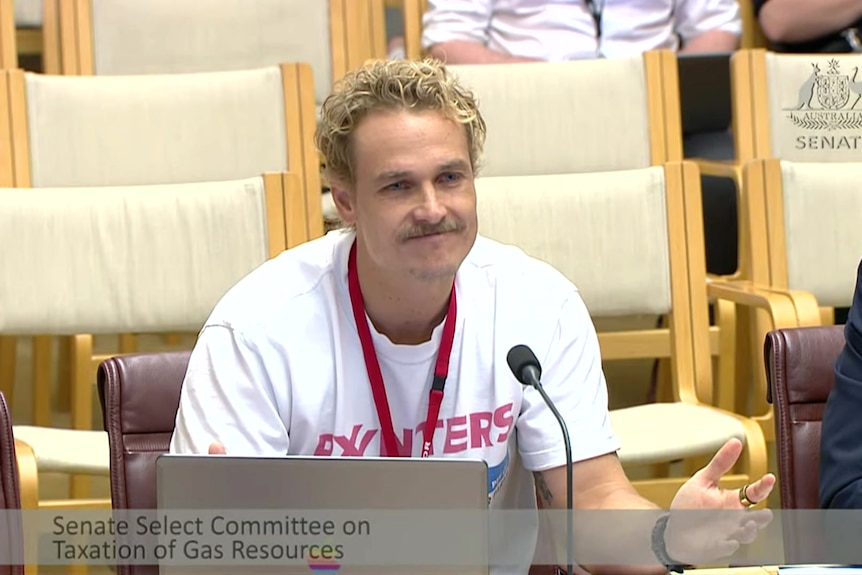
Konrad Benjamin addressed Senate estimates to call for a tax on gas exports (ABC News)
‘Just do it’: Ken Henry
On Tuesday, proponents of a tax appeared before the inquiry.
Former treasury secretary Ken Henry attended in a personal capacity — “somewhat liberated from a set of obligations”, as he put it — and said Australia needed to “just do it in the national interest”.
“Just do it and stop the crap that the Australian public have put up with for decades now in respect of the taxation of Australia’s finite natural resources,” Mr Henry said.
Former high school teacher, now popular political influencer and the face of Punters Politics, Konrad Benjamin, said he was appearing on behalf of the millions of Australians who did not get a seat at the table with politicians.
He said that regular Australians had been made to believe that gas and the PRRT was “too complicated” by the “corporations and lobbyists who were in fact getting rich by us not understanding it”.
“So here we millions of regular Aussies are now paying attention and we understand a few things we might not have understood before,” Mr Benjamin, who now has more than half a million Instagram followers, said.
He said that Australians understood how valuable our gas was, that we were “giving most of it away for free” to foreign corporations who paid “close to bugger-all tax”.
Mr Benjamin said there was “no other issue” that drove the same level of engagement across his social media channels.
“Politicians ignore just how much we’re paying attention to this at their own peril.”
Beathan Mullen, the chief executive officer of The Superpower Institute, a climate policy think tank started by economist Ross Garnaut and former competition watchdog head Rod Sims, also appeared before the committee.
Mr Mullen said the institute’s analysis showed the gas industry paid around $1.4 billion in tax under the PRRT.
“If you compare ourselves to global norms we are at the bottom of the table,” he said.
“We take about 18 per cent of the tax from the gas industry on a cash flow basis and other comparable companies are taking north of 75 per cent.”

David Pocock asked Cecile Wake whether Shell Australia had contributed to a campaign currently running from Australian Energy Producers. (ABC News: Matt Roberts)
Fears about investment
Queensland Resources Council chief executive officer Janette Hewson said bringing in a new tax sent a signal that “investment is not welcome” in Australia.
“That means that the investment will go elsewhere and we know that the demand for LNG and for gas around the world continues to be strong and will be for decades and is an important part of the energy transition,” Ms Hewson said.
Bran Black, chief executive of the Business Council of Australia, said the BCA did not support a new tax “that undermines the very investment needed” to deliver supply and that Australians were already receiving a “fair return”.
“Abrupt regulatory changes send exactly the wrong signal at precisely the wrong time,” Mr Black said.
Regional partnerships with Asian countries like Japan represented more than $400 billion of investment “built on decades of trust”, he stressed, and those partners were already considering other options.
Energy giant ConocoPhillips and energy retailer Origin Energy also sent representatives to argue against changes.
As the inquiry got underway, Western Australian Labor premier Roger Cook publicly expressed his opposition to a gas export tax.
“I don’t think it would be good for Western Australia, and I’ve made those views clear to the prime minister,” Mr Cook said on Tuesday.
On Wednesday afternoon, Treasury secretaries, Australian Taxation Office commissioners and representatives from the Australian Competition and Consumer Commission appeared.
They were mostly unable to reveal the data sought by the committee on PRRT.
Later on Wednesday, representatives from the Department of Industry, Science and Resources and the Department of Climate Change, Energy, Environment and Water appeared.
