
Albanese poised to kill off move to increase taxes on gas giants
The prime minister is poised to kill off a move to increase taxes on gas giants in next month’s budget, echoing the industry’s argument that exporters are already paying tens of billions of dollars in taxes each year.
While the government has modelled options, to raise more revenue for a budget deep in deficit, there is a growing consensus that now is not the time to be hiking taxes on the LNG that Australia is exporting to trading partners.
Anthony Albanese has spent the past fortnight visiting Singapore, Malaysia and Brunei to shore up the country’s fuel supplies, while assuring leaders that Australia is a reliable and trusted trading partner.
The ABC spoke to several senior sources who said they did not believe a new gas tax was being “seriously considered” and that — three weeks out from budget — no such plan had been brought to cabinet.
The Middle East conflict, they said, had made the proposal harder to execute.
However, they concede a campaign to slap a 25 per cent tax on gas exports — being run by independent senator David Pocock and the Australia Institute — is “cutting through” in the community, and in Caucus.
A Greens-led parliamentary inquiry this week heard from proponents, who believe Australians are being robbed of their fair share of wealth from the nation’s gas, and opponents, who argue touching tax settings would spook investors and harm Australia’s trading relationship
Speaking on the ABC, Mr Albanese said some of the arguments being put forward by campaigners were “disingenuous”, including the assertion companies were exporting gas tax-free.
As the government finalises the details of an east-coast gas reservation scheme, Mr Albanese says the industry pays company taxes and royalties, on top of the Petroleum Resource Rent Tax (PRRT).
“They pay around about $22 billion [a year] and, importantly, … you do need to acknowledge the tens of billions of dollars of investment that occurs in order to have that gas extracted,” Mr Albanese told Afternoon Briefing.
“And without that investment, that’s come from North America and Japan, in Inpex’s case, we wouldn’t be having a debate because there wouldn’t have been that extraction occur.”
The figure being cited by Mr Albanese is from Australian Energy Producers — representing the country’s major gas companies — which states the sector is Australia’s second-largest corporate taxpayer, “contributing $21.9 billion in taxes and royalties last year”.
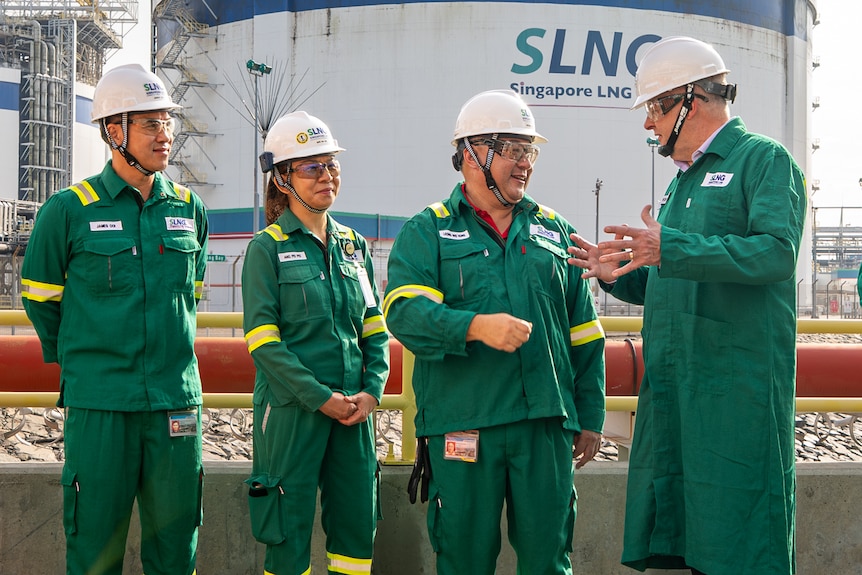
Anthony Albanese has spent the past fortnight visiting South-East Asia to shore up fuel supplies, while assuring leaders that Australia is a reliable and trusted trading partner. (Supplied: PMO)
‘Would not be good for Western Australia’
Western Australian Premier Roger Cook also intervened in the debate this week, telling reporters he did not support higher taxes on the sector.
“I don’t support it, but I understand that, for many people, it seems like an attractive proposition,” Mr Cook said on Tuesday, acknowledging the momentum behind the campaign.
“But I don’t think it would be good for Western Australia and I’ve made those views clear to the prime minister.”
Mr Albanese is heavily invested in WA and, in 2024, dumped a planned overhaul of federal environmental laws after Mr Cook raised concerns about the potential impact on his state.
The ABC revealed last month that Treasury had been asked to model “new levy options” to tax the windfall profits being made by coal and gas companies during the conflict in the Middle East.
It also asked Treasury to work up options for further reform of the PRRT, which raised around $1.5 billion last financial year.
“Energy producers should not benefit from high international prices at the expense of domestic customers,” the prime minister’s department wrote.
The revelation helped build momentum for a campaign being run by unions, think tanks and Senator Pocock, whose social media videos comparing the amount of revenue raised from the beer excise and the PRRT have gone viral.
One senior Labor source said the issue was “energising voters” across the political spectrum who believed the system was rigged against them.
Polling commissioned by Redbridge and the Australia Institute appears to back that up, finding 70 per cent of Greens supporters and 67 per cent of One Nation voters surveyed supported a 25 per cent tax on gas exports.
While acknowledging there was public support for gas companies to pay more tax, Mr Albanese said an “honest debate” was needed.
“I’ve seen there are reports suggesting that there’s more on beer tax than gas. It’s just not true,” he told the Daily Aus podcast.
“I understand that people would like to see more taxes paid, but we need to have an honest debate about it as well.
“And some of the debate has distorted some of the facts which are there.”
