

Pursuit Of Jade osmanthus cake recipe
SINGAPORE – Chinese historical romance drama Pursuit Of Jade has turned actor Zhang Linghe into one of the hottest C-drama stars of the moment and sparked interest in a snack featured on screen.
In the 40-episode drama, a chart-topper since its March 6 debut on streaming platforms iQiyi and Netflix, osmanthus cake is the favourite childhood treat of Zhang’s character, male protagonist Marquis Xie Zheng. In a flashback scene, his mother makes it for him before she takes her life.
Seventeen years later, he finds a box containing a mouldy plate of the sweet cakes, which leads him to the truth behind her death.
The dessert has since taken on a life of its own outside the drama. Fans have tried to hunt it down, while social media users such as TikTokker @melanieli_ and YouTuber @raw_bytes have posted their versions of the floral cake.
At the request of The Straits Times, executive Chinese chef Edward Chong, 43, of Cantonese restaurant Peach Blossoms at Parkroyal Collection Marina Bay, agreed to recreate the dessert.
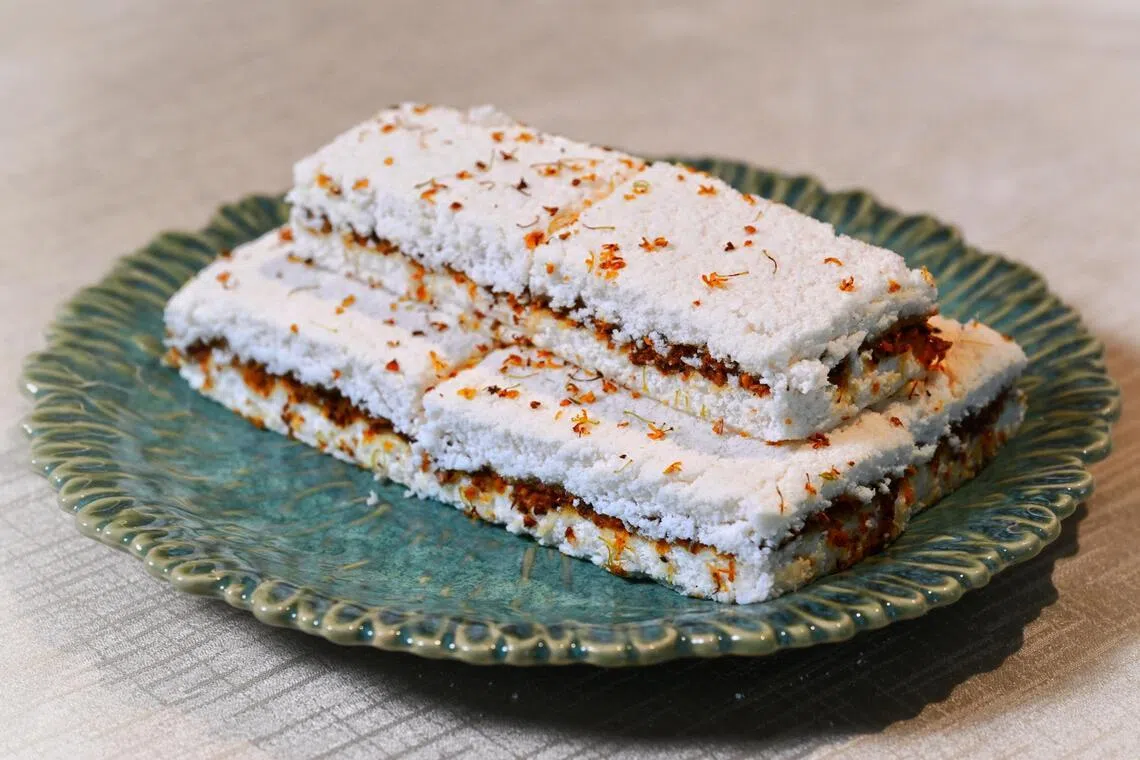
Chef Edward Chong of Peach Blossoms at Parkroyal Collection Marina Bay recreates the Osmanthus Cake from Chinese drama Pursuit Of Jade.
ST PHOTO: CHONG JUN LIANG
He was egged on by his wife and mother, both fans of the Pursuit Of Jade series.
As a chef, he says he was drawn to the traditional cooking methods and kitchen equipment shown in the drama. Scenes of female protagonist Fan Changyu, played by actress Tian Xiwei, cooking savoury dishes such as pork intestine noodles caught his eye.
As the drama does not show how the osmanthus cake is made, he based his version on scenes of the plated snack.
He had never eaten osmanthus cake before, so he looked up traditional versions online and called chef friends in China. They knew about the C-drama’s popularity, but were surprised it had put the traditional snack in the spotlight.
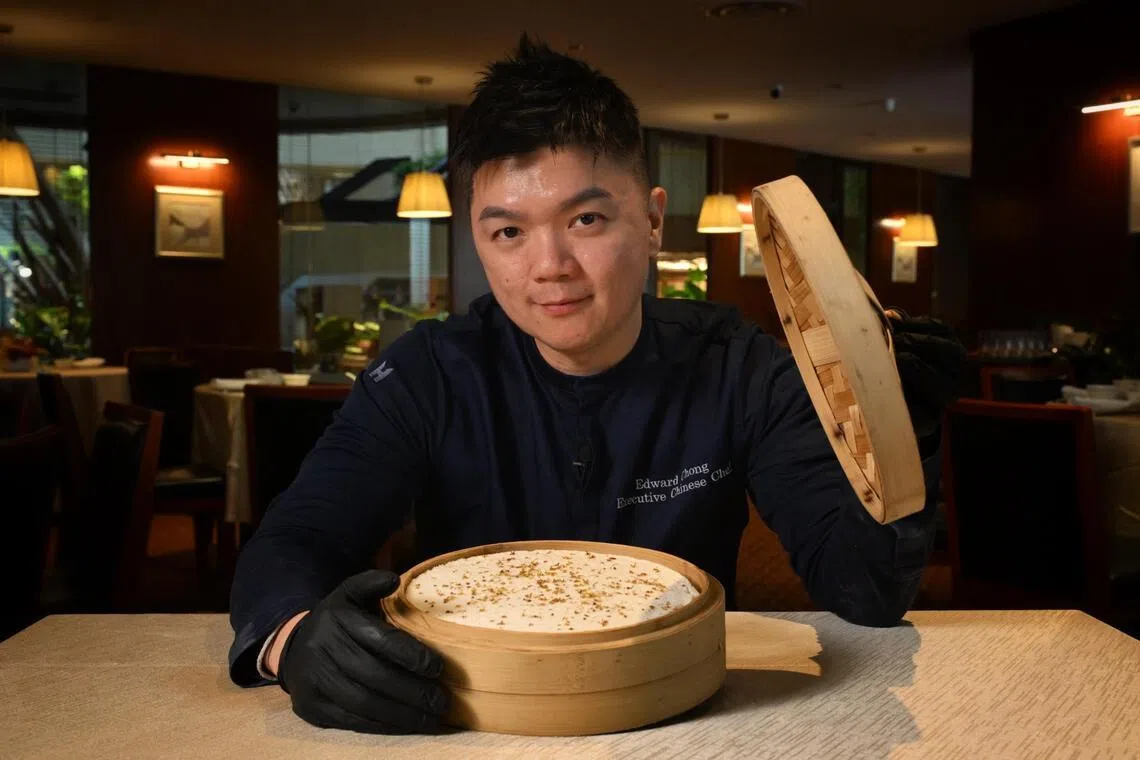
It took Chef Chong eight attempts to arrive at a right recipe for recreating osmanthus cake from C-drama Pursuit Of Jade.
ST PHOTO: CHONG JUN LIANG
“Many traditional Chinese snacks and kueh-style desserts deserve more attention. They are often simple, but carry a lot of heritage, technique and meaning that people may overlook today,” he says.
He found similarities between osmanthus cake and ding sheng gao, or victory rice cake, another pastry he came across in Hangzhou a few years ago. The traditional Chinese glutinous rice cake is associated with success and good fortune, and the version he tried had white and red layers and red date filling.
Osmanthus cake also reminds him of yue guang bing, or moonlight biscuits, a sweet pastry he ate as a child growing up in Seremban, Malaysia, during the Mid-Autumn Festival. The pastry is made mainly with glutinous rice flour and sugar. “Eating this osmanthus cake sends me back to my childhood,” he says.
His osmanthus cake is made with rice flour, glutinous rice flour, wheat starch, honey and dried osmanthus flowers. The texture is meant to be soft, spongy and fluffy, similar to huat kueh, or prosperity cake.
“It is soft and elegant on the palate, with a subtle fragrance that comes through gradually, making it easy to enjoy even for someone trying traditional Chinese pastries for the first time,” says Chef Chong.
“I wanted to recreate the osmanthus cake as closely as possible to what viewers saw in Pursuit Of Jade in terms of appearance. Ultimately, it’s about bridging what audiences connect with on screen and translating that into something they can genuinely experience.”
Getting there took the chef with 24 years of culinary experience eight attempts over a few days.
The ingredients were easy to obtain. The ratio was the problem.
At first, he used twice the amount of dried osmanthus flowers, which brought a bitter edge to the filling. Instead of sugar, he chose honey for a gentler form of sweetness. When he added more honey to balance the bitterness, however, the mixture seeped through the base.
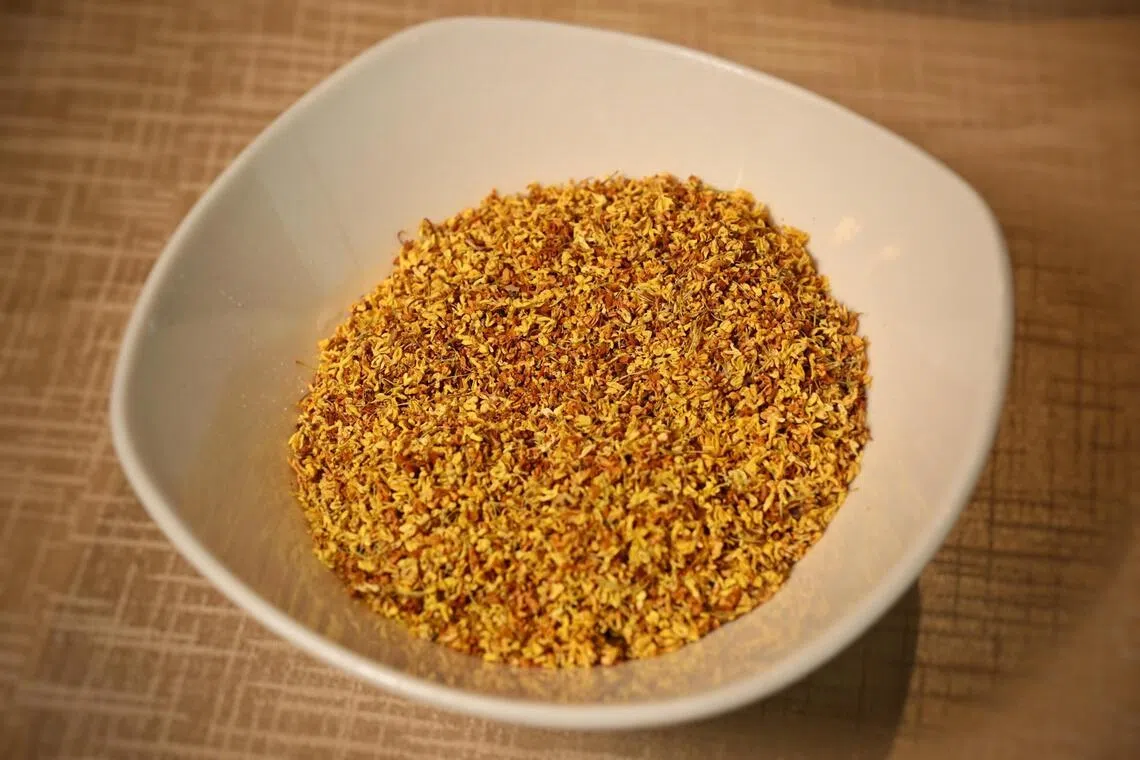
Using too much dried osmanthus can result in a bitter filling.
ST PHOTO: CHONG JUN LIANG
It took several adjustments to get the filling right without too much moisture ruining the cake’s fluffy texture. Some versions were too sweet, while others did not hold their shape after steaming.
He says: “I kept the sweetness level intentionally low to allow the ingredients to express themselves in a subtle, balanced way.”
In the recipe, he uses rock sugar, which is blended to a fine texture. He prefers it for its mellow sweetness, though it can be substituted with fine sugar.
Patience is needed, as the filling has to be prepared in advance. Dried osmanthus flowers are soaked with honey for two days. The honey helps balance the bitterness and draw out the fragrance.
His osmanthus cake will be available as an off-menu dine-in item at the restaurant from May 16. It is priced at $48++ for a cake that serves six, and diners have to request it five days in advance.
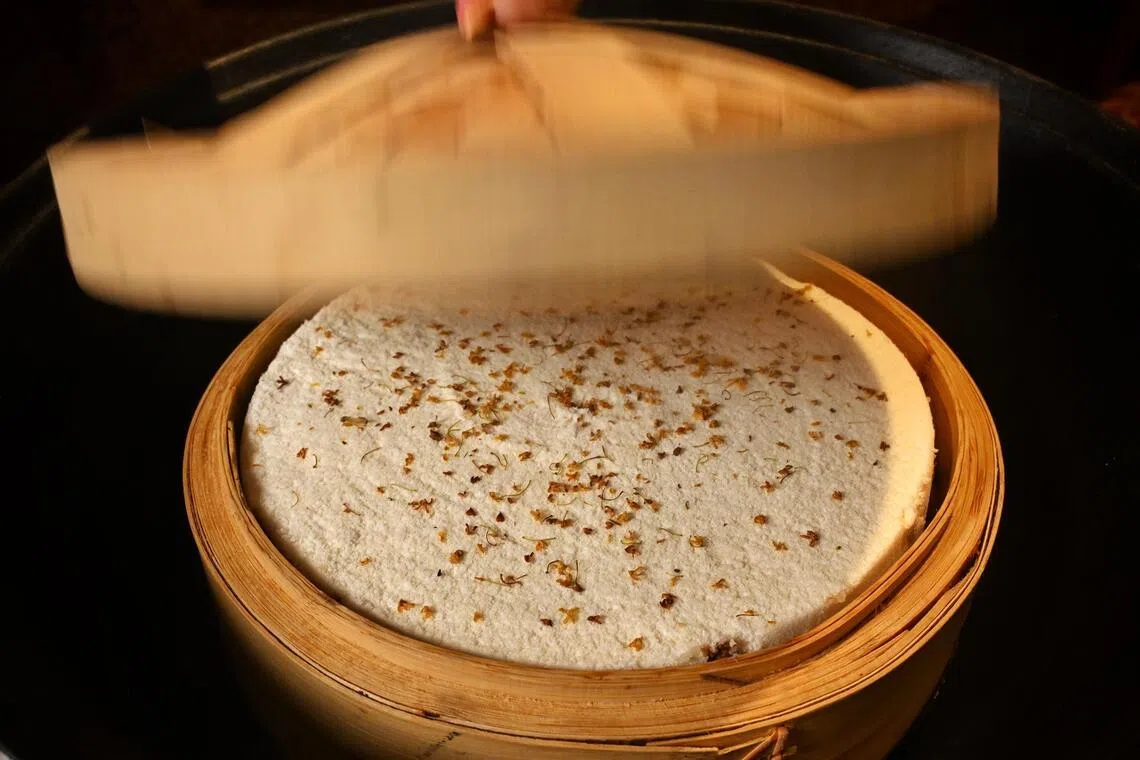
This is because it is best eaten hot. Once it dries out, the texture hardens, and steaming it for too long will also ruin its fluffy texture.
For home cooks attempting his recipe, his advice is to control the steaming time and avoid being heavy-handed with the osmanthus.
If the cake is under-steamed, it will not set properly. If it is over-steamed, the texture can become dense or dry. Too much osmanthus or steaming it for too long, makes the cake bitter and dulls its floral scent.
This is not the first time a screen dish has found its way into his kitchen.
In 2022, during the Covid-19 pandemic, diners asked him to recreate Sorrowful Rice, the char siew and fried egg rice popularised by Stephen Chow’s 1996 comedy The God Of Cookery.
“Many of our diners had re-watched the movie at home during the pandemic and craved the dish,” he recalls. At Peach Blossoms, his version was made with Japanese pearl rice, Iberico pork char siew and air-flown Japanese eggs. It was priced at $28++ a person.
Chef Chong says: “When a dish is linked to a character or actor, it naturally becomes something people want to experience in real life. Eating the dish is almost like stepping into the story.”
For him, the Pursuit of Jade’s mother-and-son backstory struck a personal chord. While working on the cake, he thought about his mother’s niang dou fu and her home-cooked meals he rarely eats now as he works in Singapore.
“I believe everyone has a childhood dish they look back on,” he says. “For me, especially after becoming a chef, I rarely have the chance to return home to Seremban, Malaysia, to enjoy my mum’s cooking. But I still think about her niang dou fu – the taste, the warmth and those shared meals at the table.”
That is what he wants diners to taste in the cake. “Light, fragrant with a gentle floral aroma that feels comforting,” he describes.
Chef Edward Chong of Peach Blossoms at Parkroyal Collection Marina Bay recreates the Osmanthus Cake from Chinese drama Pursuit Of Jade.
ST PHOTO: CHONG JUN LIANG
Ingredients

Chef Edward Chong of Peach Blossoms at Parkroyal Collection Marina Bay recreates the Osmanthus Cake from Chinese drama Pursuit Of Jade.
ST PHOTO: CHONG JUN LIANG
For the filling:
30ml hot water
360g honey
30g dried osmanthus flowers
For the cake:
320g rice flour
100g glutinous rice flour
30g wheat starch
75g rock sugar, blended, or 75g fine sugar
160ml hot water
1g dried osmanthus flowers (for garnish)
Equipment
Steamer paper liner (24cm in diameter)
Cotton steamer cloth (24cm by 24cm) or a round steamer cloth mesh (24cm in diameter)
Bamboo basket (26cm in diameter)
Method
1. Prepare the filling two days ahead of making the cake.
2. In a bowl, add 30ml hot water, honey and dried osmanthus. Mix well.
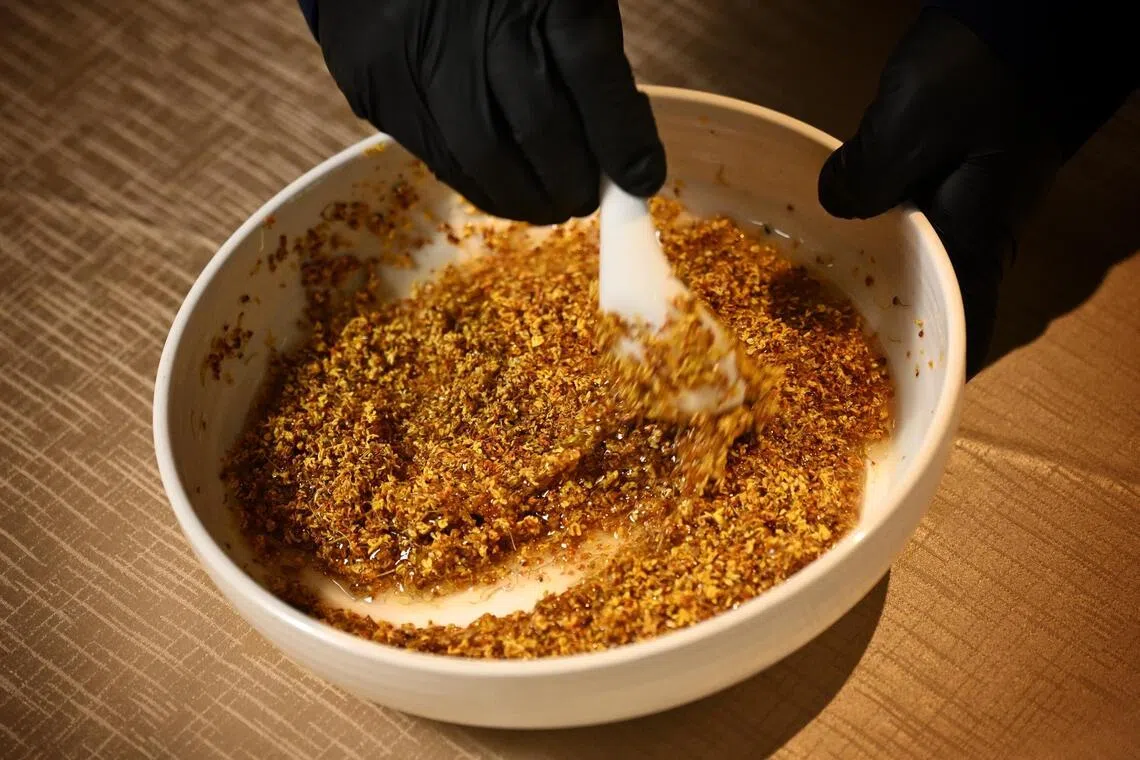
The filling has to be prepared two days ahead.
ST PHOTO: CHONG JUN LIANG
3. Spread the filling in an even layer over the steamer liner paper then place in a tray or plate. Cover with cling wrap without touching the filling and chill for two days.
4. Dissolve the sugar in 160ml of hot water.
5. In a metal bowl, mix the rice flour, glutinous rice flour and wheat starch.
6. Gradually add the syrup to the flour while gently rubbing the mixture by hand, until the mixture forms small clumps and comes together as a soft dough when pressed.
7. When it reaches this consistency, press the mixture through a sieve, into a bowl.
8. The final mixture should be fine and powdery.
9. Divide the mixture into two equal portions.
10. Line the bamboo basket with the cloth mesh and add half the mixture.
11. Use a cake scraper to flatten the surface. Lift the bamboo basket and tap it gently against the table to level the surface.
12. Invert the filling gently over the mixture in the bamboo basket, peeling away the liner paper as you lay it down.
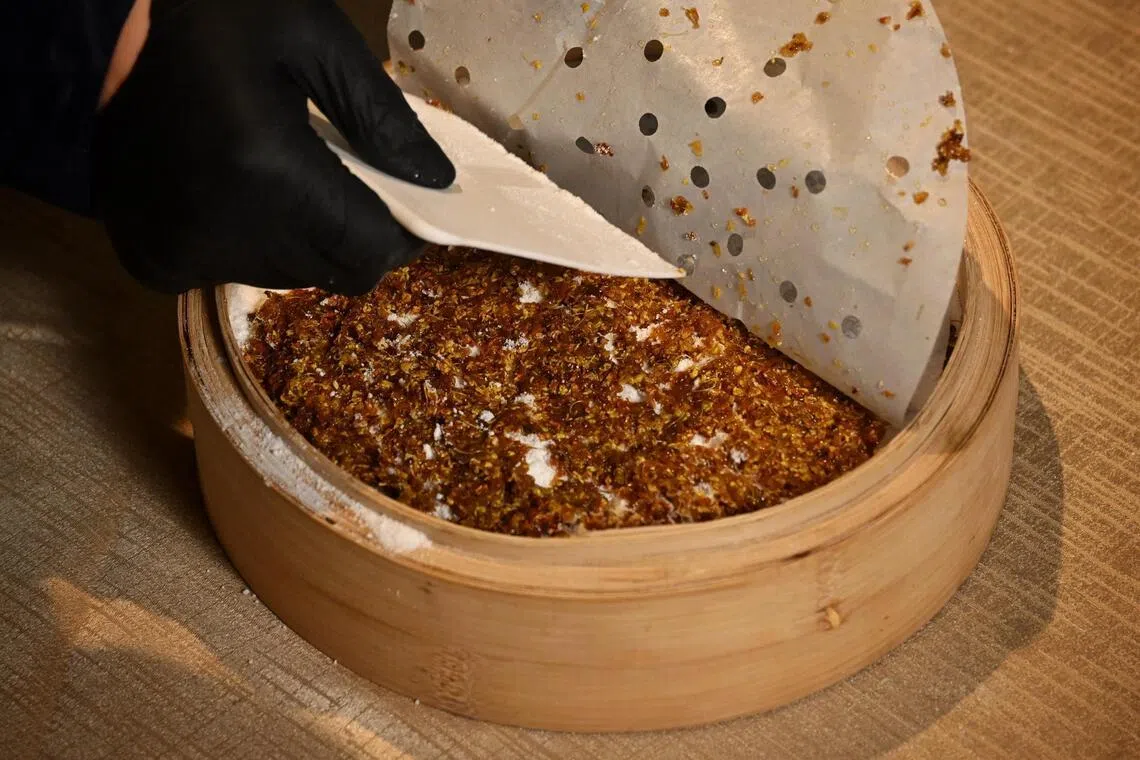
Invert the filling and carefully peel off the liner paper.
ST PHOTO: CHONG JUN LIANG
13. Add the remaining flour mixture to the basket, covering the filling, and level the surface.
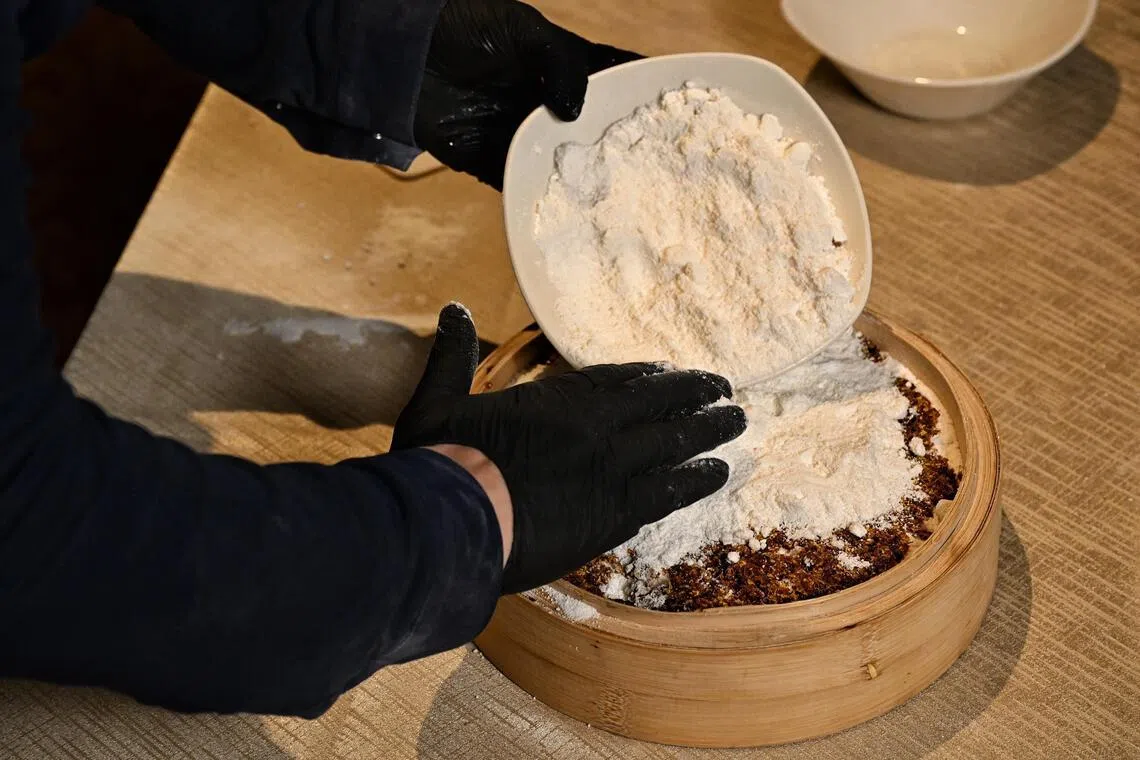
Cover the filling with the remaining flour mixture.
ST PHOTO: CHONG JUN LIANG
14. Cover and steam for 45 to 60 minutes over high heat. Once the cake is firm to the touch, it is ready.
15. Slice and serve immediately. Serves six.
Osmanthus Cake will be available at Peach Blossoms as an off-menu item for dine-in from May 16, with a five-day advance order.
Peach Blossoms is located at Level 4, Parkroyal Collection Marina Bay, 6 Raffles Boulevard, and is open from noon to 3pm and 6.30 to 10.30pm on Mondays to Fridays, and from 11.30am to 3pm and 6.30 to 10.30pm on Saturdays and Sundays. For more information, call 6845-1118.
