

TikTok parent ByteDance plans tiered subscriptions for AI chatbot Doubao
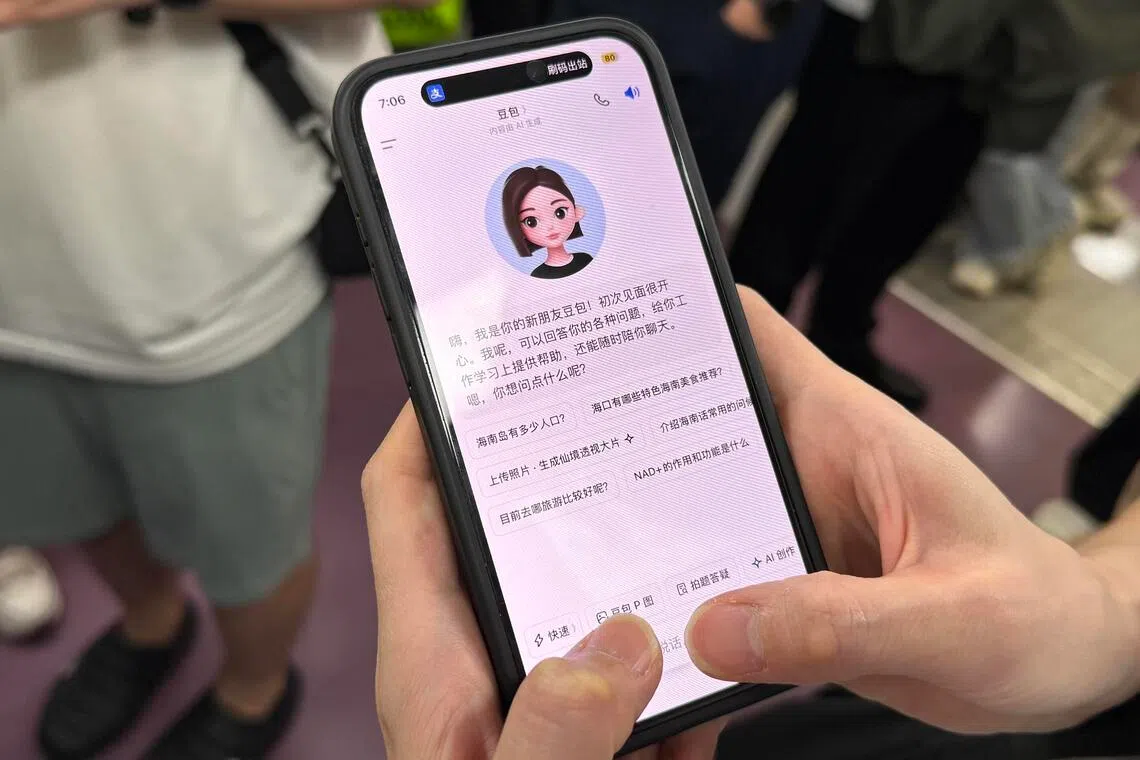
SHENZHEN – Chinese tech giant ByteDance, the parent company of TikTok, is testing paid subscriptions for its artificial intelligence chatbot Doubao, in a move towards monetising the technology as both costs and user numbers surge.
Doubao, which is China’s most widely used AI application, is exploring a tiered subscription model in which people pay either 68 yuan (S$13), 200 yuan or 500 yuan to access premium features. These are said to centre around complex tasks such as making slides, analysing data and producing videos.
The chatbot will continue to have a free version, a Doubao spokesperson said, with the plans on paid subscriptions still in the testing phase. The company has not said when the fee-based services will kick in.
The proposed “freemium” subscription model for Doubao, offering both free and premium levels, would mark a shift from the largely free-to-use chatbot landscape in China right now. Tech giants have been willing to sacrifice profits – and instead pay to entice new users – to wrest a bigger share of the market.
Doubao had 345 million monthly active users in March 2026. This is more than double that of Alibaba’s Qwen and DeepSeek’s chatbot apps, which were China’s second and third-most popular AI apps with 166 million and 127 million monthly active users respectively, based on data from QuestMobile, a consultancy.
Doubao users – and computing power consumed – have grown sharply in recent months.
China’s tech giants including ByteDance mounted a marketing blitz during Chinese New Year to attract more users, with Doubao featuring prominently during the Spring Festival Gala, the nation’s most-watched TV show.
Doubao’s monthly active users grew by some 100 million in the first quarter of 2026, QuestMobile data showed. ByteDance said that Doubao’s daily token consumption in March had doubled over the past three months as more people used AI agents and performed compute-heavy tasks such as video generation.
Some analysts believe that ByteDance’s decision to charge for Doubao stems in part from rising costs as its user base grows.
“A surge in users means a surge in requests, which in turn means a surge in the computing power needed to support this,” said Mr Zhang Yi, chief executive at Guangzhou-based consultancy iiMedia Research Group.
With costs swelling, ByteDance would have had to think about a pathway to commercialisation, as it would be unsustainable for the company to keep spending on AI without getting any fees in return, he added.
Analysts said the company’s move reflects confidence that consumers would be willing to pay a premium after having used Doubao.
That ByteDance is willing to charge for premium features, and in the process risk users switching to other chatbots, points to a belief in its product’s ability to retain customers, said Mr Su Lian Jye, a chief analyst at tech research firm Omdia.
Still, questions remain over how many Chinese consumers would be willing to pay for premium access to Doubao.
When news of the subscription model circulated in the past week after a notice on Doubao’s App Store download page outlined the paid tiers, multiple people took to social media to declare that they would simply stop using the chatbot if they had to pay – or switch to free alternatives like Alibaba’s Qwen or DeepSeek.
“Look at what happened to Baidu when it tried charging fees – it flopped miserably,” wrote one Weibo user from Guangdong.
Baidu in late 2023 launched a paid tier for its Ernie Bot but had to backtrack in early 2025 amid a proliferation of free-to-use competitors such as DeepSeek. Baidu’s chatbot does not currently rank in China’s top 10 most popular AI apps.
Not everyone rejected the idea. Guangzhou-based consultant Nicky Wang, 37, said he would be willing to pay for Doubao – his preferred Chinese chatbot after trying out others – should he find himself needing its premium features.
He currently uses both Doubao and ChatGPT daily, including to do research for work and find strategies for playing computer games, and says it makes sense for heavy users to pay as “tokens after all need money”.
But for 23-year-old Zane Liu, paying for Doubao is a hard no. “Its abilities are clearly not comparable to ChatGPT’s,” said the Guangzhou-based Master’s student, who uses both chatbots to help with schoolwork. “I would rather pay for ChatGPT.”
Doubao’s prices, at $13, $37 and $93 a month, are in some cases more expensive than ChatGPT’s monthly rate for individual users, which are currently at $11, $30 and $138 respectively.
For now, analysts note that ByteDance’s foray into paid subscriptions marks an experiment that could be instructive for an industry yet to find a clear model to meaningfully monetise consumer AI assistants.
“If Doubao, with the largest user base by a wide margin, cannot convert a meaningful fraction to paid subscribers, the implication extends beyond ByteDance,” wrote analyst Poe Zhao in his Hello China Tech newsletter, which breaks down tech developments in China.
“It would suggest that standalone AI subscriptions face structural resistance in the Chinese consumer market,” he said.
