
EU passes tariff deal with US to cap levies
BRUSSELS — The European Union approved Wednesday a tariff deal with the United States to cap tariffs on most EU exports at 15%, avoiding a direct clash with President Donald Trump ahead of his July 4 deadline.
Fierce debates raged among the 27-nation bloc’s lawmakers and leaders, jeopardizing the hard-won bargain governing the massive exchange of goods and services across the Atlantic Ocean between two of the world’s largest economies, now weathering dangerous fallout from the war in Iran.
In the European Parliament, legislators threatened to block the trade agreement that European Commission President Ursula von der Leyen had struck last July with United States President Donald Trump at his Turnberry golf course in Scotland, following months of bargaining in the wake of his administration’s global fusillade of tariffs.
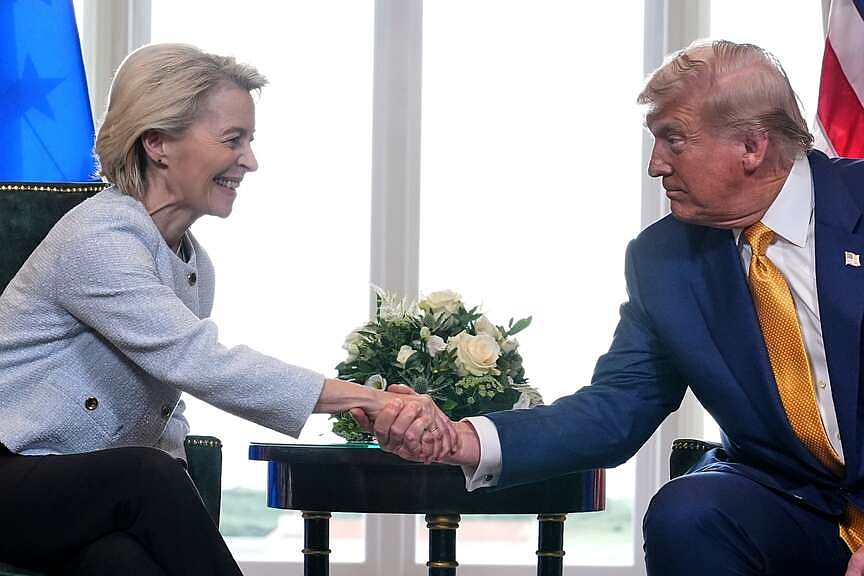
The handshake between von der Leyen and Trump initiated months more of negotiations over details between Washington and Brussels, just as criticism within Europe of the deal spiked after Trump threatened to take control of Greenland, a semiautonomous territory of Denmark. He has backed away from the threat, at least for now.
“A deal is a deal, and the EU honours its commitments,” said the EU executive in a social media post welcoming the agreement.
European lawmakers had successfully insisted on adding protections to the deal in case the U.S. backtracks or wavers on details, said Bernard Lange, the head of the parliamentary trade committee.
“If there is something going wrong, of course, we are self-confident to act on that,” he said.
The rough outlines of a deal are clear: a 15% tariff cap on most European imports, while tariffs on U.S. industrial goods would be reduced to zero. While the deal burdened consumers and businesses with a tariff increase from the previous average of 4.8%, it also gave businesses certainty so they could plan ahead, a factor credited with helping Europe avoid a recession last year.
With the continued closure of the Strait of Hormuz driving up prices as the war in the Middle East rages on, proponents of the EU-U.S. deal argue that settling trade between them is crucial in a time of global economic fragility.
The American Chamber of Commerce in Brussels said in a statement that it was “relieved” to see the EU reach a consensus on the deal. “The trilogue agreement is a sign that the EU is honouring its commitments under the deal,” it said, allowing Washington and Brussels to “move beyond tariffs” to tackle thorny issues like critical supply chains.
The EU’s trade negotiator, Maroš Šefcovic, said the final push to approve the deal came after five hours in “an intensive night” of trilogue discussions between the European Council, European Parliament and the EU’s executive, the European Commission.
He said that when the political agreement is formally adopted by lawmakers in the coming weeks, “this outcome will reinforce stability in EU-U.S. trade and open the door even wider to constructive cooperation on many issues of strategic importance.”
But there is concern in Europe that the White House may not be able to follow through on the deal after the U.S. Supreme Court this year ruled against the legal authority Trump had used to impose that tax.
This left Trump looking for substitute authorities, and his administration has imposed a 10% tax while investigating trade imbalances and national security issues, to impose new tariffs to make up for lost revenue. In May, a federal court said that Trump had overstepped the tariff power that Congress had allowed the president under the law, making the new tariffs “invalid” and “unauthorized by law.”
EASING TRADE TENSIONS
The Chinese government on Wednesday sought to draw a line on trade tensions with the United States, saying that both sides had agreed not to raise tariffs further while signaling that it could retaliate if Washington did so again.
China also confirmed for the first time that it would buy American beef and Boeing airplanes, two deals that Trump touted after his summit with China’s leader, Xi Jinping, last week.
In a statement Wednesday, China’s Ministry of Commerce said that Beijing had agreed to buy 200 Boeing planes, a transaction that would mark the largest single Chinese purchase of the U.S. manufacturer’s aircraft in nearly a decade. The ministry also confirmed that Beijing had approved U.S. slaughterhouses to resume exporting beef to China, giving a green light to more than 600 U.S. companies after an initially muddled notice last week.
The announcements came in a online posting by the Ministry of Commerce five days after the two leaders’ meeting in Beijing. Trump and other U.S. officials have since hailed the summit’s success and the commercial commitments secured from Beijing.
But critical points of friction remained unresolved, particularly over tariffs. Trump, for his part, told reporters afterward, “We didn’t discuss tariffs.”
On Wednesday, China’s commerce ministry pushed back on that account, saying the U.S. and China had “engaged in in-depth discussions on tariffs” during the latest negotiations. The ministry added that it hoped Washington would “honor its commitments” and ensure that U.S. tariff levels on Chinese goods would “not exceed the level stipulated” during talks last fall in South Korea, when the two sides had agreed to a tariff truce.
It was the second time a Chinese official said tariffs were discussed during last week’s talks, a sign that Beijing may be laying the groundwork for retaliation in the future, said Dan Wang, China director at Eurasia Group.
“It reflects a baseline for China that tariffs cannot go up,” Wang said. “Trump tried to downplay it. China will likely retaliate if tariffs do go up.”
Trump and Xi agreed to a yearlong truce in October that left tariffs on Chinese goods at 30%. But in February, those tariffs, along with Trump’s so-called reciprocal tariffs on other countries, were struck down after the Supreme Court ruled them illegal.
The White House responded by imposing a 10% tariff on all imports under a temporary trade clause known as Section 122.
U.S. Treasury Secretary Scott Bessent has since said the administration plans to revive the tariffs through investigations into forced labor and industrial overcapacity under Section 301, another trade provision.
Experts have argued that the investigations are directed at China.
Trump, meanwhile, has preferred to emphasize the handful of trade wins.
Boeing, in particular, has long sought to regain its footing in the Chinese market, and Kelly Ortberg, the company’s CEO, was among the U.S. business leaders who accompanied Trump to Beijing. Nearly 1 in 7 commercial planes in operation today flies in China.
But Boeing’s relationship with Beijing deteriorated after the worldwide grounding of the 737 MAX aircraft following two crashes less than five months apart that killed a total of 346 people. In 2020, citing the coronavirus pandemic, China canceled an outstanding order for 29 of the jets.
Boeing resumed deliveries to China in 2024, but those shipments stalled last year as Trump raised tariffs on Chinese goods.
It remains unclear which aircraft models Beijing has agreed to purchase.
It also remains unclear how much American beef China will ultimately buy after reinstating the registration of U.S. beef suppliers.
In the end, Beijing granted licenses to 690 U.S. companies, after a confusing turn of events that briefly seemed as if officials had reversed course and approved about 200.
Still, the restoration of the U.S. beef trade may prove more symbolic than substantial. Beijing has been trying to shield domestic cattle farmers from a flood of imported meat.
Information for this article was contributed by Sam McNeil of The Associated Press and by Alexandra Stevenson and Catie Edmondson of The New York Times.
