
Balen Shah stirs controversy in Nepal with ‘encroaching India’ remark. What did he say? Row explained
Nepal Prime Minister Balendra Shah, also known as Balen Shah, on Sunday triggered a major controversy when he spoke in Parliament about the border dispute with India, saying he had learned that his country was “encroaching” on Indian territories.
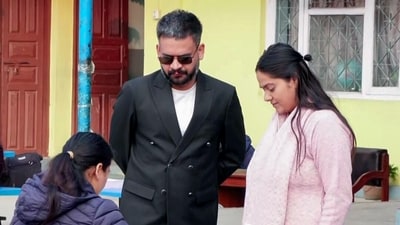
The Nepal PM made these remarks while answering questions in Parliament on a long-running border dispute with India.
This was his first speech in the Nepal Parliament after taking over as PM of the Himalayan nation in a historic election back in March.
The ongoing Parliament session started on May 11. Shah, in his remarks, suggested, without elaborating, that India and Nepal have agreed to seek assistance from historians, surveyors, and experts to resolve the matter, adding that Kathmandu has also taken up the matter with China and the United Kingdom.
“You will be surprised to know about a fact, which I have learnt recently, only after becoming the Prime Minister. It is not only India that has encroached Nepalese territories, but Nepal has also encroached India’s territories in many places,” said the prime minister.
“Now both countries should study the facts and sit together as friends and resolve the issue,” he added
What is the India-Nepal border dispute?
Nepal and India have long had a boundary dispute over Lipulekh, Limpiyadhura, and Kalapani, with both countries claiming the areas.
The disagreement between India and Nepal concerns a 335 to 372 square kilometre area at the strategic tri-junction of India, Nepal, and Tibet.
The core of the conflict stems from differing interpretations of the 1816 Treaty of Sugauli, which established the Kali River (also known as the Mahakali River) as Nepal’s western boundary. However, the treaty did not clearly specify the exact geographic source or origin point of the river.
While India says the river originates from a spring below Lipulekh, Nepal says it stems from a point further northwest at Limpiyadhura stream.
India maintains that the territories are part of Uttarakhand and has said the issue should be addressed through bilateral dialogue.
The Nepal clarification
Hours after Balen Shah’s comments, Nepal’s Foreign Ministry said the Prime Minister’s remarks were related to “no-man’s land encroachments” and “cross-border occupation” between the two countries, rather than any territorial claims.
“There are problems relating to cross-border occupation and no-man’s land (Dasgaja) encroachments in some other areas besides these. What the prime minister mentioned in Parliament was related mainly with Dasgaja encroachment and cross-border occupation,” the Foreign Ministry spokesperson said in a statement.
The spokesperson also said that there is a possibility that “land being used by people on the Indian side may lie in Nepalese territory” and vice versa.
“What the PM said about Indian land lying in Nepali side is related to the cross-border occupation,” the statement said.
There was no immediate response from the Indian side on Shah’s comments, but earlier this month, while rejecting Nepal’s objection to the upcoming Kailash Mansarovar Yatra through the long-established Lipulekh Pass, India had dismissed Kathmandu’s territorial claims over the region as an “unilateral artificial enlargement” that New Delhi finds “untenable.”
Balen Shah’s government faces heat
Balen Shah’s comments about Nepal encroaching on Indian territory have sparked controversy for his government back home, despite the foreign ministry’s clarification.
Opposition lawmakers, including Basana Thapa of the Nepali Congress and Ramesh Malla of the Nepali Communist Party, objected to Shah’s remarks and demanded that they be expunged from the parliamentary record.
They said the prime minister should either provide evidence to support his claim that Nepal had encroached on Indian territory or withdraw the statement.
Former Nepal foreign minister Pradip Gyawali has also reportedly sought an apology from Shah.
Many Nepalese social media users criticised the prime minister’s comments, while several experts dismissed them.
Former Nepalese ambassador to India, Nilambara Acharya, told Kantipuronline, a media portal, that Shah has “no information regarding Indian territories being encroached by Nepal.”
According to Acharya, 97 per cent of the border disputes between the two sides have already been resolved. There are reports of some Nepalese using land in India and some Indians using land in Nepal due to missing border pillars in some border areas, he said, but the Nepal government, as such, has not encroached on India’s territory.
Another former ambassador of Nepal to India, Deep Kumar Upadhyay, said that Nepal’s encroachment on India’s territory is not documented in any record.
“India has also not raised this issue on record… So far, we have conducted studies, but this issue has never surfaced… I don’t know in which context the prime minister spoke about such a serious matter,” he told the Nepalpress online news portal.
Nepal-India border expert and renowned geographer Buddhi Narayan Shrestha has also dismissed the prime minister’s claim that Nepal is encroaching on Indian territory.
“Nepal has never encroached on Indian territories or extended its occupation in the border area. In some border areas due to cross-holding occupations, farmers of both countries have used each other’s land,” he said.
Balen Shah’s comments come a day before a delegation of the ruling Rastriya Swatantra Party (RSP), led by its chairman Rabi Lamichhane, is set to visit India at the invitation of BJP president Nitin Nabin.
During his five-day visit, Lamichhane will hold high-level political and diplomatic meetings in New Delhi, among other engagements, the RSP said in a statement.
