
Free hotel Wi-Fi is a hacker’s favourite hunting ground, and a travel eSIM is the cheap fix
Travelling overseas this winter? The free Wi-Fi in your hotel lobby could cost you a lot more than the data you think you’re saving. Here’s the security case for a travel eSIM, plus an honest look at whether it actually beats your roaming plan.
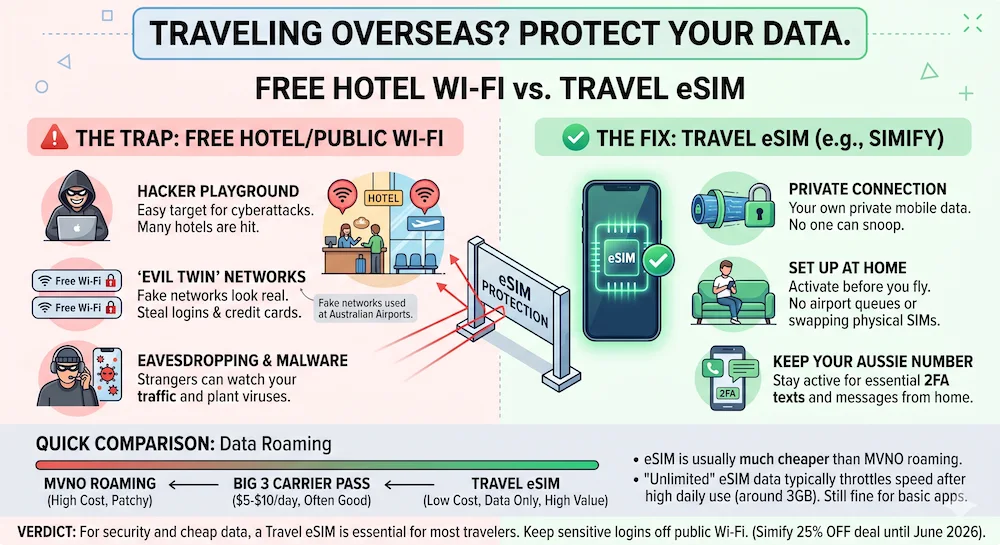
Free public Wi-Fi is everywhere the moment you leave Australia. Hotels, airports, cafés, even laundromats wave it at you the second you walk in. It’s convenient, it’s free, and it’s one of the easiest ways to hand your personal data to a stranger.
That’s the pitch behind the latest campaign from Simify, the Australian eSIM and international roaming company. As scare campaigns go, this one has more evidence behind it than most.
Simify (formerly SimsDirect) was started in 2018 by co-founders Aidan Butler and Mac Steer, and says it’s connected more than 500,000 travellers across 190-plus countries since.
The hotel Wi-Fi problem is worse than it looks
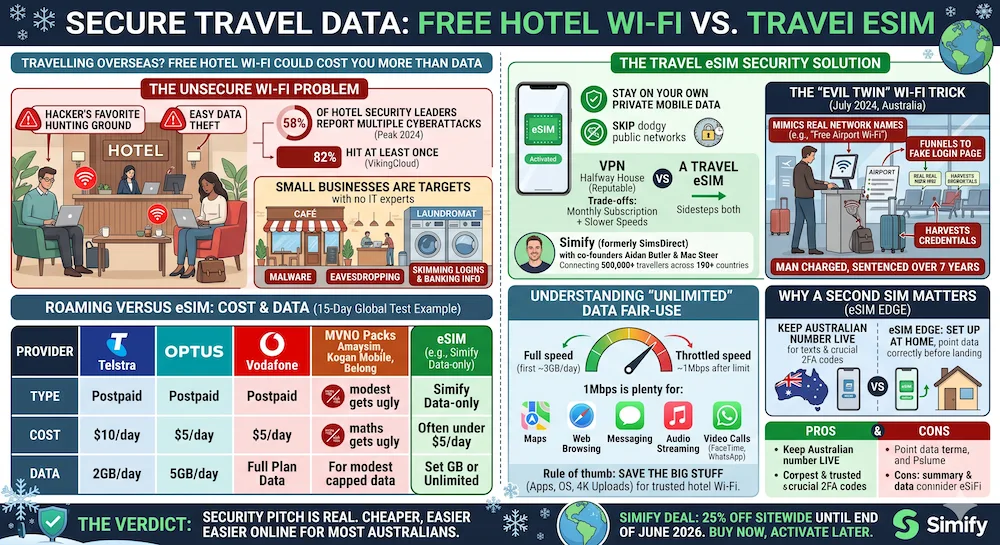
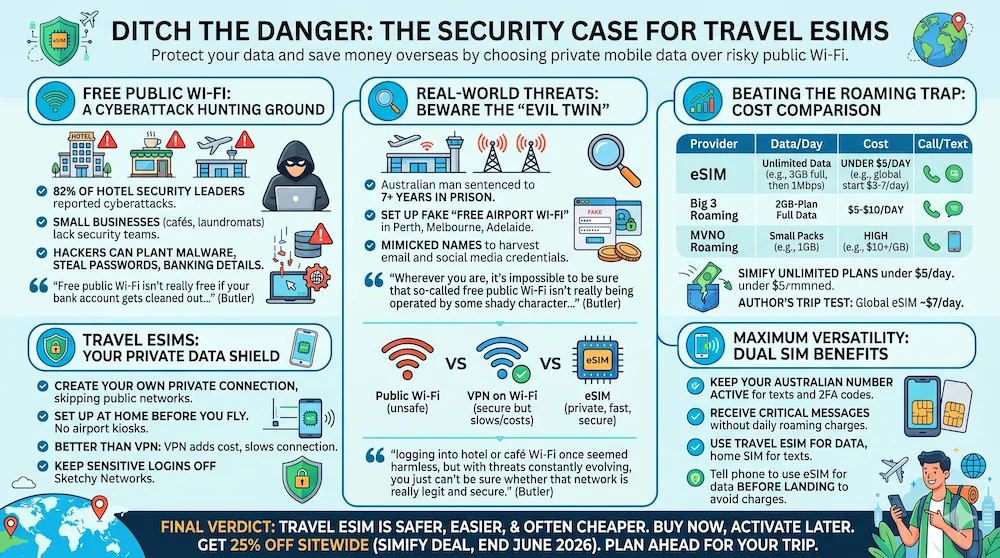
During the 2024 northern-summer peak season, 58% of hotel security leaders reported five or more cyberattacks, and 82% were hit at least once, according to VikingCloud research covered by Hospitality Net. (The Simify release pins the stat on a “2024 Cybersecurity in Hotels Report”, but the numbers trace back to VikingCloud’s hospitality study, so credit where it’s due.)
Hotels at least have IT teams. The café and the laundromat down the street don’t.
According to Simify co-founder Aidan Butler, smaller businesses like cafés and laundromats don’t employ cybersecurity experts, so they’re unlikely to even realise they’ve been attacked.
Once an attacker compromises a public network, they can plant malware on connected devices, eavesdrop on your traffic, and skim logins, passwords, banking details and credit card numbers. You won’t feel a thing while it happens.
“It sounds like a great idea for saving a few bucks on data, but people are starting to wake up to the fact that public Wi-Fi isn’t safe anymore,” Butler says. “Logging into hotel or café Wi-Fi once seemed harmless, but with threats constantly evolving, you just can’t be sure whether that network is really legit and secure.”
The “evil twin” trick that already hit Australian airports
Australia has already lived through a textbook case. In July 2024, the Australian Federal Police charged a Western Australian man over a string of “evil twin” Wi-Fi networks set up at airports in Perth, Melbourne and Adelaide, and on domestic flights.
The networks mimicked the names of legitimate free Wi-Fi, then funnelled travellers to a fake login page that harvested their email and social media credentials. He was later sentenced to 7 years and 4 months.
“People can be too trusting. Just because you see a network called ‘Free Airport Wi-Fi’ pop up nearby, that doesn’t mean it’s the real deal,” Butler says. “Wherever you are, it’s impossible to be sure that so-called free public Wi-Fi isn’t really being operated by some shady character sitting in the corner.”
How a travel eSIM shuts the door
The fix is almost boring: stay on your own mobile data and skip the public networks entirely.
Back when roaming cost a fortune, leaning on free Wi-Fi made sense. Today’s unlimited eSIM travel plans take that excuse away. You get your own private mobile connection that no one in the hotel lobby is snooping on, and you set the whole thing up before you leave home.
There’s a halfway house worth a mention: a VPN app. Run a reputable VPN over hotel or airport Wi-Fi and it really does encrypt your traffic, so the chancer in the corner just sees gibberish. It works.
The cost and the speed are the trade-off. A decent VPN is a monthly subscription on top of everything else you’re paying, and pushing your data through a distant server can slow your connection noticeably. A travel eSIM sidesteps both by keeping you off the sketchy network to begin with.
As a bonus, a travel eSIM sits alongside your normal SIM, so your Australian number stays live for the texts that matter, like the two-factor codes your bank fires off the second you try to log in from overseas.
“Free public Wi-Fi isn’t really free if your bank account gets cleaned out when you’re travelling abroad,” Butler says.
Roaming versus eSIM: what you’ll actually pay
Here’s where it gets interesting for iTWire readers, because the security story is only half of it. For a lot of Australians, an eSIM is also just cheaper.
| Provider | Type |
|---|---|
| Telstra | Postpaid roaming |
| Optus | Postpaid roaming |
| Vodafone | Postpaid roaming |
| Amaysim (MVNO) | Prepaid pack |
| Kogan Mobile (MVNO) | Prepaid pack |
| Belong (MVNO) | Prepaid add-on |
| Simify | Data-only eSIM |
The big three look fine on paper. Telstra’s International Day Pass is $10 a day for unlimited calls but only 2GB. Optus does $5 a day with 5GB and unlimited calls. Vodafone’s $5 day pass lets you use your plan’s full data and call allowance in 100-plus eligible countries, which is arguably the best value of the lot if you’re already a customer.
Then there’s the rest of us. If you’re on an MVNO like Amaysim (now owned by Optus), Kogan Mobile (which rides the Vodafone network) or Telstra-owned Belong, roaming gets patchier and the per-gigabyte maths gets ugly fast. That’s exactly the gap Simify and its rivals drove a truck through.
Simify’s unlimited plans usually land under $5 a day depending on the country, and its data-only global eSIMstarts around $3 a day. Set that against an MVNO charging $10 for a single gigabyte and the decision makes itself.
My own 15-day test: San Francisco to Singapore, Austria to Australia
I’ll put my money where my mouth is. On a recent trip I hit San Francisco, Boston, Vienna and Singapore before flying home, roughly 15 days, on a global eSIM that worked out to about $7 a day.
That’s 4 cities across 3 continents, cheaper than Telstra, the carrier I’m actually with, and I never touched a single airport Wi-Fi network.
It’s not the cheapest option going. Optus and Vodafone customers paying $5 a day get something my eSIM didn’t: voice calls on their own number. Most cheap data-only eSIMs, Simify’s included, don’t carry voice on your home number (some offer it, but you pay more for the privilege).
So it’s a trade-off, and an honest one.
What “unlimited” really means
A quick reality check on the word “unlimited”, because every eSIM company leans on it.
In practice, Simify-style “unlimited” plans run at full speed up to roughly 3GB a day, then drop to about 1Mbps until your 24-hour window resets.
That sounds limiting. It mostly isn’t. 1Mbps is plenty for maps, web browsing, messaging apps, audio streaming, and WhatsApp or FaceTime calls, audio or video. The experience stays smooth and you stop thinking about data at all.
The one habit to build: save the big stuff, app downloads, OS updates, that 4K holiday video upload, for when you’re on what is supposed to be trusted Wi-Fi back at the hotel. Keep the sensitive logins on your mobile data, and use the room Wi-Fi for bulk transfers, ideally behind a VPN.
Why you might still want a second SIM
Even if your roaming plan is decent, a second line earns its place in your phone.
A travel eSIM lets you keep your Australian number switched on purely to receive texts and missed-call alerts, without answering and triggering a daily roaming charge. That’s especially useful for 2FA codes and the “where are you?” messages from home.
eSIM has a clear edge over a local physical SIM here. You set it up in your living room before you fly: no hunting for a kiosk at arrivals, no handing your passport to a stall in a foreign airport, no swapping out (and losing) your Aussie SIM.
The catch: most travel eSIMs are data-only, so they won’t give you a local number for local calls. A local physical SIM or local eSIM will, often cheaply, if you’re staying in one country long enough to care.
One more thing trips people up. Plenty of phones still have only one physical SIM slot, so if you want to keep your home number alive while travelling, an eSIM is the only way to run both at once.
A setup note that can cost you real money: tell your phone to use the travel eSIM for data before you land. Otherwise, the second your plane touches down and your phone checks the weather, you’ve triggered your home carrier’s daily roaming charge anyway. (Ask me how I know.)
The pros and cons
Pros:
-
Usually cheaper than postpaid roaming, and dramatically cheaper than most MVNO roaming
-
Your own private mobile data, so you can skip dodgy public Wi-Fi entirely
-
No need to pay for a monthly VPN subscription (which also slows your speeds) just to use public Wi-Fi safely
-
Set it up at home, with no airport queues, no passport and no local SIM hunt
-
Keep your Australian number live for texts and 2FA codes
-
Unlimited data (with a fair-use speed cap) covers maps, browsing, messaging, audio and video calls via Whatsapp, Facetime, Messenger, Viber (etc)
-
One global plan can cover several countries on the same trip, but you can also buy cheaper plans that cover one country (or, for example, the US, Mexico and Canada)
-
Buy now, activate later
Cons:
-
Most cheap plans are data-only: no voice calls on your own number
-
“Unlimited” is throttled to about 1Mbps after roughly 3GB a day, some eSIM providers (that aren’t Simify) downgrade to much slower speeds, such as 64 to 256kbps, which is a real downside – choose your eSIM provider carefully!
-
Big downloads still want trusted Wi-Fi
-
You need an eSIM-capable phone, and you must set it as your data line correctly
-
No local number for local calls
-
If you’re on Telstra, Optus or Vodafone postpaid, your existing $5 to $10 day pass might already be good enough
The catch, and the current deal
Staying connected overseas is a balancing act, not a one-size answer. If you’re with Telstra, Optus or Vodafone and you make a lot of voice calls, your roaming day pass is probably fine. If you’re on an MVNO, or you mostly live in data, maps and messaging apps, a travel eSIM is close to a no-brainer.
If you’re going to try one, the timing’s good. Until the end of June 2026, Simify is running 25% off sitewide, and you don’t have to activate the eSIM straight away. You can buy it now and set it to switch on later in the year, which is handy if you’re planning ahead for a spring or summer trip.
The verdict
The security pitch is real, and the evil-twin case proves it’s already happening on home and overseas soil. For me, though, the bigger draw is simpler: for most Australians not on a big-three postpaid plan, a travel eSIM is the cheaper, easier way to stay online – and even then, I loved the flexibility of only activating Telstra’s international roaming when I needed it.
Set it up before you fly, point your data at it, and keep your Aussie number alive for the texts that matter. The hotel lobby Wi-Fi can stay exactly where it is.
